
























If you’re a student eager to figure out how to solve algebra problems? If you’re a parent wondering how to teach algebra to your child?
Then you’ve indeed reached the right place. Multiple Algebra Apps are available on the web to learn everything about it.
Algebra is one of the most intimidating subjects for a lot of students. But not anymore! Forget about the painful algebra problems you experienced in the past. Use one of the best apps in existence today and make learning fun!
Algebra Apps enable students to learn and solve problems through visual representations and clear step-by-step instructions that guide them through intuitively solving problems. It can be used to solve both simple and complex issues.
There are many great algebra apps, and it isn’t easy to know what is good. This template uses an enthusiastic tone to show you the best algebra apps that help kids solve problems. These apps allow students to solve problems in a friendly, easy-to-use format that encourages creativity.
Here are some of the best algebra apps we’ve found. Use them at home and in the classroom to help you learn the basics and beyond.
They’re especially beneficial for those who are having trouble with algebra.
The Significance of Algebra: Empowering Education and Everyday Life
Algebra holds a profound significance in both education and everyday life.
This powerful mathematical discipline unveils a realm of problem-solving prowess, critical thinking, and logical reasoning.
With its intricate principles, algebra empowers individuals to navigate complex challenges and make informed decisions, rendering it an essential component in academic and practical spheres.
In the realm of education, algebra serves as a fundamental pillar, bridging the gap between arithmetic and advanced mathematical disciplines.
Proficiency in algebraic concepts cultivates the ability to discern patterns, manipulate variables, and solve equations. These skills are vital for success in science, technology, engineering, and mathematics (STEM), where algebraic thinking reigns supreme.
Beyond academia, the importance of algebra permeates everyday life. From managing personal finances to comprehending data trends, algebraic concepts form the bedrock.
Budgeting, calculating expenses, and analyzing investments involve variables, equations, and formulas. By harnessing algebra, individuals can make informed financial decisions and effectively plan for the future.
Moreover, algebra underpins technological advancements and innovation. Fields such as computer science, engineering, and architecture heavily rely on algebra to design algorithms, solve complex equations, and model physical systems.
From optimizing traffic flow to crafting efficient structures, algebra empowers innovation and progress.
In essence, the importance of algebra in education and everyday life cannot be understated. Its influence extends beyond mathematical understanding, shaping critical thinking, problem-solving skills, and analytical reasoning.
Embracing algebraic knowledge equips individuals with the tools to thrive in an increasingly complex and data-driven world.
Unveiling the Criteria for Selecting the Best Algebra Apps
In the vast landscape of algebra apps, it’s crucial to discern the best options that align with your learning goals and preferences.
To ensure an optimal experience, consider these essential criteria for selecting the best algebra apps:-
User-friendly interface and intuitive design:- A well-designed app should have an interface that is easy to navigate, visually appealing, and logically organized. Intuitive features enhance the user experience and ensure seamless interaction.
Comprehensive content coverage:- Look for apps that offer a wide range of algebraic topics, including equations, functions, graphs, matrices, and more. Comprehensive coverage ensures a well-rounded learning experience.
Interactive features for engaging learning experiences:- Engaging and interactive features such as practice exercises, quizzes, and visual representations foster active learning and reinforce understanding. Look for apps that offer hands-on experiences.
Progress tracking and performance analytics:- An excellent algebra app provides tools to track your progress, monitor strengths and weaknesses, and offer personalized recommendations. This feature enables you to identify areas that require more attention and track your improvement over time.
Availability across different platforms:- Consider the app’s availability on various platforms, such as iOS, Android, or web-based. This ensures flexibility and accessibility, allowing you to study algebra anytime and anywhere.
By considering these criteria for selecting the best algebra apps, you can make an informed choice and maximize your learning potential.
Remember to choose an app that suits your specific needs and preferences, as finding the perfect fit will enhance your algebraic journey.
Here, we have prepared a list of some of the best ones for you –
Best Algebra Apps To Unlock Your Math Potential
1. Mathway: Algebra Apps With Math Problem Solver
Mathway is one of the best Algebra Apps for solving math problems. It can solve algebraic equations, calculus equations, and trigonometry problems and provide step-by-step solutions to your algebra homework.
The app offers instant answers to the user’s most complex math problems.
It’s designed for beginners with no previous knowledge of mathematics or algebra. The app has a user-friendly interface that makes it easy for students to use it without difficulty.
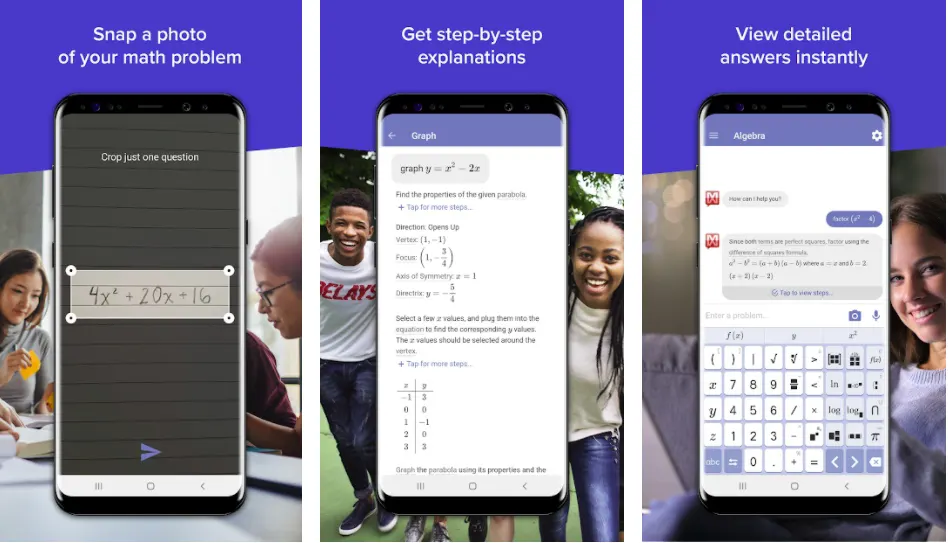
Mathway is a trusted and highly recommended app for all college students and professionals. Who is struggling with algebra problems? The app provides interactive ways to solve many math problems of different levels.
The Mathway app also has more advanced features such as solving equations by step, step-by-step explanations through solving, and symbol substitution.
You can use the Mathway app to get instant answers when you have a math question. It is among the useful free calculator apps and has a Pro version in the App Store on Android, iPhone, and IPad that offers instant answers.

Download the App from Google Play Store
Download the App from Apple App Store
2. WolframAlpha
Do you struggle to get through your algebra homework? If so, WolframAlpha is the perfect homework helper for you. WolframAlpha is a powerful online tool with many features and tools to help with math, including an algebra solver.
WolframAlpha is not just a great tool for searching for facts. If you need help with your math homework, WolframAlpha is an app you’ll want to grab. It’s quick, answers questions, and more.
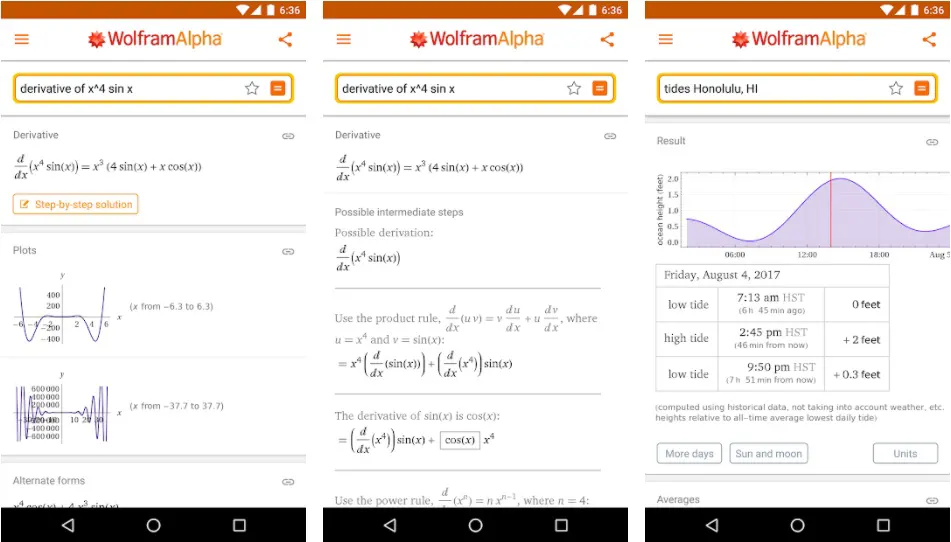
It is a uniquely valuable tool for solving practice problems quickly on the fly! It will answer a question, show you a graph of data, and plot complex equations and solutions.
WolframAlpha is “a computational knowledge engine,” a super-powerful search engine that uses its algorithms to quickly answer complex questions and generate reports based on your questions.
This computational search engine is available across thousands of domains, over one thousand added per year, and—you guessed it—more are continually added.
It is an online reference that provides free and premium versions to users. It can provide all sorts of assistance for math and other disciplines that are not as heavily studied.
For many educational purposes, the free version provides more than enough assistance. You should be able to locate everything you need at your fingertips without ever leaving your home.
Download the App from Google Play Store
Download the App from Apple App Store
3. Graphing Calculator X – apps for algebra 2
Graphing Calculator X is a beautiful calculator for your iPad, iPhone, and Android devices, based on the design of hardware calculators.
It has a clean user interface with excellent typography, making it one of the best graphing calculator apps on the App Store.
With Graphing Calculator X, you can solve algebraic, quadratic, 2-variable linear, and polynomial equations. It has a solver for these equations and advanced functions such as Sin, Cos, Ln, E, etc.
Graphing Calculator X is the best-selling calculator app, and with good reason. The name says it all. This graphing calculator is one of the most intuitive, full-featured mobile apps designed to work as a traditional calculator with a scientific display.
It’s ideal for high school and college students who need a graphing calculator for solving complicated math problems.
It shows the step-by-step student answers to all their calculations and gives a detailed explanation of every step. The Graphing Calculator features an intuitive interface for anyone to use. It supports complex numbers, vectors, matrices, polar coordinates, and parametric equations.
It also provides features like entering graphs by simply drawing them on the screen or using your finger to circle points on the chart. You can even compare graphs side-by-side with the history feature!
Graphing Calculator is one of the best Algebra apps for math. It is an easy-to-use, user-friendly app to help you solve math problems.
It may not have all the functionalities that some other apps might have, but it has everything you need to complete your math homework or study for a test.
The graphing part of the app is beneficial if you find a solution to an equation that involves graphing.
Download the App from Google Play Store
Download the App from Apple App Store
4. Photomath
Photomath is a free and easy-to-use app that solves math problems of all levels. It is a calculator app that uses your phone’s camera to read math problems. It’s the perfect app for students who never want to be without math homework.
This app is excellent for students from high school up to college; it helps them get through complex concepts and classwork by providing step-by-step instructions on solving problems.
It delivers impressive results and doesn’t require any installation or downloads.
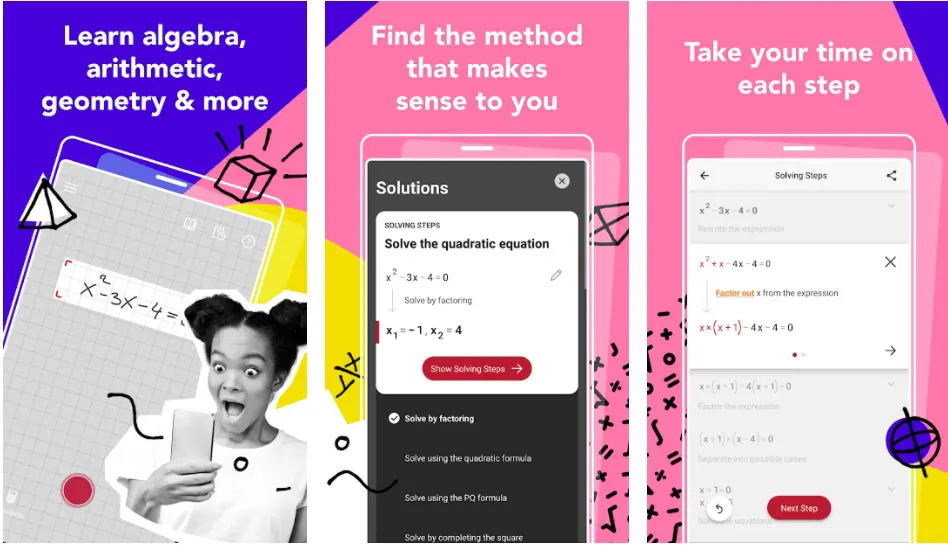
Photomath is one of the best algebra apps that can solve any math problem, no matter how complicated. It can translate any mathematical expression into an image-based step-by-step solution instantly. It’s convenient for people who learn best by visualizing or “seeing in your mind.”
The app can be used offline, which is an excellent advantage for those who don’t have internet access on their mobile phone or tablet device.
And has no ads, making it great for students without a lot of money or access to technology.
The Pro version of Photomath Plus is risk-free – they offer a free trial. The app is downloadable on the App Store or Google Play. It is available for iOS, Android, and Windows devices.
Download the App from Google Play Store
Download the App from Apple App Store
5. MathPapa – Algebra Apps with Algebra Calculator
MathPapa is an online tool that can help you solve math problems. It offers one of the best calculators which can solve algebra problems in a simple guide for better understanding.
It provides algebra calculators, math tutors, and math resources for students. It is an AI-based calculator that can solve the equation for you, show the steps, and then give you the answer and its justification.
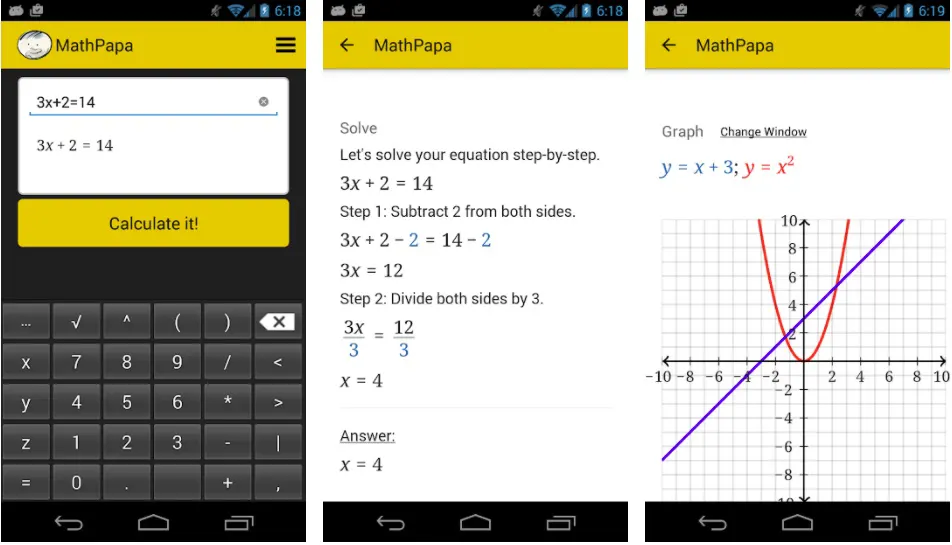
It offers step-by-step solutions to algebra problems without needing to understand complex formulas or hard-to-remember steps. It’s a great way to engage with math problems because it provides hints which help you solve them more quickly!
With MathPapa, students can focus on the concepts they are learning instead of getting bogged down with solving an answer. It also graphs the equation, solves linear and quadratic inequalities, factors quadratic expressions, and evaluates expressions.
PhotoMath is also very convenient since it doesn’t require an internet connection. You can still use the app if you’re in a place that doesn’t have Wi-Fi, like a school library.MathPapa is a free app for your android, iPad, iPhone, or iPod that solves math problems for you.
Download the App from Google Play Store
Download the App from Apple App Store
6. Pre-Algebra Prep
The Pre-Algebra Prep app provides videos designed to teach learners to solve different problems. The video tutorials show how each problem can be solved and follow-up questions and reports where the learner can see their progress after finishing.
The pre-algebra prep course has been designed for students who need extra math help before starting high school or college.
The tutors will help you fully grasp the elements of pre-algebra as you continue to prepare for algebra, geometry, trigonometry, and calculus. This app is designed to help you revise fundamental mathematical topics required for pre-algebra.
The topics covered are fractions, decimals, ratios and percentages, angle formulas, trigonometry, and shapes. All the topics are presented through videos that will teach you how different issues can be solved step by step.
Through these videos, the user will thoroughly understand all necessary mathematical topics. Images and symbols are also covered to allow quick recall at exam time.
Direct teaching is used to teach the pre-algebra tutorial sections of the video classes, presented as a succession of step-by-step sub-skills required to master the skill being taught. Explanations are offered at each point, and examples are utilized throughout the video to expand learning.
Pre Algebra prep is available for iPhone, iPad, and Android devices. It’s helpful to have the machine to take quizzes anytime, anywhere.
Download the App from Google Play Store
7. Maple Calculator
Maple is math software that can be used to solve mathematical problems. It can visualize graphs of 2-D and 3-D expressions and provides step-by-step solutions.
This versatile app makes it easy to enter, solve, and visualize mathematical problems from algebra, precalculus, linear algebra, or differential equations. Without Maple’s powerful algorithms you can use to solve equations, students and professionals would have a hard time in math.
Maple is a powerful tool for students, teachers, engineers, scientists, and others who need advanced mathematical problem-solving. Whether you have university-level math problems or need help with simple calculations, this powerful calculator provides step-by-step solutions to your math issues.
It provides immediate feedback, making it ideal for people just learning algebra or who want to brush up on their arithmetic abilities.
Maple is an excellent algebra-free mobile app for both iOS and Android users. It is an essential companion for all students to learn algebra.
Download the App from Google Play Store
Download the App from Apple App Store
8. Math Tutor
A math tutor is designed to make it easier for you to learn and understand the basic concepts of math. The tutor has over 1500+ video lessons in math, algebra, calculus, physics, chemistry, and engineering.
The math tutor is an app that gives detailed mathematics and scientific internet videos.
These videos cover various topics at various levels, teaching ideas in a straightforward, step-by-step manner before going through multiple examples, all intended to widen and enhance students’ comprehension.
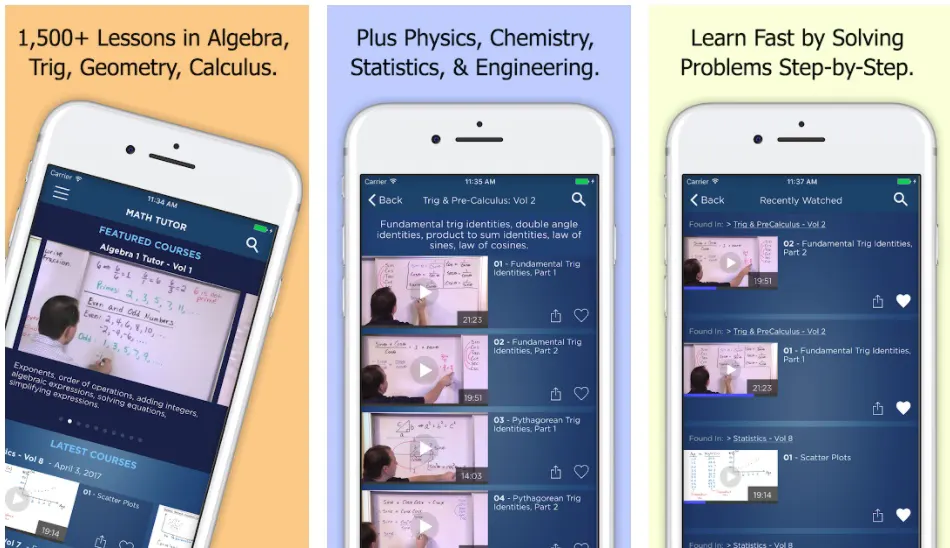
This tutor can be used as a supplement to your child’s school curriculum, so you don’t have to worry about any gaps in learning.
It is also perfect if you have a child with special needs, as they can request one-on-one sessions with the tutor, and the tutoring sessions will always be personalized to your child’s needs.
Students can learn math with a video tutor in a way that is not available offline. They can learn math from the comfort of their own home without going to college.
The video tutors are available 24/7, so they are always there for students who want to learn math anytime and anywhere.
The Math tutor is a digital tutor aimed at helping students learn math that is unavailable offline. This app will also break down the material to make it easier for them to understand and help them solve problems they may be struggling with.
The videos are created by professionals and are set up so that it is possible to watch them on any internet-enabled device from home or school. It also has a step-by-step guide on how to solve the problem.
This math tutor is free for iOS and Android users, so you don’t need to worry about your budget.
Download the App from Google Play Store
Download the App from Apple App Store
9. The Fun Way to Learn Algebra
The app is free and introduces the fundamentals of algebra for visual learners. The app focused on language and visuals to help students grasp concepts more quickly.
When students learn algebra the fun way, they gain confidence in the subject and remember what they’ve learned. The Hands-On Equations virtual game system makes learning algebra easy and allows students to learn anywhere, anytime.
No matter how you slice it — whether with an app or a physical set—Hands-On Equations lite gives students a new way to visualize the step-by-step processes needed to solve problems successfully.
Instead of spending hours with tutorials or books to understand algebra, this app can help you learn it in a fun way. Algebrator is a game-like educational tool designed to make algebra fun and accessible to students of all levels at school and at home.
This fun app gives students a taste of the same in-depth algebraic experience as the paid version of Hands-On Equations. Only with this FREE app will they play math games to improve their algebra skills and have fun!
Hands-On Equations is the most effective algebra software for children. The app is available in the Apple App Store for Android, iPhone, and iPad.
Download the App from Google Play Store
10. Hands-On Equations 3
The Hands-On Equations 3 app is great for young people struggling with algebra. The visual components incorporated into the app make comprehending what is being taught, making learning more enjoyable.
It is a set of tutorials for students who have already completed levels 1 and 2. These tutorials are for anyone who desires to learn more.
The lesson is designed to be a step-by-step process with an introduction, the concept, examples, practice problems, and explorations. The equations at this level are already a bit more complicated than those seen at levels 1 and 2, but they are still relatively straightforward and straightforward to solve.
In Level 3, the student will learn to solve equations containing negative constants and be introduced to the green number, representing the opposite of the red number.
Solving equations is one of the most accessible and beneficial things we will perform in this part.
The topics at this level are divided into linear expressions, inequalities, and quadratic terms. The goal of linear words is to represent real-world situations with equations. Inequalities aim to identify the conditions under which an equation has a solution.
This app is a fantastic tool for pupils learning mathematics. The app makes it easy to visualize complex problems and provides a fun interface! Equations 3 is a paid app that can be downloaded onto any Android phone.
Download the App from Google Play Store
Download the App from Apple App Store
11. Khan Academy
Khan Academy is a digital learning platform that provides free educational videos, exercises, and practice tests for students, teachers, and lifelong learners.
The content aligns with the Indian NCERT education objectives & CBSE (Class K – 12) syllabus. They celebrate all kinds of learners and provide personalized learning paths to anyone wanting to learn professionally.
It is an excellent tool for those struggling in high school or college or wanting to teach their children at home.
It is an open-source educational website aiming to’ change education for the better by providing an accessible, world-class education for anyone anywhere.
Khan Academy is a non-profit organization that provides over 4000 video lessons online on various subjects from math, science, financial history, and many more.
The Khan Academy app is available for iOS (iPad and iPhone), Android, and desktop users. It provides easy access to instructional videos and practice exercises without cost or registration.
Download the App from Google Play Store
Download the App from Apple App Store
12. SplashLearn: Kids Math & Reading Learning Games
SplashLearn is a free app suitable for children aged 7 to 11. It helps kids by giving them online access to reading, maths, and spelling games and interactive worksheets that they can complete on the go.
It is designed to help pre-primary school children learn their maths and reading skills. It’s full of colorful activities for your kids, including drawing, flashcard games, and even interactive worksheets.
The Splash Math app has been developed to help the child learn more about numbers, addition, subtraction, multiplication, and division.
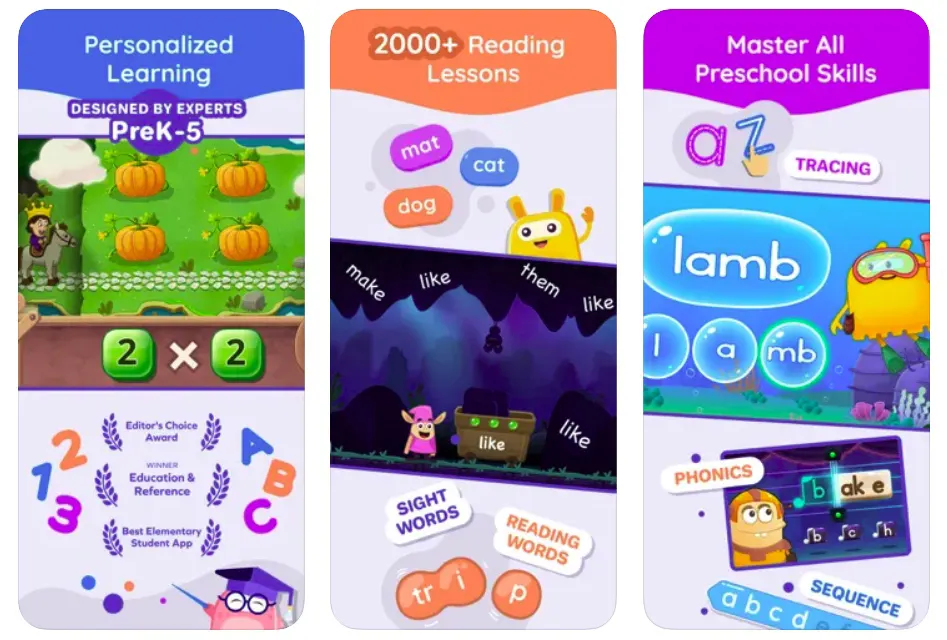
It is based on a previous release of an educational program called “Splash!” The program adapts to suit the student’s progress and preferred difficulty level in this new version of Splash Math.
SplashLearn is one of the most popular augmented reality Algebra apps for children to learn while playing with their parents or friends.
It uses colorful images, sound effects, and animations to make learning more interactive and engaging for kids. It is a free app for Android and Ios that can be played on any modern device with a browser.
The program is a one-stop shop for all educational content. It has an extensive library of 4000+ reading and math games, educational activities, and books.
SplashLearn is an educational app that teaches kids about concepts they need to know through fun and interactive games.
Download the App from Google Play Store
Download the App from Apple App Store
Algebra apps for high school
In the modern digital era, algebra apps for high school have become indispensable tools for students seeking to excel in mathematics.
These apps offer a dynamic and interactive learning experience, helping students develop a strong foundation in algebraic concepts.
With many options available, let’s explore some of the best algebra apps for high school that can revolutionize how students approach and engage with algebra.
Mathly: Algebraic Mastery: Mathly provides comprehensive coverage of high school algebra topics, accompanied by interactive lessons and practice exercises.
Its engaging interface and step-by-step problem-solving guides enhance students’ understanding and confidence in algebraic concepts.
Algebrator: Equation Explorer: Algebrator offers a unique approach to learning algebra by allowing students to explore equations through visual representations and simulations.
Its intuitive interface and interactive tools make it easier for high school students to grasp complex algebraic concepts.
Algebra Ace:- Algebra Ace provides a wide range of algebraic lessons, quizzes, and practice exercises specifically tailored for high school students. Its adaptive learning algorithm adapts to each student’s progress, ensuring personalized and effective learning.
Equation Explorer:- Equation Explorer is an app that strengthens students’ equation-solving skills.
Through interactive examples and guided practice, high school students can master solving linear, quadratic, and simultaneous equations.
Here is a table highlighting Algebra apps for high school based on user reviews:-
| App Name | User Reviews | Features |
|---|---|---|
| Mathly | ⭐⭐⭐⭐⭐ (4.8/5) | Comprehensive coverage, interactive lessons |
| Algebrator | ⭐⭐⭐⭐ (4.4/5) | Visual representations, interactive simulations |
| Algebra Ace | ⭐⭐⭐⭐ (4.5/5) | Tailored for high school students, adaptive learning |
| Equation Explorer | ⭐⭐⭐⭐⭐ (4.9/5) | Emphasis on equation-solving skills, guided practice |
Unleashing the Power of Algebra Apps: Tips for Maximizing the Benefits
To harness the full potential of algebra apps, it’s essential to utilize them effectively and optimize your learning experience.
Here are some valuable tips for maximizing the benefits of algebra apps and ensuring fruitful results:-
Set Goals and Create a Study Plan: Define your goals for using the Algebra app, whether mastering specific topics or improving problem-solving skills. Create a study plan to allocate dedicated time for app usage and track your progress.
Engage with Interactive Features: Make the most of the app’s interactive features, such as practice exercises, quizzes, and simulations.
Actively participate in solving problems, manipulating variables, and exploring concepts to reinforce understanding.
Track Progress and Revisit Weak Areas: Utilize the app’s progress-tracking features to monitor your performance. Identify and revisit weak areas to reinforce your understanding and address any knowledge gaps.
Supplement with Traditional Resources: While algebra apps provide valuable learning experiences, supplementing them with traditional resources such as textbooks or online tutorials can provide additional depth and context to your studies.
Embrace Problem-Solving and Real-Life Applications: Apply algebraic concepts to real-world scenarios and problem-solving situations.
Seek opportunities to solve practical problems, analyze data, and make connections between algebra and everyday life.
By following these tips for maximizing the benefits of algebra apps, you can enhance your learning journey, strengthen your algebraic skills, and gain a deeper understanding of the subject.
Remember to stay consistent, remain motivated, and explore the app’s different features to make your algebraic experience truly transformative.
📗FAQ’s
What is the best app to help with algebra?
Some of the best apps that will make learning algebra easier than ever are WolframAlpha, PhotoMath, Mathway, Graphing Calculator, etc. Most of these apps are free but also have a paid version. All these are available on iOS and Android to have the best experience.
What website helps with algebra?
You can also start learning Algebra from certain websites, such as QuickMath. In the Algebra section, you can get answers to all the equations, calculus, and more very easily.
This site helps not only high-school students but also college students too in helping them solve complex math problems.
What are the disadvantages of Photomath?
Even though Photomath is one of the most useful apps for solving math problems, it can have massive disadvantages, especially for children.
With the use of this tool, you can get all the answers to the equations without having to solve them, which small children are putting to regular use to complete their homework with no effort.
Is MalMath free?
Yes, the MalMath app allows students to get the answers to all the equations and look at all the step-by-step descriptions.
It is one of the best apps you can use to solve algebra and learn as well with the help of proper steps given along with answers. Students, teachers, and parents can make the best use of it.
How long does it take to learn algebra?
Learning maths and Algebra is an ongoing process depending on your level. It may take years to master the field, while some can quickly solve even the most complex equations.
The best way to learn algebra is through certain learning apps you can download on your phone or directly through YouTube tutorials.
Is there a difference between Khan Academy and Khan Academy Kids?
If you want to take up Khan Academy courses to learn Algebra, you first need to determine whether to go for Khan Academy or Khan Academy Kids.
Both are exceptionally good in the courses and learning. However, the kid’s app is for Pre-K through 2nd grade, and the Khan Academy is from 3rd Grade onwards.
Is Photomath good for algebra?
Photomath is a mobile app that solves math problems using a smartphone or tablet’s camera, including algebraic equations.
It helps check or quickly solve problems but is not a replacement for understanding the underlying concepts. It’s important to comprehend how to solve algebraic equations without relying solely on technology.
Photomath provides step-by-step solutions to problems but doesn’t always explain the reasoning behind each step.
Therefore, seeking out additional resources and practice problems is necessary to understand algebraic concepts thoroughly.
How can I learn algebra for free?
Learning algebra for free is possible using online resources. Some options are:
Khan Academy: A non-profit that provides free educational videos and practice exercises on several subjects, including algebra. The site is a self-paced learning tool that guides you through the material.
OpenStax: A non-profit that produces free, peer-reviewed textbooks for subjects such as algebra. These textbooks are available for free download as PDFs or online.
MIT OpenCourseWare: A website that provides free access to lecture notes, exams, and videos from actual MIT courses, including algebra. You won’t earn college credit, but it can be a valuable learning tool.
YouTube: A vast collection of educational videos on algebra created by experienced educators. Use the search function to find videos that cover specific algebraic concepts.
Mathway: A website and app that allows entering algebraic equations and receiving step-by-step solutions. While not designed to teach algebra, it can be a helpful tool for checking work and understanding how to solve problems.
By taking advantage of these resources, a strong understanding of algebra can be developed without spending money.
What is the best way to learn algebra?
Learning algebra effectively depends on your preferences and learning style.
Here are some tips:
Start with basics: Have a firm grasp of basic math concepts, such as fractions and arithmetic, before advancing to algebra.
Practice frequently: To become proficient in algebra, practice is necessary. Begin with simple problems and progress to more difficult ones.
Use multiple resources: Textbooks, online courses, videos, and apps are among the available resources to learn algebra. Experiment with different resources to identify which ones are most helpful.
Seek assistance when needed: Reach out to a teacher, tutor, or online community when you are struggling with a problem or are unsure of a concept.
Prioritize understanding over memorization: Algebra is about comprehending how to solve problems, not memorizing formulas. Ensure you comprehend the rationale behind each step of a problem rather than simply memorizing the steps.
Maintain motivation: Learning algebra can be demanding, but perseverance is crucial. Establish objectives and celebrate your accomplishments along the way.
Remember, acquiring proficiency in algebra requires dedication and effort. By following these tips and locating the resources that best suit your needs, you can develop a strong understanding of algebra and succeed in your studies.
What app gives you algebra answers?
Apps are available to provide algebraic answers. Examples include:
Photomath: A popular app that uses a smartphone camera to scan and solve math problems, such as algebraic equations. Solutions include step-by-step instructions and visual representations.
Mathway: An app that can solve algebraic equations and other math problems, such as calculus and statistics. It provides step-by-step solutions.
Cymath: An app that provides step-by-step solutions to algebraic equations and has a calculator to solve calculus and algebra problems.
Although these apps can be useful for quick answers and to verify work, they cannot replace a solid understanding of algebraic fundamentals. It’s important to learn how to solve algebraic equations unaided.
What is the algebra2 app?
An “Algebra 2 app” is an app that focuses on teaching and providing resources for advanced mathematical concepts, such as quadratic equations, logarithms, and trigonometry.
Several apps are available that cover Algebra 2 concepts, such as:
Mathway: Provides step-by-step solutions for various math topics, including Algebra 2.
Algebra 2: Offers practice problems, lessons, and quizzes to help learn Algebra 2 concepts.
Khan Academy: Provides video lessons and practice exercises on various math topics, including Algebra 2.
Cymath: Offers a step-by-step calculator and provides solutions to algebraic equations, including those related to Algebra 2.
Photomath: Uses a smartphone camera to scan and solve math problems, including those related to Algebra 2.
These apps are helpful resources for students studying Algebra 2, but should not replace a comprehensive understanding of the underlying concepts.
How do I improve my algebra skills?
Improving your algebra skills requires effort and time, but the following tips can help:
Master basics: Ensure a firm grasp of fundamental math concepts, such as arithmetic and fractions. These concepts are essential for comprehending more complex algebraic equations.
Practice frequently: Algebra is a skill that demands practice to master. Solve as many problems as possible, starting with easy ones and gradually advancing to more challenging ones.
Utilize multiple resources: Textbooks, online courses, videos, and apps are excellent resources for learning algebra. Experiment with various resources to determine which ones are most effective for your learning style.
Request assistance when required: If you get stuck on a problem or don’t understand a concept, don’t hesitate to ask for help. This could be from a teacher, tutor, or online community.
Prioritize understanding over memorization: Algebra is not about memorizing formulas but how to solve problems. Make sure you comprehend the reasoning behind each step of a problem rather than simply memorizing the steps.
Maintain motivation: Improving your algebra skills can be challenging, but perseverance is important. Establish objectives and celebrate your accomplishments along the way.
By following these tips, you can enhance your algebra skills and develop confidence in your ability to solve algebraic equations.
What website helps with algebra?
Websites are available to provide resources for learning and practicing algebra. Some examples include:
Khan Academy: Offers free video lessons and practice exercises on various math topics, including algebra.
Mathway: Provides step-by-step solutions to algebraic equations and other math problems, such as calculus and statistics.
Purplemath: Offers lessons and practice problems for algebra concepts with easy-to-understand explanations and examples.
Wolfram|Alpha: A computational knowledge engine that can solve equations and provide information on algebraic concepts and formulas.
Coolmath: Provides various math resources, including algebra lessons and practice problems. It offers interactive games and puzzles to make learning algebra more engaging.
Utilize these websites to learn and practice algebra. Experiment with different resources to determine which ones work best for you.
How can I help my child with algebra?
To assist your child with algebra, follow these tips:
Encourage regular practice: Consistent practice is necessary to master algebra. Urge your child to practice algebraic equations regularly, beginning with easier problems and gradually working up to more challenging ones.
Provide support: Help your child work through problems and understand the underlying principles of algebra when they struggle or get stuck.
Use varied resources: Experiment with textbooks, online courses, videos, and apps to determine what resources work best for your child’s learning style.
Build strong foundations: Fundamental math concepts such as arithmetic and fractions are the backbone of algebra. Ensure your child understands these concepts before progressing to more complex algebraic equations.
Acknowledge progress: Celebrate your child’s accomplishments and set realistic goals.
Consider seeking help: A tutor or teacher can offer personalized instruction to help your child overcome difficulties.
Following these tips can help your child develop a strong foundation in algebra and the skills necessary to solve algebraic equations.
Can you self-study algebra?
It is possible to learn algebra through self-study, but it can be more challenging compared to learning in a classroom environment. Here are some tips:
Utilize resources: Many resources provide clear explanations, examples, and practice problems for learning algebra.
Practice regularly: Regular practice is essential for mastering algebra. Solve problems regularly, starting with easier ones and gradually progressing to more challenging problems.
Seek help when necessary: If you get stuck on a problem or struggle to understand a concept, seek assistance from a teacher, tutor, or online community.
Create a study plan: Establish a plan with specific goals and a timeline for achieving them. Allocate a certain amount of time each day or week to studying algebra.
Stay motivated: Self-studying algebra can be challenging, so staying motivated and committed is important. Set goals and celebrate your accomplishments along the way.
While self-studying algebra is possible, having access to resources and support can help you stay on track and answer any questions you may have.
At what age should algebra be taught?
Algebra is often first taught in middle or early high school, typically around ages 12 to 15.
Does algebra help your brain?
Algebra can help develop your brain in several ways, such as:
Problem-solving: Algebraic equations require critical thinking and problem-solving skills. Practicing algebra can improve your ability to solve complex problems.
Logical reasoning: Algebra involves logical thinking and the ability to manipulate rules and formulas, which can improve your logical reasoning skills.
Memory and visualization: Algebraic equations often involve abstract concepts and visualizing the relationships between variables. This can improve your spatial and visual memory, which is useful in various fields.
Attention to detail: Algebraic equations require careful attention to detail, and practicing algebra can improve your ability to focus on details and avoid mistakes.
In addition, studying algebra can also develop persistence and determination, as solving complex algebraic equations can require time and effort.
Practicing algebra is an excellent way to exercise your brain and improve your problem-solving and reasoning skills.
Conclusion
Algebra apps can help students learn to solve math problems. It isn’t easy to know what is good about algebra, but these apps are written in an enthusiastic tone that helps you decide which algebra app is excellent for you.
There are many more apps available covering a wide range of math topics. We’ve performed our best to provide you with information that will help you determine whether or not you need an algebra app and which algebra apps are ideal for your child.
Although apps cannot replace a teacher, they can help students gain confidence and comprehend various algebraic concepts.
The list above should cover your bases if you’re looking for apps that will specifically help you with algebra. Use these apps to stay motivated and work on becoming a true math pro while you’re at it.