






















Biology has always been one of the most interesting subjects for learning and teaching. And modern approach with a combination of innovation and technology can make things even more intriguing.
There should be a clear line between creative learning and babysitting strategies. For students to succeed in biology, teachers must be aware of different ways of making it meaningful and exciting. Thankfully, we now have endless options for doing just that!
Resources are abundant, tools, websites, eBooks, add mobile applications to learn and teach biology in a very exciting and effective modern way.
To get students and educators started, I have listed 11 extraordinary biology apps to spice things up while tutoring and learning the subject.
Role of mobile apps in biology education
The role of mobile apps in biology education has transformed how students engage with the subject matter, fostering a dynamic and interactive learning environment.
These innovative applications bridge the gap between theory and practice, providing students with a hands-on approach to studying biological concepts.
Mobile apps offer a myriad of advantages in biology education. Immersive and visually appealing, they captivate learners and make complex topics more accessible.
Through interactive simulations, students can explore the intricate structures of cells, organisms, and ecosystems, gaining a deeper understanding of biological processes.
Quizzes and gamification elements motivate learners, making the learning experience enjoyable and rewarding.
Furthermore, mobile apps enable students to access many resources at their fingertips. With comprehensive study materials and detailed illustrations, learners can delve into anatomy, genetics, and ecology, enhancing their comprehension.
These apps also facilitate real-time data collection and analysis, enabling students to engage in citizen science and contribute to ongoing research efforts.
The convenience and flexibility of mobile apps allow students to learn anytime, anywhere.
They can supplement classroom instruction and serve as valuable study tools outside the traditional classroom setting. Additionally, remote learning is made more engaging through the use of interactive apps, ensuring continuity of education.
In conclusion, the role of mobile apps in biology education cannot be overstated. They revolutionize learning by providing an interactive, accessible, and engaging platform for students to explore the wonders of biology.
As technology advances, these apps will undoubtedly play an increasingly crucial role in shaping the future of biology education.
Best Biology Apps To Boost Your Biology Education👌
1. BioDigital
BioDigital is undoubtedly one of the best biology apps for students seeking a comprehensive and interactive learning experience.
With its advanced features and user-friendly interface, BioDigital offers an immersive exploration of the human body and various biological systems.
The app provides a vast library of 3D models, showcasing the intricacies of anatomy and physiology.
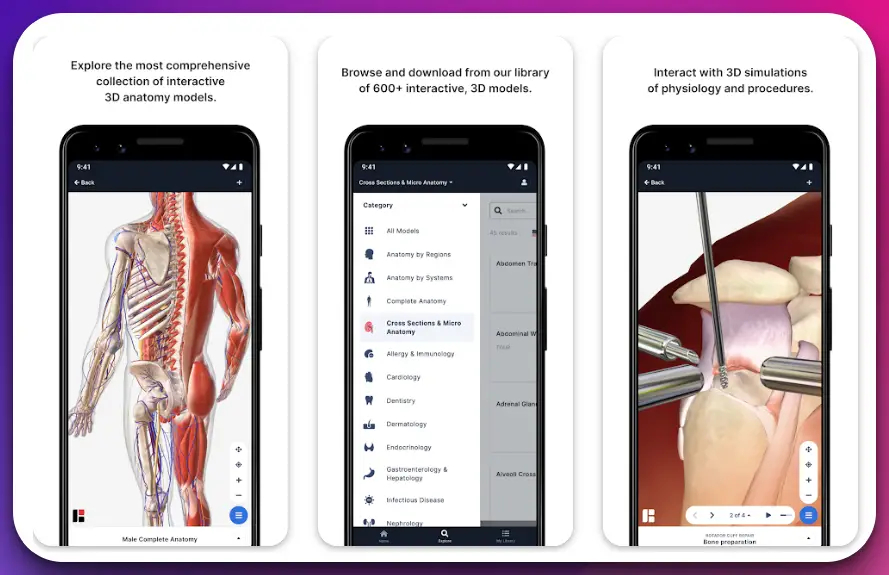
Students can delve into each system’s intricate details from the skeletal to the cardiovascular system. BioDigital’s remarkable accuracy ensures that learners gain a deep understanding of the human body’s structures and functions.
One of the app’s standout features is its interactive functionality. Students can zoom in, rotate, and manipulate the models, enabling them to explore the human body from different perspectives. This hands-on approach fosters engagement and facilitates better comprehension.
BioDigital also offers educational quizzes and interactive lessons, allowing students to test their knowledge and reinforce their understanding.
The app’s gamified elements provide an enjoyable learning experience, making it ideal for students of all ages.
Moreover, BioDigital’s cross-platform compatibility ensures accessibility across various devices, including iOS, Android, and web platforms. This flexibility allows students to access the app’s rich content anytime.
In conclusion, BioDigital is an exceptional biology app for students due to its comprehensive content, interactivity, and user-friendly interface.
Whether used as a supplementary learning tool or for independent study, BioDigital empowers students to grasp the complexities of biology in an engaging and immersive manner.
Download The App From Google Play Store
Download The App From Apple App Store
2. Khan Academy
Khan Academy emerges as one of the best biology apps available, offering students a wealth of knowledge and interactive resources to enhance their understanding of the subject.
With its comprehensive curriculum and user-friendly interface, Khan Academy provides a dynamic learning experience for students of all levels.
One of the key strengths of Khan Academy lies in its extensive collection of educational videos.
These videos feature expert instructors who skillfully explain complex biological concepts, making them accessible and engaging. Students can watch these videos at their own pace, pausing and rewinding to reinforce their understanding.
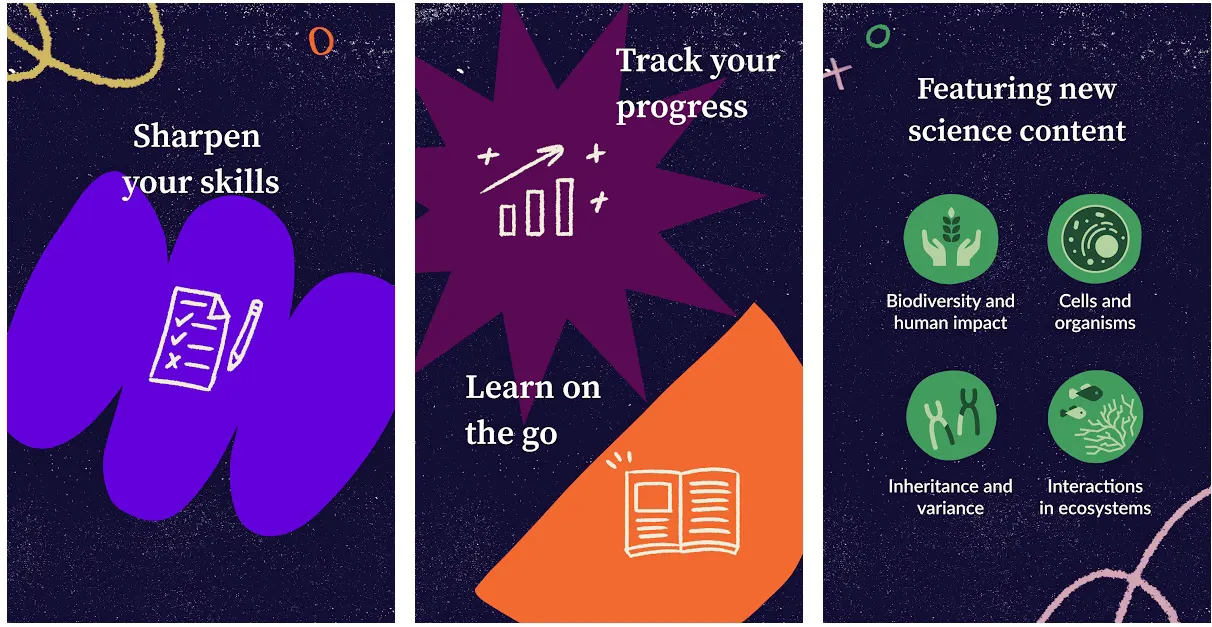
The app also offers practice exercises and quizzes that allow students to apply their knowledge and assess their progress. By tailoring the content to individual learning needs, Khan Academy ensures a personalized learning experience.
Additionally, Khan Academy provides detailed progress tracking and analytics, enabling students to monitor their performance and identify areas for improvement.
This data-driven approach empowers students to take ownership of their learning and make targeted efforts to strengthen their biology skills.
Furthermore, Khan Academy is a comprehensive study companion covering various biology topics, including cellular biology, genetics, ecology, and more.
Its well-structured lessons and visual aids aid in conceptual understanding, while the interactive quizzes and challenging problems foster critical thinking and problem-solving skills.
In conclusion, Khan Academy is one of the best biology apps due to its robust curriculum, engaging videos, personalized learning, and detailed progress tracking.
With its commitment to providing quality education, Khan Academy empowers students to excel in their biology studies and develop a deeper appreciation for the wonders of life.
Ratings on Apple Store – 4.4 / 5 | Ratings on Google Play Store – 4.4 / 5
Download the App on Google Play Store
Download the App from Apple App Store
3. Anatomy Learning
Anatomy Learning is an exceptional app that truly lives up to its claim of being a true 3D app for studying human anatomy.
With its immersive and detailed features, this app revolutionizes how students explore and understand the human body’s complexities.
The standout feature of Anatomy Learning is its impressive 3D models. These models provide a realistic representation of the human anatomy, allowing students to visualize and interact with each organ and structure in stunning detail.
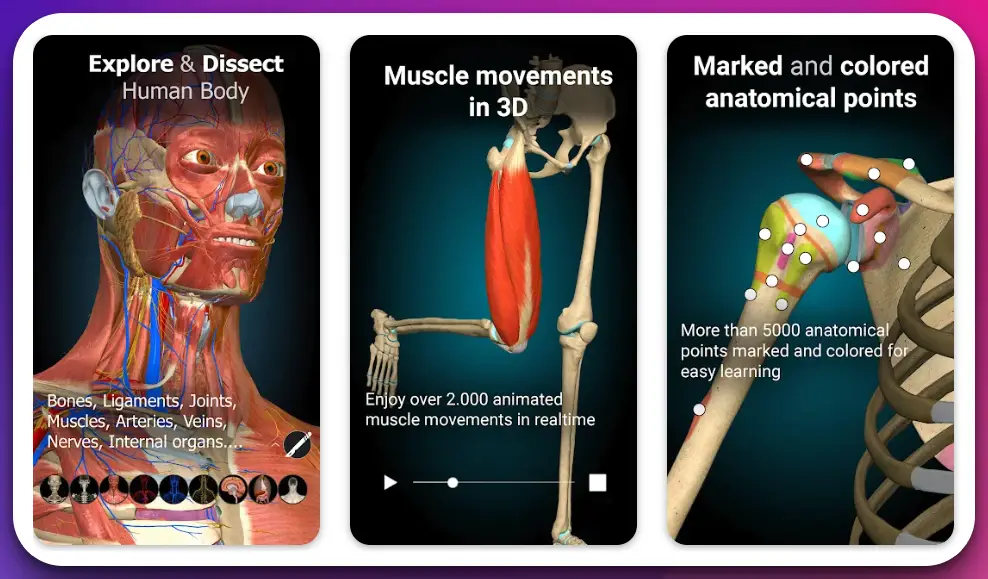
The ability to rotate, zoom in, and examine every angle fosters a comprehensive understanding of the human body’s intricacies.
This app goes beyond static images and offers dynamic visuals that enhance the learning experience.
Students can witness animated simulations of physiological processes, such as the functioning of the cardiovascular system or the contraction of muscles.
These interactive elements bring the subject to life, making it easier for students to grasp and retain information.
Anatomy Learning also provides a range of educational resources to support learning. Users can access detailed descriptions of each anatomical structure, accompanied by labels and relevant information.
The app also includes quizzes and practice exercises that enable students to assess their knowledge and progress.
Whether used by medical students, healthcare professionals, or anatomy enthusiasts, Anatomy Learning is a powerful tool for studying human anatomy.
Its true 3D functionality, detailed visuals, and educational resources make it an indispensable companion for anyone seeking a deeper understanding of the human body.
Download The App From Google Play Store
Download The App From Apple App Store
4. Wolfram Alpha
The Wolfram Alpha app is a remarkable tool that has proven its worth in biology.
With its sophisticated computational engine and vast knowledge base, Wolfram Alpha revolutionizes how students and professionals approach biological inquiries.
What sets the Wolfram Alpha app apart is its ability to provide instant access to a wealth of biological information.
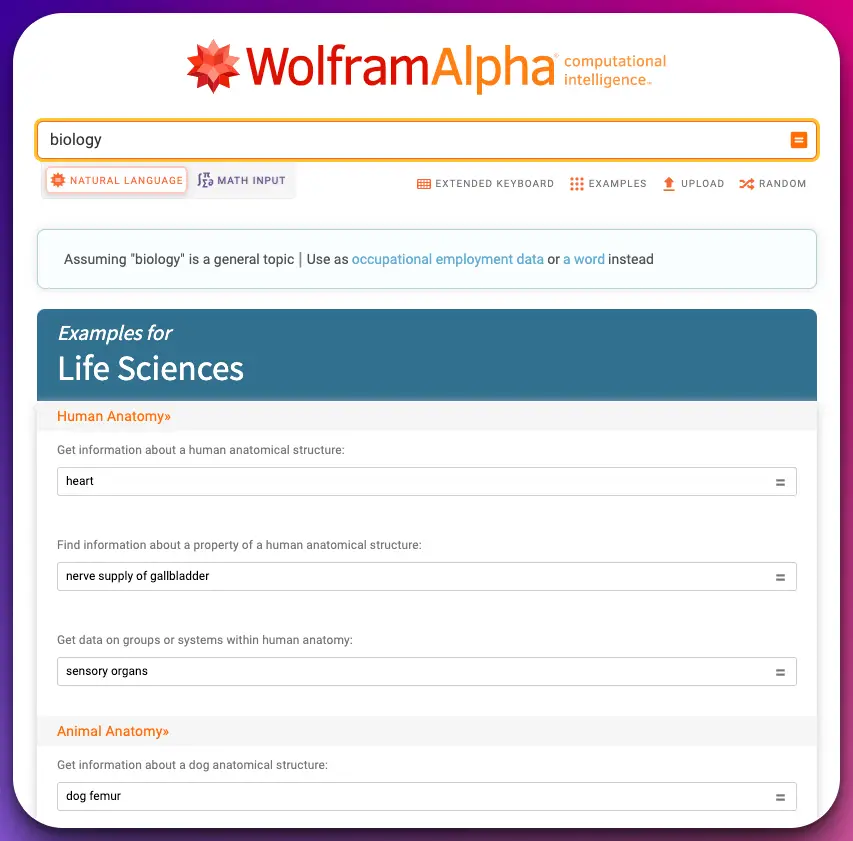
Users can input various queries, from molecular structures to genetic sequences, and the app delivers comprehensive and detailed results. It serves as a powerful knowledge repository that assists in both basic and advanced biological research.
The app’s computational capabilities allow for complex analyses and data visualization.
For instance, users can explore phylogenetic relationships among species, perform statistical analyses on experimental data, or even simulate biochemical pathways. This level of functionality makes it an indispensable companion for researchers and students alike.
Wolfram Alpha also excels in its ability to solve biological equations. From population genetics to enzymatic kinetics, the app can swiftly compute and present solutions with meticulous accuracy.
This feature enables users to focus more on the conceptual aspects of their research, saving time and effort in tedious calculations.
In summary, the Wolfram Alpha app is an invaluable resource for anyone in the biology field.
Its computational power, vast knowledge base, and ability to provide instant access to information make it a must-have tool for researchers, students, and professionals seeking to explore and unravel the intricacies of the biological world.
5. Phylo
Phylo is an innovative and captivating web-based application that merges biology and puzzle-solving.
This unique game engages users in an exciting quest to align DNA sequences and unravel the mysteries of evolutionary relationships.
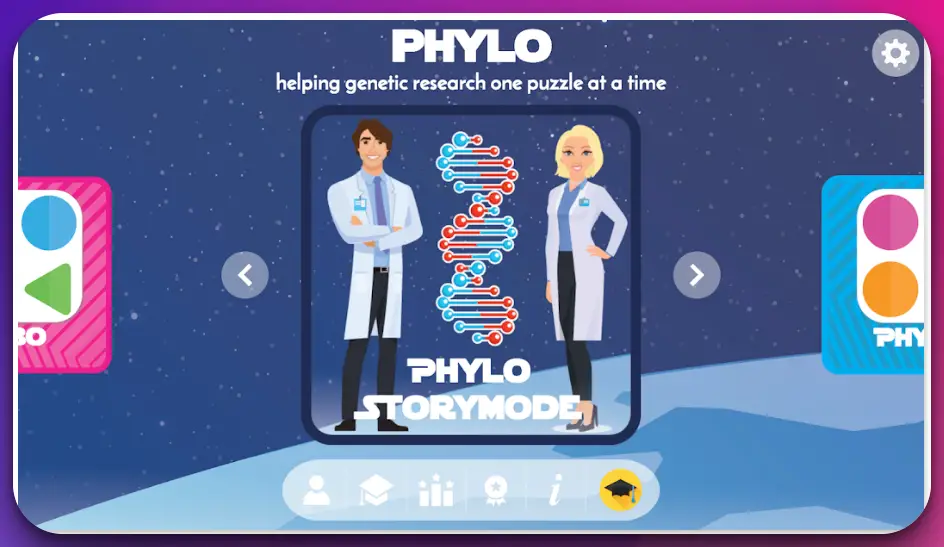
At its core, Phylo aims to crowdsource scientific research by transforming complex genetic data into an entertaining puzzle format. Players are presented with colored blocks, each representing a nucleotide base in a DNA sequence.
The challenge lies in rearranging these blocks to achieve the optimal alignment reflecting the evolutionary history of the studied organisms.
By participating in this interactive game, users are actively contributing to computational biology.
The alignments generated through Phylo are analyzed by researchers, providing valuable insights into the genetic relationships between different species.
What makes Phylo truly remarkable is its ability to engage players of all ages and backgrounds in exploring genomic data.
The game effectively bridges the gap between scientific research and public participation, fostering a sense of citizen science and inspiring a new generation of biological enthusiasts.
Overall, Phylo stands as a shining example of how gamification can be leveraged to advance scientific research.
Its fusion of genetics, puzzle-solving, and citizen science creates an immersive experience that educates and empowers players to actively contribute to studying evolutionary biology.
Download The App From Google Play Store
Download The App From Apple App Store
6. Essential Anatomy 5
Essential Anatomy has rightfully earned its reputation as the world’s most used medical study and reference app.
This powerful tool provides medical students, professionals, and enthusiasts with an unparalleled resource for exploring the intricacies of the human body.
With its comprehensive anatomical models and interactive features, Essential Anatomy offers a dynamic learning experience.
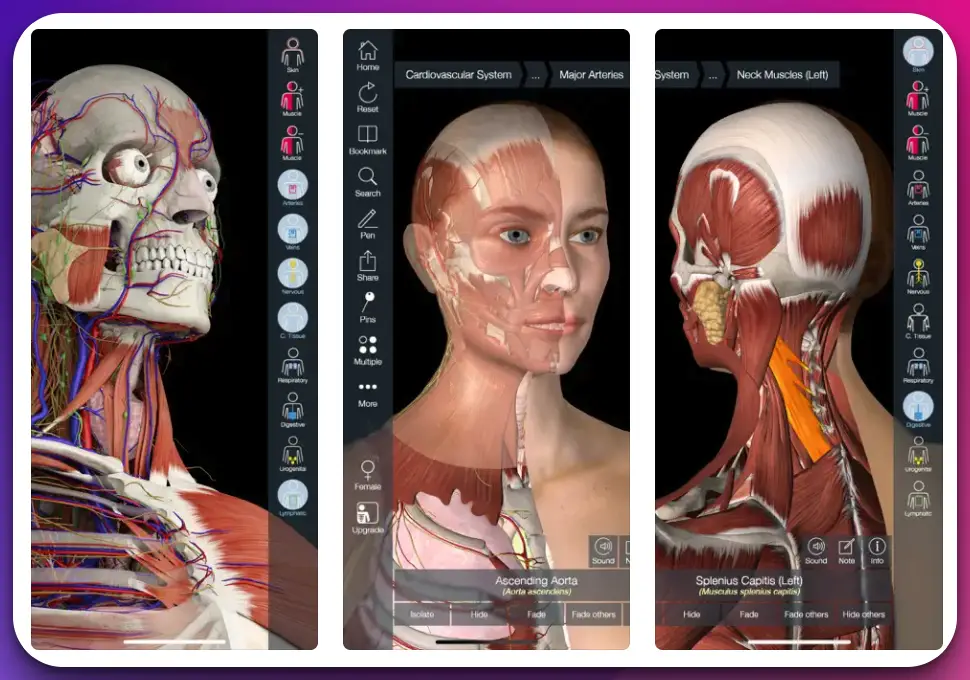
Users can navigate through different body systems, such as the skeletal, muscular, and nervous systems, with astonishing accuracy. The app’s high-resolution images and detailed structures allow in-depth exploration and analysis.
Essential Anatomy provides interactive quizzes and educational resources as a study aid, enabling users to test their knowledge and reinforce key concepts.
The app’s 3D cross-sections and labeling functionality allow for a thorough understanding of anatomical relationships.
What sets Essential Anatomy apart is its versatility. It is equally beneficial for medical professionals who need a quick reference during patient consultations and students who require a comprehensive study tool.
The app’s user-friendly interface and intuitive navigation make it accessible to all skill levels.
Furthermore, Essential Anatomy’s regular updates ensure that users stay up-to-date with the latest medical advancements. New features and content additions enrich the app’s value as an indispensable medical companion.
In conclusion, Essential Anatomy has rightfully claimed its position as the world’s most used medical study and reference app.
Its comprehensive anatomical models, interactive features, and versatile functionality make it an essential tool for anyone seeking a deep understanding of the human body and its intricate structures.
Download The App From Apple App Store
7. Complete Anatomy
Complete Anatomy stands out as the preeminent anatomy platform of our time, offering a comprehensive suite of features that solidify its position as the BEST anatomy app available today.
With its rich functionality and extensive anatomical detail, this remarkable platform caters to medical professionals, students, and enthusiasts’ needs.
One distinctive quality that sets Complete Anatomy apart is its unparalleled level of available content. The app boasts a vast library of anatomical structures meticulously rendered in three dimensions, providing an immersive learning experience.
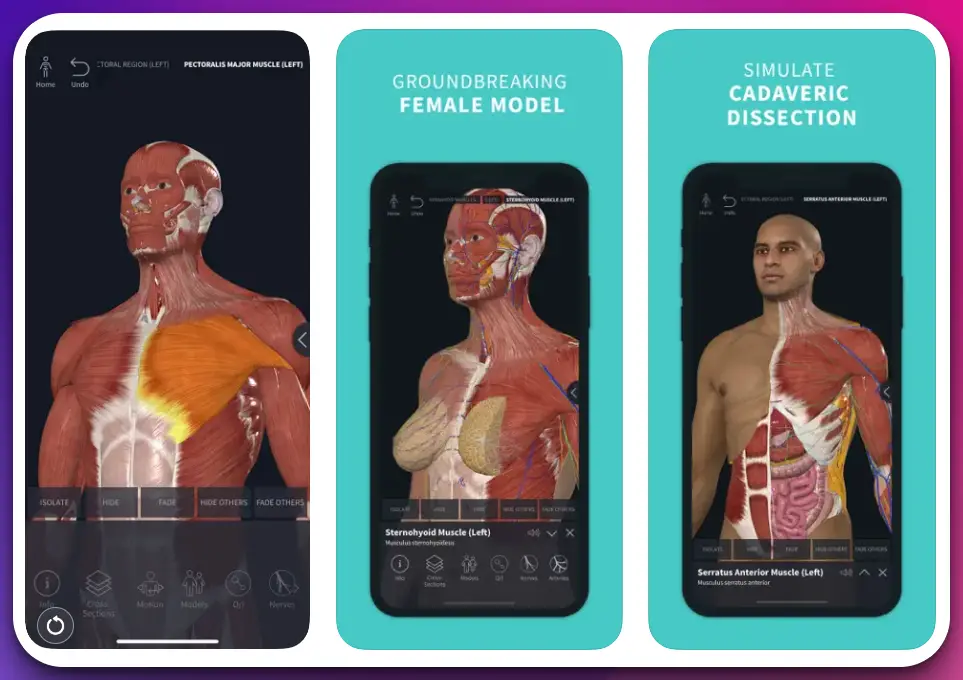
From the intricate intricacies of the human musculoskeletal system to the complexities of the nervous and cardiovascular systems, the platform encapsulates the entirety of human anatomy.
The app’s interactive nature allows users to explore these anatomical structures with ease and precision.
With just a few taps, one can rotate, zoom in, and dissect virtual models, gaining invaluable insights into the intricacies of the human body.
This dynamic approach to learning greatly enhances comprehension and facilitates a deeper understanding of anatomical relationships.
Complete Anatomy’s commitment to educational excellence is evident in its innovative features. The platform offers virtual dissection, allowing users to simulate real-life dissection experiences without needing a physical cadaver.
Moreover, the app’s cross-sections feature empowers users to visualize internal structures layer by layer, providing unparalleled detail and context.
The platform’s versatility extends beyond its core features. With built-in quizzing and testing tools, Complete Anatomy is a formidable study companion, enabling users to reinforce their knowledge and assess their progress effectively.
The app’s augmented reality capabilities also enable users to superimpose anatomical structures onto the real world, fostering a unique and interactive learning experience.
In summary, with its comprehensive content, interactive interface, and innovative features, Complete Anatomy unquestionably earns its title as the BEST anatomy platform.
It empowers users to delve into the depths of the human body, unraveling its intricacies with unparalleled precision and facilitating a profound understanding of anatomy.
Download The App From Google Play Store
Download The App From Apple App Store
8. BiologyMaster – Biology for YOU
Enjoy learning biology in a very simple and interesting way with undoubtedly one of the most unique biology apps to date! BiologyMaster inspires you to learn and teach biology thoroughly and comprehensively.
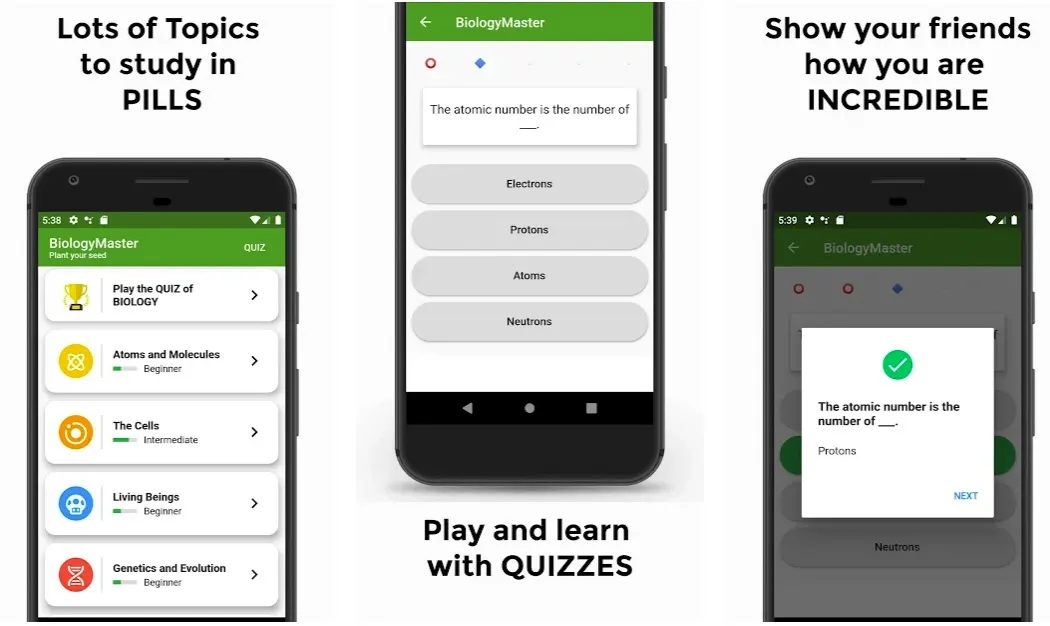 Focusing on almost all the topics of the subject is as simple as it gets with the app. With a unique concept of a modern approach to learning a centuries-old subject, the app takes you through a very fascinating journey to go deep, add come out informed like a pro!
If you are willing to spend some time regularly and go with a holistic approach to learning, the app has a lot more than you can imagine!
Topics like cell junctions, cell life cycle, forms and functions of organisms, classification of living person digestion, gaseous exchanges, nervous system, reproduction, genetics, evolution, add more – all are there in the app.
And it’s not only about listing these topics in detail. BiologyMaster trains you to master the subject at your speed so that you are more than ready to face your next biology exam with confidence and complete knowledge.
What about taking on some challenging quizzes? There are some to test your knowledge and track your progress.
Features of BiologyMaster – Biology for YOU:-
- Dozens of biology topics to learn
- Test your knowledge with different quizzes
- Showcase your talent by sharing it with friends
- Very simple and easy-to-understand explanations
- Tested and trusted by a lot of educators
Devices – Android and iOS
Ratings on Apple Store – 5.0 / 5 | Ratings on Google Play Store – 4.6 / 5
Download the App on Google Play Store
Download the App from Apple App Store
9. Biology Today
How about having one of the most popular biology magazines at your fingertips?
Biology Today is one of the top competitive magazines published exclusively by MTG Learning Media Pvt limited and is a fascinating source of information, especially for those who are interested in biology.
And, when you get the chance to explore the magazine right on your iPhone, it becomes even more easy and full of fun.
The app is designed to improve the overall quality of biology education, enhancing students’ interest in the subject and helping them become successful professionals by fostering their thinking and analytical ability.
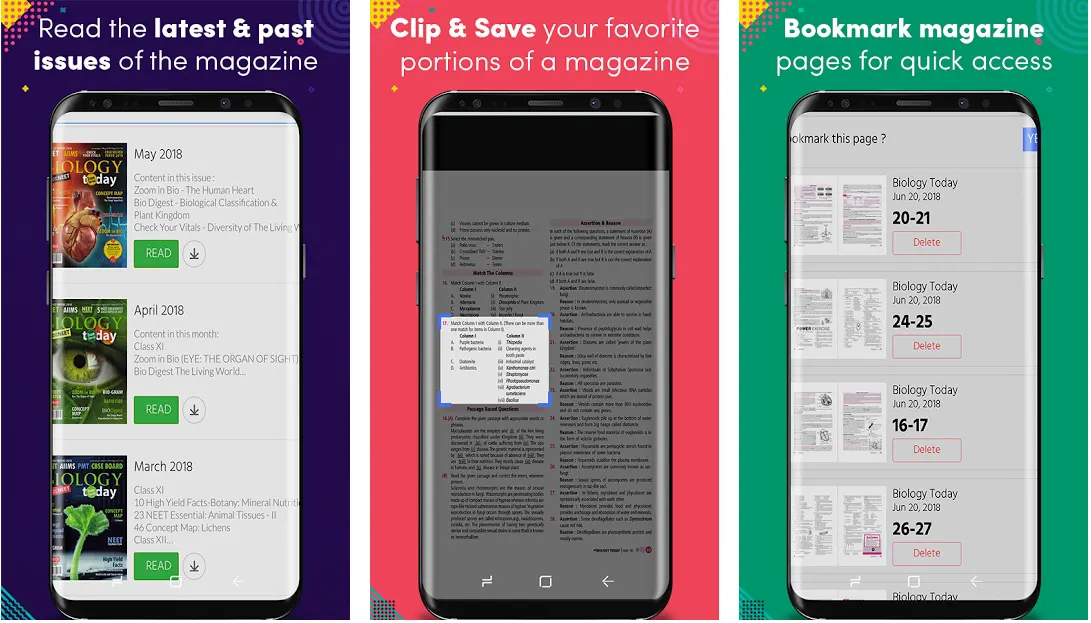
With the app, you constantly get supplies of essential learning material such as valuable texts, previous years’ papers, sample papers, memory tips, flow charts, and more from some of the most legitimate sources.
If you are planning to master the subject for examination purposes, or even if you are simply interested in the subject to enhance your knowledge, biology today can be your ultimate app!
The app has already helped a lot of medical and engineering aspirants, and there is no reason why you can’t be the next!
Features of biology today:-
- Explore one of the most popular biology magazines right at your fingertips
- Check out the latest research and events
- Allows you to save your favorite portions of the magazine
- Access quickly by bookmarking the pages of your interests
- Share the fascinating facts on social media
Devices – Android and iOS
Ratings on Apple Store – 5.0 / 5 | Ratings on Google Play Store – 3.9 / 5
Download the App on Google Play Store
Download the App from Apple App Store
10. Human Anatomy 4D-Mixed Reality
Here is one of the leading apps, especially if you are interested in the anatomy branch of the subject.
Human Anatomy 4D-Mixed Reality is not just another anatomy app, but it is a lot more!
With the app, you can experience the human body just like it is in your living room, laboratory, classroom, or study room, only in the blink of an eye!
Take yourself through the anatomy of the human body just like you are walking around a physical character in a real-life!
Look up and down, check out all the body parts, interact with the organs, and learn about anatomy in any one of the most fascinating ways!

The cherry on the top, the app works perfectly in all the known immersive platforms of popular augmented reality, mixed reality, virtual reality, add more! Want something more?
You get all these features without paying a cent! The app is more than ready to perform out of the box.
Simply install it on your smartphone, follow the easy instructions right on your screen, add immersive yourself into a wonderful world of anatomy.
The app is not only designed for anatomy or biology students. People from other walks of life, including teachers, medical professionals, researchers, and even kids, can use the app without any problem.
Features of Human Anatomy 4D-Mixed Reality:-
- 4D anatomy in a completely different way
- Check out all the human body parts and organs like never before
- Equally good for students, teachers, and healthcare professionals
- Beautifully covers all aspects of human anatomy
- Compatible with mobile AR
Devices – Android and iOS
Ratings on Google Play Store – 4.8 / 5 | Ratings on Apple Store – 4.4 / 5
Download the App on Google Play Store
Download the App from Apple App Store
11. Cell Biology
Interested in learning some of the most fascinating aspects of cell biology? Here is the app designed especially for that!
The cell biology app has everything you are looking for in the stream of cell biology.
Whether you are a beginner, an advanced-level student, a researcher, or even a teacher, this app will prove mighty handy for you. The app works like a medical dictionary but is much more than that.
One of the most unique apps designed for students, teachers, hobbyists, and even professionals.
The cell biology app is no less than an ocean of knowledge that helps you master the subject comprehensively.
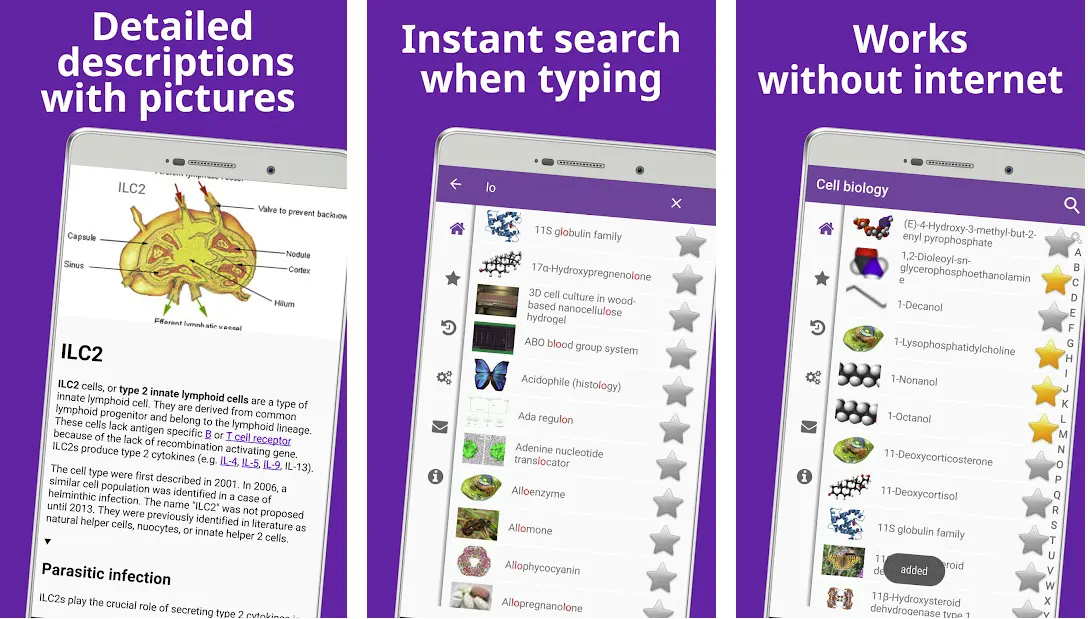
More than 7500 definitions of words, terms, and sentences are used in cell biology.
All the definitions and meanings are collected from very reliable sources, and you can completely trust them as far as the quality of the content is concerned.
And, regarding the overall user interface, the app is right there with some of the best.
Features like the advanced search function, why to search, auto-complete, and learning and teaching cell biology have become so easy and fun with the app.
Whether you are looking for a simple tool to enhance your knowledge of biology or want a tool for quick reference, the app is more than handy!
Features of Cell Biology:-
- Packed with more than 7500 terms, characteristics, and definitions
- Ideal for students, professionals, and even hobbyists
- Advanced voice search function with autocomplete
- Allows you to work offline
- An excellent tool for quick reference
Device – Android
Ratings on Google Play Store – 4.6 / 5 | 50,000+ Downloads
Download the App on Google Play Store
12. Cell World
Exploring various aspects of the human cell is always astonishing and full of surprises! The deeper you go, the more complex things get to do to the mysterious science behind the formation and structures of building blocks of the human body.
You can never get bored learning about different parts of human cells, their structures, functions, and their importance in the human body.
Cell World is an app that takes you on a hypnotic journey inside the human cell. You get to learn various minute details related to each part of the cell.
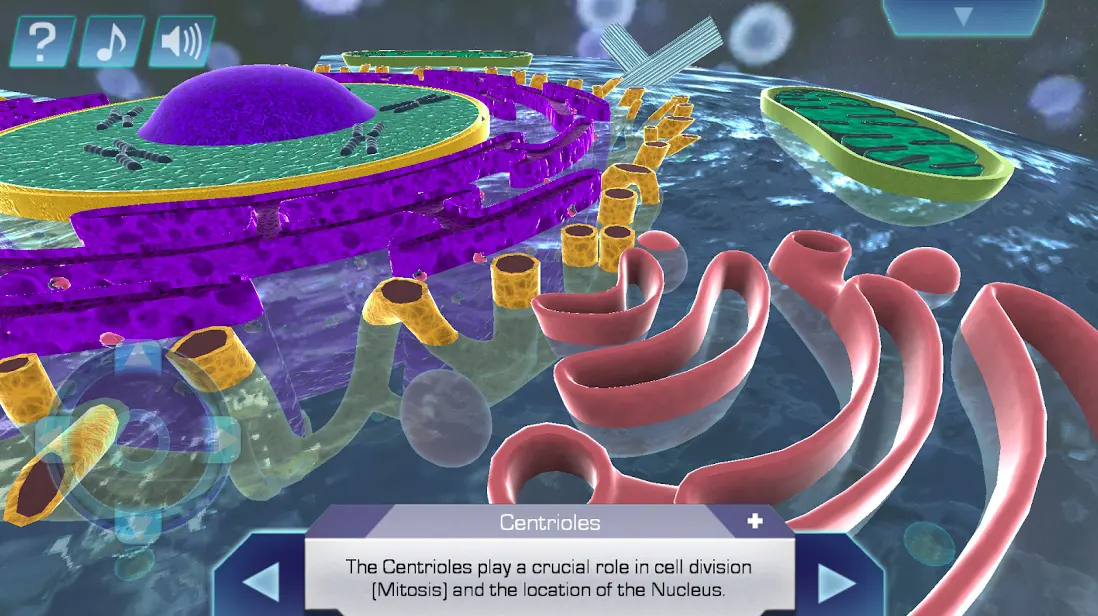
From the mind-boggling structures of the cell membranes to the formation and development of the nucleus, mitochondria, ribosomes, and other parts, the app enables you to know about cells uniquely and interactively.
Getting ready for the next experiment in your school’s biology lab? How about experiencing stunning navigation inside the cell?🧐
You can immerse yourself in the extraordinary interiors with stunning graphics and unbelievable details. Check out the app, and surprise your teacher with a detailed knowledge of the human cell!
Features of Cell World:-
- A detailed explanation of different parts of the human cell
- Stunning graphics depicting the minutest of details
- Visually appealing structures for an immersive experience
- The very tiny app, easy to use
- Makes learning interesting and full of fun
Device – Android
Ratings on Google Play Store – 4.6 / 5 | 5,00,000+ Downloads
Download the App on Google Play Store
13. Virtuali-Tee by Curiscope
Let’s explore an ultimate way of learning biology with Virtuali-Tee by Curiscope!
The app perfectly works in conjunction with a unique augmented reality tee shirt and makes learning lively, interesting, and very inspiring.
Whether you are a teacher or a biology student, this app will be more than enough for you with a detailed and realistic simulation of the subjects.
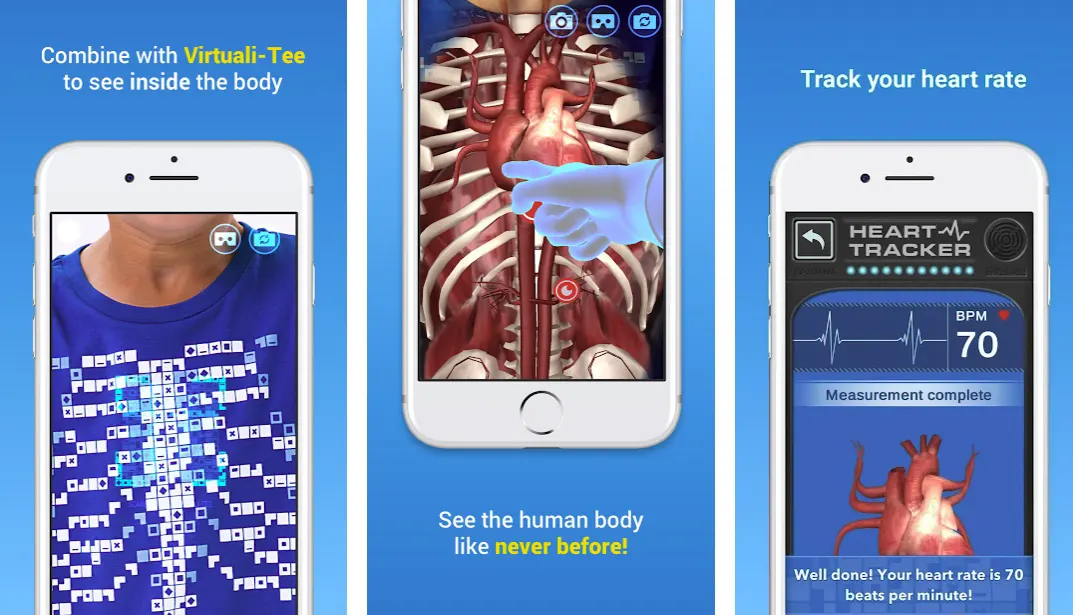
You can isolate individual physiological systems performing all the extraordinary functions.
Learn more about the bloodstream, small and large intestines, lungs, liver, heart, brain, and other organs like never before!
Thanks to the modern 360-degree VR experience, you can easily check out the minutest details of the human body. What more?💁
The app also has highly interesting features, including the heart tracker, google cardboard compatibility, an animated and smart doctor, etc.
Stunningly clear graphics and a user-friendly interface are two other fascinating aspects of the app; add make biology learning and teaching full of fun and interesting.
So, whether you are a student of biology, teaching the subject in a school, or you are intrigued by the subject, you should have a look at the app.
Features of Virtuali-Tee by Curiscope:-
- Instantly see inside your body
- Experience the anatomy and physiology of the human body like never before
- 360-degree view for enhanced learning
- Stunning graphics to check all the details
- User-friendly and quick interface
Devices – Android and iOS
Ratings on Apple Store – 4.5 / 5 | Ratings on Google Play Store – 3.7 / 5
Download the App on Google Play Store
Download the App from Apple App Store
14. Molecular Biology
Next on my list of the top apps is the free application of molecular biology. The user-friendly app is especially known for its very beautiful, simple, add highly interactive user interface.
Suppose you are always interested in finding biology terminologies and their meanings.
In that case, molecular biology is more than a suitable app for you, which works as a tiny but very comprehensive pocket dictionary.
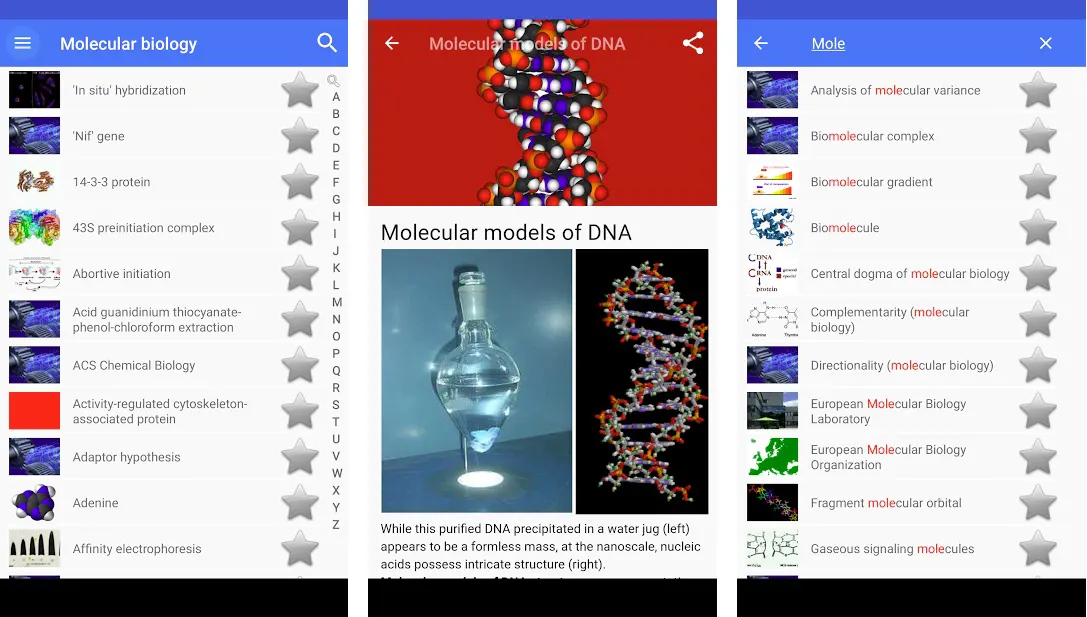
With the app, you can explore one of the most fascinating ways of mastering the difficult words and terms used in biology and also learn their meanings.
In addition to the dictionary, you can also go through some very useful and informative biology articles and descriptions.
The app is more than useful even when you are not online or struggling with a weak Internet connection.
Except for photos, you can have complete access to all the content on the app, including terminologies, descriptions, research articles, and more.
Searching for descriptions on the app is very simple, and easy and doesn’t take much time.
You can manage the list of your favorite topics: articles you have already explored, words you have checked, and a lot more.
Add an unlimited number of notes in the favorite section, and never forget what do you have noted while learning.
Features of Molecular Biology:-
- A wide range of content, including terminologies, articles, and descriptions
- Allows you to create and manage bookmarks easily
- Very simple, fast, and easy to use
- Favorite section for creating a limited number of notes
- Share your learnings with friends
Device – Android
Ratings on Google Play Store – 4.5 / 5 | 50,000+ Downloads
Download the App on Google Play Store
15. Biology By Open-Education
Biology by open education is one of the most impressive apps specially designed for students of both school and college levels.
From lessons to quizzes, flashcards, and glossaries, there is everything you look for in a biology learning app.
The app features multi-semester biology courses perfectly designed for science majors. The content in the app is based on an evolutionary approach to learning biology.
It enhances the ability of students to learn biology not only for career purposes but for various everyday applications as well.
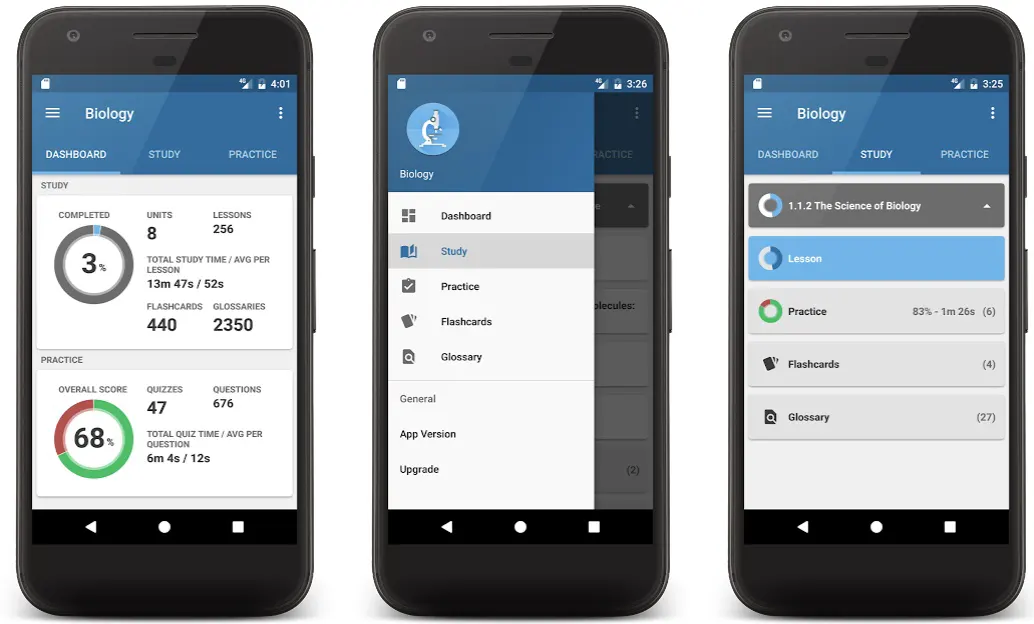
Biology perfectly meets the requirements of modern students and teachers, and most of the content is strategically condensed to maintain an overall scope and the maximum coverage of traditional texts in some of the most popular biology books.
If you are a teacher, the app provides some of the best ways of customizing the teaching experience by adopting a healthy and flexible teaching approach.
In the app, you also get an innovative art program designed to incorporate learners’ critical thinking and train them to understand and apply basic concepts.
Features of Biology:-
- A wide range of lessons, quizzes, glossaries, flashcards, and practice questions
- It enables you to track the learning progress
- A powerful combination of modern learning and traditional texts
- One of the best ways to prepare for examinations
- Very simple, enhanced, and clean look
- Suitable for both students and instructors
Device – Android
Ratings on Google Play Store – 4.4 / 5 | 50,000+ Downloads
Download the App on Google Play Store
16. Complete Biology – cell biology apps
Complete Biology is among the finest apps for students looking for a handy reference guide.
The app exclusively focuses on high school, secondary, and graduate students and biology teachers.
More than 35 topics cover almost everything related to the subject and can be more than effective for competitive exams.
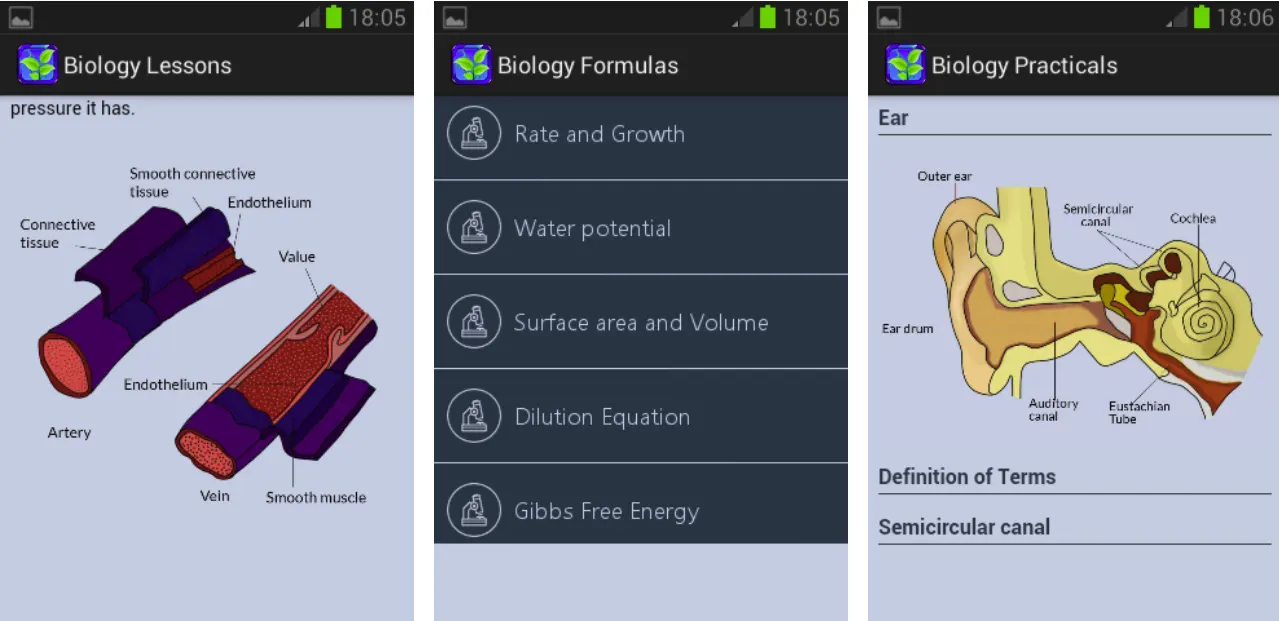
You learn the subject very interestingly across eight categories dealing with tutorials, possible exam questions, dictionaries, practical manuals, various formulas, etc.
If you are a lover of biology subject, I am sure you are going to admire the app for various reasons.
Topics like the organization of life, the concept of living things, cells and their environment, respiratory system, tissue system, cell properties, animal nutrition, reproductive system, and the biology of heredity, among others, are listed in the app.
All of these topics are dealt with exclusively in detail. The educational content is collected from reliable sources and uploaded on the app after repeated studies and verifications.
It doesn’t matter what type of exam you are preparing for; you can get some much-needed help from the app, and that too, without spending a penny.
Features of Complete Biology App:-
- Designed for students of all levels as well as teachers
- It makes biology learning simple and full of fun
- Highly informative content collected from reliable sources
- Deals with all the topics in detail with pictures
- It helps you to prepare for various competitive exams
Device – Android
Ratings on Google Play Store – 4.2 / 5 | 5,00,000+ Downloads
Download the App on Google Play Store
17. Full Biology Questions
One of the most useful apps designed especially for high school students who want to make their career in biology.
Full biology questions are a one-stop destination for high school students who want to improve in the subject with the proper approach to learning.
The app covers almost all the topics in a very unique add innovative way.
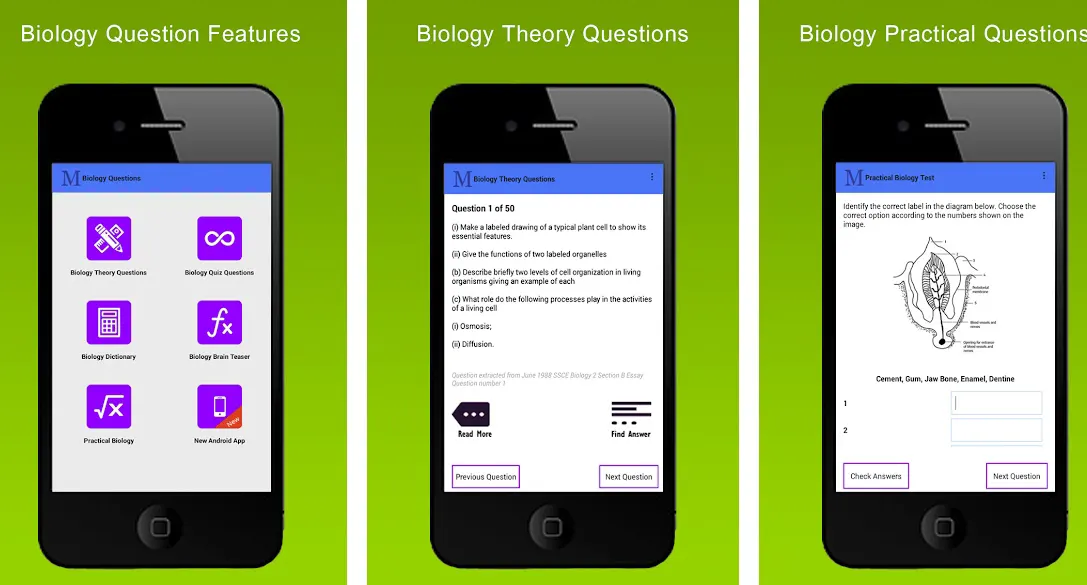
So many questions deal with the minutest of details related to the most common aspects of biology whether detailed solutions.
As a student, you can finally start scoring decent marks in your monthly tests or even semester exams.
If you tend to forget the terms of their meanings, are you are always afraid of developing an incomplete concept, having this app on your smartphone can be proved game-changing.
You don’t necessarily have to spend a lot of time searching for topics of interest. Because, the full biology questions app covers everything expertly and make learning as simple as it gets for you.
Thanks to an exclusive biology dictionary in the app, you can check out the meaning of unfamiliar terms whenever and wherever you want.
Features of full biology questions:-
- An excellent source of biology questions with solutions
- A dedicated practical biology section
- Detailed illustrations with diagrams and labels
- More than handy for high school biology students
- Covers both theoretical and practical parts of biology
Device – Android
Ratings on Google Play Store – 4.1 / 5 | 1,00,000+ Downloads
Download the App on Google Play Store
📗FAQ’s
Which app is best for biology class 11?
BiologyMaster is one of the best applications for biology for students of all classes and levels, including class 11. The app features very simple and easy to learn explanations, dozens of amazing biology topics, along with quizzes to test your knowledge.
What is the best website for biology?
Nature.com is the best website for biology, especially for educational purposes. Other decent biology learning websites include doodle.com, oup.com and frontiersin.org etc.
Is there an app for biology answers?
Yes, Biobrain is one of the most reliable applications to get all your questions answered related to biology. The app doesn’t only offers detailed explanation offers detailed explanation with comprehensive diagrams, but also enables you to test your knowledge with quizzes.
What is the best way to learn biology?
Understanding the concepts is more important than memorizing words. Making daily routine is also very crucial, and you even have to use various active study methods along with fleshing out notes regularly.
Why is biology so hard?
The massive syllabus is one of the reasons of biology being so hard. Additionally, highly complicated interactions between different living systems along with unfamiliar concepts and terms make biology hard to learn. Students also find biology challenging because it needs an in depth basic knowledge along with broad perspective.
How do I study biology last minute?
There is no “magical stick” you can use and prepare for your biology exams last minute. Comprehensive study along with regular revisions throughout the season makes a lot of difference. Yes, you can surely revise everything you have learn, but without putting your life to pause!
How do you get an A in a level biology?
Proper understanding of concept, regular revision, learning through notes, practicing diagrams, as well as taking care of your writing are some common yet highly effective ways to ensure you get the grades of your dreams in biology.
Can I self-study biology?
Yes of course! You can self study biology at any stage of your life, as there is no age limit to learning anything. Reading printed articles, checking out various scientific content, participating in seminars, workshops, forums, and listening to podcasts are some very highly efficacious ways of studying biology yourself.
How do I study for a biology exam in one day?
There is no shortcut to shortcut at all to prepare for your exam in one day! However, you can try making your last day more productive by memorizing important terms, checking out summaries in the textbook, making mind maps, graphs, charts, and diagrams etc.
How do you complete 5 chapters in 3 hours?
Highlighting important aspects of each chapter, checking out all the summaries, giving special attention to important terms are some practical ways of preparing 5 chapters in three hours.
How can I cheat in exams?
No need to do that! Cheating is never, never a good idea! Work hard, keep studying constantly, and keep preparing for your exam every day! It’s better to fail rather than passing through cheating! Because failure teaches you so much, and cheating makes you coward, weak, and of course, a cheater!
How do you remember 100 pages in a day?
Remembering 100 pages in a day is neither practically possible nor you should try to do that! Studying 100 pages in a day, and more importantly understanding the concept you get from that is what you should focus at rather than trying to remember those many pages!
Conclusion
Biology is like an endless ocean of knowledge, and once you are in for exploration, you will only go deeper with some of the most fascinating and mind-boggling facts and details.
The old-school method of learning is surely the way ahead as well. At least, that’s how I think as a lifetime learner! But, there is nothing wrong if we also get some help from technology.
These are my best biology apps available on the Apple Store and Google Play Store and are designed to add that definitive touch to learning and teaching biology.
I would recommend you to try most of them if not all to experience a brand-new way of learning, probably one of the most interesting subjects in the world.