
























Are you suffering from a tingling sensation when using the mouse? Perhaps, it is an early sign of arthritis. You may want to take immediate action to ensure that your hands & wrists do not suffer anymore.
The best way to do that would be to find the ideal mouse. You will benefit from this review if you constantly work with a mouse. We are going to be talking about the best mouse for arthritis today.
You can easily find a suitable model to rejuvenate your hand and wrist. Besides, the model will prevent new problems from cropping up. You see, the producers of the traditional mouse don’t seem to consider that you can suffer from health-related issues.
You can work and operate on the mouse, but it can cause minor problems on your hands. When you keep working with them regularly, you aggravate your pain, which can cause arthritis and carpal tunnel syndrome.
How the mouse for arthritis helps you?💁
When you are into heavy graphics or gaming, then you can have issues happening now and then on your wrists. Luckily for you, getting a good mouse is no longer something impossible. You can find many models designed for people with joint problems.
The units do not make you have pressure on your arm and reduce the grip that you need to have on the mouse. You can also choose from models that lessen the wrist and elbow movements.
When you have to work in front of a PC or laptop, you might want to choose a model that does not worsen your condition. Moreover, you will continuously feel pain when you do not use a specially designed mouse for your wrist.
Please avoid the traditional mouse when experiencing mild pains or a tingling sensation on your hands or wrists. This post provides a list of the best mouse for arthritis, which you may want to consider using regularly.
Importance of using the right mouse for arthritis:-
If you sit in front of your PC, laptop, and tablet browsing the internet, playing games, or checking emails, you may develop discomfort in your hand or wrist area. It is known as arthritis or carpal tunnel syndrome.
It can get only worse with time. You can take measures like exercising, massaging, and resting your hands for a while. However, in the long run, it may not work for you. That is why you must make use of ergonomic office accessories.
How To Choose the Right Mouse for arthritis?
You may consider the following factors to choose the mouse for an arthritic thumb.
The posture:-
The posture or the mouse’s grip on your hand is the most vital thing to note. Unless you can grip it well, you may not be able to work with it comfortably. Moreover, when you want to work for lengthy hours, then it should not cause posture issues.
The shape:-
The mouse for arthritis is designed differently, and it depends on the maker’s research & development team. While some manufacturers have provided you with trackball models, others offer a vertical model.
The price:-
Lastly, mice are not necessarily expensive; they come priced at less than $50, and you can find unique models in the market for less than $100. Since we are dealing with specially designed mice, you can expect to spend around $150 for a top-notch model.
Best Mouse For Arthritis – Our Top Pick👌👌
We have compiled a list of the best mouse for arthritis based on our research. Our team has studied hundreds of models before developing some top-notch models. You would be delighted to find out that they are the ultimate mice sold right now in the market.
1. Anker Ergonomic Optical USB Wired Vertical Mouse
First on the list of the best mouse for arthritis is the Anker Ergonomic Optical USB Wired Vertical Mouse. As the name implies, it is a vertical mouse. Anker is a maker that you can believe in because its products are reliable and durable.
It is elegantly designed and gives you the right kind of grip hold. This model is helpful for those with gripping, arthritis, and other wrist issues. Besides, the vertical design is somewhat narrow, making it easy to grip.
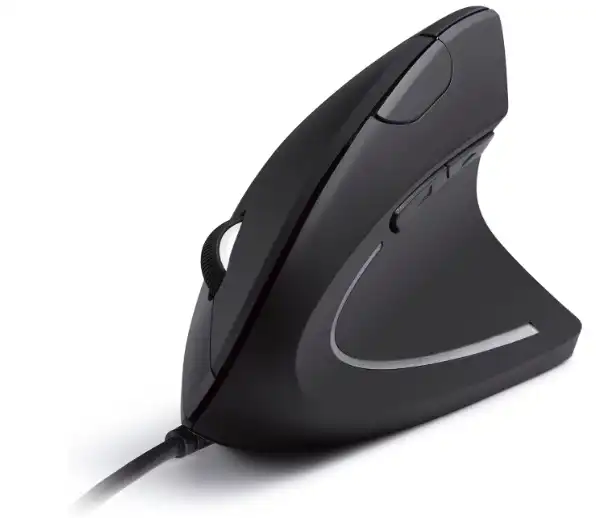
The mouse is tall in shape, and you feel as if you are in the handshake position. It reduces your wrist movements.
Now, you do not have to twist the mouse from side to side. But you will want to push the model using your arm, which is much easier.
It comes with the anticipated 1000/1600 DPI resolution optical tracking technology, which may not be much in terms of productivity. In this sense, they are not the ideal figures for gaming and other top-end purposes.
You can make use of the buttons that are simple to use. It offers you immense comfort when you are working or navigating pages. The product is lightweight and easy to hold for lengthy hours.
The maker has provided you with 18 month warranty and a 4.9 feet cable to use. Moreover, you are given a lifetime technical support guarantee. The mouse is priced at less than $33, making it cheap.
Pros:-
- The mouse is elegantly designed.
- The unit comes with optical tracking technology.
- It has a quick switching of DPI.
- It can fit both small & large hands.
- The product is priced at affordable.
Cons:-
- Unfortunately, it comes with no Bluetooth compatibility.
The Anker Ergonomic Optical USB Wired Vertical Mouse is a second-to-none model, and it comes infused with terrific features that can provide you with several capabilities. But you may not find it ideal for gaming, as it is priced cheaply.

2. Perixx PERIMICE-713 – Best mouse for arthritis in index finger
Next on our list is the Perixx PERIMICE-713 Wireless Ergonomic Vertical Mouse. The model comes with an exceptional design that is ideal for right-handed users.
It is a natural ergonomic vertical mouse that is produced to give you the ability to hold it comfortably for a prolonged period. Additionally, you would be happy to note that it comes with six buttons.
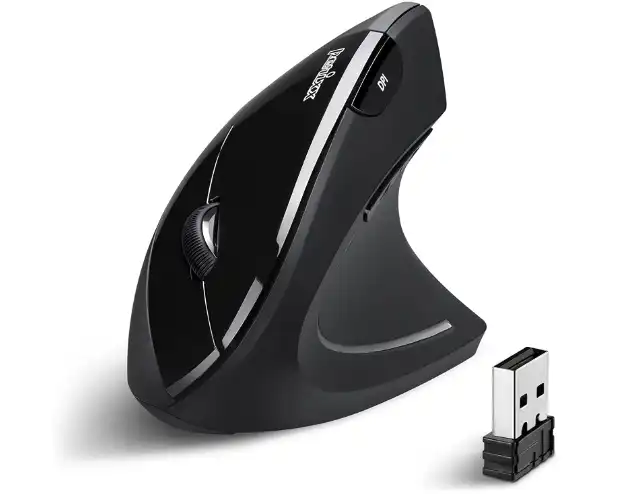
They can help in enhancing your work production or gaming ability. It has 3 DPI levels that allow you for optimum navigation. The optical sensor and the mouse sensitivity can be altered using the DPI control button.
It comes with adjustable 3 DPI levels of 800/1200/1600. This wireless model comes with a 2.4GHz that is operational for up to 10 meters. The mouse has a nano USB receiver with a storage compartment where you can place the USB safely.
Most models do have this feature these days. However, some units do not come with it. Power-saving buttons also help you save power by switching off the power button. You would delight that it has certified FCC, CE, and RoHS qualified.
You can work with it on several operating systems, including Windows 7, 8, and 10. The vertical mouse is priced at less than $30. You can easily purchase this model, and you could be a student or a working professional.
Pros:-
- It is an ergonomic vertical mouse.
- It has 6 buttons for improving your productivity.
- The unit comes with adjustable 3 DPI levels.
- The model is operational for up to 10 meters.
- The mouse is cheaply priced.
Cons:-
- Some users claimed that the clicks were noisy.
The Perixx PERIMICE-713 Wireless Ergonomic Vertical Mouse is a breathtaking model. The mouse is highly recommended for those with grip issues, and it will be helpful when you want to add a peripheral to your PC or laptop setup on your worktable.
3. BOMENYA Vertical Wireless Computer Mouse
The BOMENYA Vertical Wireless Computer Mouse is ranked third on our list of the best mouse for hand pain. It is another vertically designed mouse with an ergonomic grip, and the model has an upgraded matte surface.
Besides, using its curve design and the non-slip stripes present on the side, you know that you can grip it well for any task. You can work with it efficiently, thereby increasing your productivity.
The unit can effortlessly fit inside your palm and decrease the pain in your wrist. It enables you to keep your hands comfortable when using it, which is vital for those with arthritis.
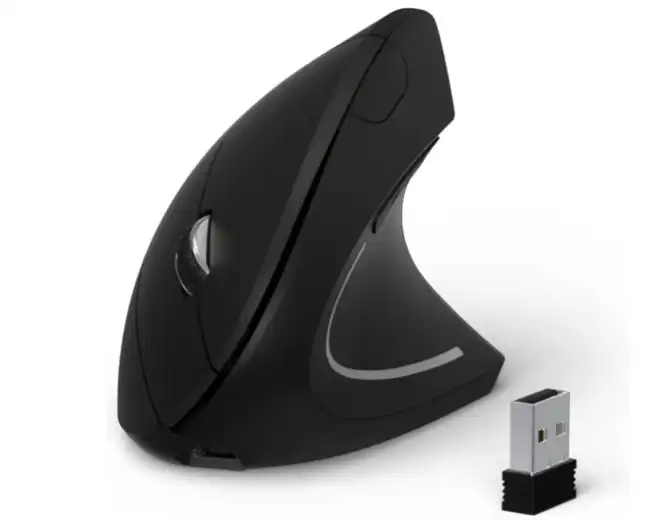
The wireless model works well because of the 2.4Ghz wireless technology. It comes infused with strong anti-interference ability. The unit is a stable cursor that offers you very accurate movement as and when you need it.
It can reach transmission speeds of more than 30 feet. The model is an exceptional mouse ideal for office and home use. You can use the USB C charging cable flawlessly, and rechargeable provision is there, enabling you to use it for a prolonged time.
It is possible due to the intelligent automatic sleep mode and dual power-saving mode. It comes having physical buttons that switch off when not in use for 10 minutes, and all you have to do is click the model again for it to work again.
The unit has three freely adjustable DPI 800, 1200, and 1600 DPI levels. You can adjust the sensitivity of the cursor depending on your tasks. It has a storage feature that lets you store the USB cable there.
When you want to use it, you can plug it in and begin to work with it. The unit provides a wide range of compatible functions and enables you to work on Windows 2000/2003/ XP/Vista & Mac OS 10.
Unfortunately, the mouse’s side buttons do not work on Apple devices. So, if you are an avid Apple product user, you may want to look elsewhere. The mouse is priced at less than $26, making it relatively cheap.
Pros:-
- It is priced low.
- It comes with a beautiful design.
- The grip and posture ability of the mouse is stunning.
- The model comes with 2.4Ghz wireless technology.
- The product has a fantastic, intelligent automatic sleep mode.
Cons:-
- The mouse is a little noisy to operate.
Can we recommend the BOMENYA Vertical Wireless Computer Mouse? Yes, we can. The model comes embedded with smashing features that are too hard to ignore. When you suffer from bone issues, give this model a try; you won’t regret it.
4. Nulaxy Ergonomic Mouse – Best ergonomic mouse for arthritis
Another exceptional model on our list would be the Nulaxy Ergonomic Mouse. Users have highly recommended the mouse because of its ability to remove the stress on your wrist. Moreover, it is easy to use because you must plug in the USB receiver.
You need to make use of 2 AAA batteries and begin your work. As we read earlier, this model comes with a handshake posture, and it is a scientifically ergonomically designed vertical mouse that offers you less pressure.
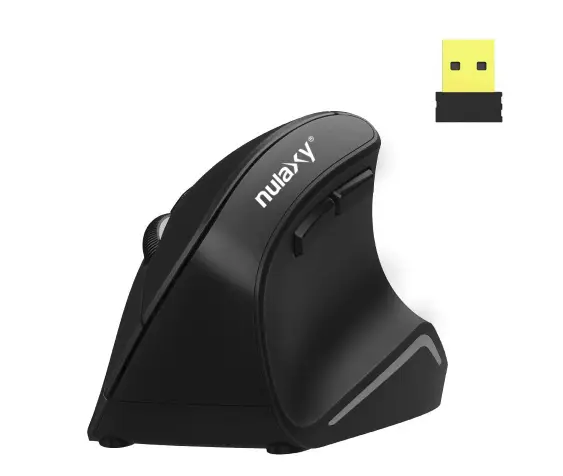
It is ideal for those requiring a model for those long working hours. The model comes with three adjustable DPI resolution optical tracking technology, and it has 800/1200/1600 DPI that offers a sensitivity than the optical mouse with precise tracking.
You will find it easy to use; it comes with no lag. There are multi-function buttons that provide you with a DPI switch. You can change the cursor’s speed and adjust the mouse’s sensitivity.
Moreover, you can find the forward and backward buttons provided. It helps you to move around effortlessly forward/backward, and this helps to increase your work efficiency. The robust scroll wheel has a rubber grip that ensures your hand does not slip off.
The unit is compatible with Windows 2000/XP/Vista and iOS, and you can also use it on your PC and Chromebook. The model is priced at less than $18, making the unit one of the cheapest models on our list of the best ergonomic mouse.
Pros:-
- The unit is cheaply priced.
- The model comes with an opulent design.
- It has a simple working functionality of plug-and-work to do.
- It comes with a DPI switch to adjust the sensitivity of the mouse.
- The product has a scroll wheel fitted with a rubber grip.
Cons:-
- Users felt that the scroll wheel could become loose.
We highly recommend the Nulaxy Ergonomic Mouse, which has several outstanding features in the model. You might want to consider using this unit when you search for a model that can help with your cause.
5. iClever Ergonomic Mouse – Best mouse for arthritis in the middle finger
We found another magnificent model worthy of being on our list of the best mouse for arthritis. It is the iClever Ergonomic Mouse, and the mouse has an ergonomic design that gives you the right hold and comfort.
We felt that the designers had done an outstanding job designing this model. It is quite beautifully crafted and elegantly designed to fit the largest hands. The unit has a unique diamond pattern to ensure that your palms can grip it.
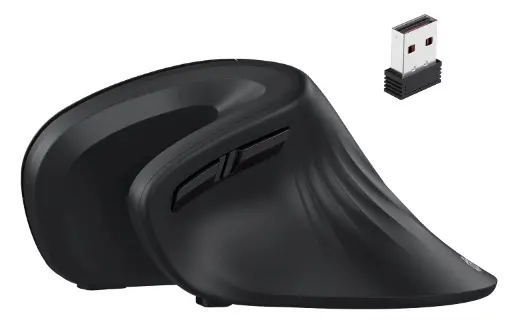
The surface of the mouse is also smooth and pleasant to touch, and you can feel that it is pretty stunning to hold. The movements are second to none giving you extraordinary powers. It can calculate the weight & stability of the surface on which it is being used.
It has five slide pads at the bottom, and your hand movements are tracked precisely. You can now adjust it between 3 DPI resolutions of 800, 1200, and 1600.
There is no need to move your hands on the forward/backward page buttons, which are present just above the thumb rest on the model. You need to move your thumb to click. This feature can work elegantly for navigating through several pages.
When you are somebody who wants to read documents or create content, then you would find this feature useful. The mouse is easy to work with and does not cause much strain on your hands at all.
It is a wireless model. That means you do not have to worry about the wires tangled somewhere. You must insert the USB cable into your PC or laptop and begin your work. It is pretty simple to work with.
The connection is fantastic, thanks to the 2.4 GHz wireless connectivity that works for 33 feet. The model is quiet in working. However, you may have to work on it for some time to get used to its working style.
This will help you understand how to use it noiselessly. It is priced at less than $25, and the model is relatively cheap.
So, if you are searching for a mouse for carpal tunnel syndrome, you know what to do now. It has several features that make it a good choice for your condition.
Pros:-
- The mouse has a diamond pattern designed for it.
- It comes with broad compatibility.
- You can work on it efficiently.
- The scrolling is second to none and comfortable to use.
- There is an auto-power saving capability.
Cons:-
- Users thought the grip was slippery as it comes with no matte.
The iClever Ergonomic Mouse is ideal for large hands. When you have carpal tunnel syndrome or hand gripping issues, then this model can suffice.
However, if you sweat a lot or find it noisy, you may want to look elsewhere for an otherwise dazzling product.
6. Logitech MX Vertical Wireless Mouse
The Logitech MX Vertical Wireless Mouse is priced at less than $100. It is our first below $100 mouse in this list of the best mouse for arthritis. We found the features too hard to resist and have to place them on our list.
Moreover, you cannot have a list of ergonomic models without mentioning Logitech. The maker has been producing mice for many years now. Besides, they excel in making several computer peripherals, including keyboards and headsets.
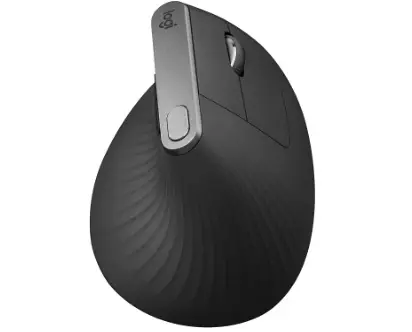
It provides a unique 57-degree angle that offers a handshake posture. this helps you not to twist your forearms or strain your hand muscles. Besides, you can work thanks to the 400 DPI sensor efficiently.
It offers precise tracking, which needs less than four times the hand movement. It comes with only a 1000 DPI resolution compared to the ordinary mouse. So, you know that your clicks are not in vain.
There is also the cross-computer control that enables you to navigate effortlessly on three devices wirelessly. Using Logitech FLOW, you can copy-paste images, files, and text from one PC to another laptop, if you want.
Isn’t it amazing? The unit comes with a rechargeable battery that enables you to remain charged for four months. A 1-minute charge can get you 3 hours of work on it, and the battery’s working life varies depending on your usage.
The unit is priced at less than $98. We agree that this is priced relatively higher than most of the models you read above. But this is a brand-for-value product that comes embedded with terrific specifications in it.
Pros:-
- The mouse has an advanced ergonomic design.
- The unit comes with hyper-efficient tracking.
- It comes with a cross-computer control feature.
- It offers you wireless connectivity to 3 devices.
- The product comes with a rechargeable battery.
Cons:-
- Users having small hands might find it difficult to grip.
The Logitech MX Vertical Wireless Mouse is a fabulous model with terrific features. If you are in search of a mouse that is ergonomic and comes with a barrage of features in it, then it has got to be this model.
7. Carpal Tunnel Mouse Wrist Resting Ergonomics Quadra Clicks
Carpal Tunnel Mouse Wrist Resting Ergonomics Quadra Clicks is our next model on the list. The model is a special-designed mouse that provides you with adequate support for the syndrome.
It is an RBT mouse that reduces the thumb squeeze, which means you are not applying too much pressure on your thumb when using this model.
Though other ergonomic models provide you with the correct posture, t certain amount of clicking activity can cause stress on your wrist.
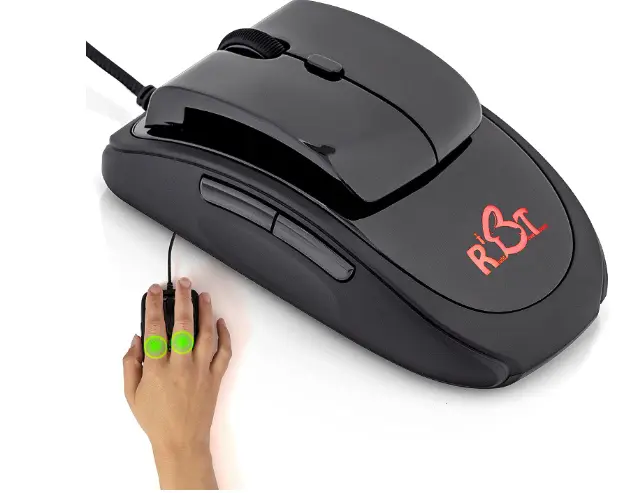
Once you begin to use this model, you realize that there is zero pressure on your wrist and hand. The relaxed wrist provides you with exceptional performance on your wrist and hand. Now, you can play games effectively.
The unit is suitable for those of you suffering from arthritis or tendonitis and if you are wearing wrist braces. It is compatible with several operating systems. Moreover, this model is durable and last at least five years of continuous usage.
It can be used for various software performance activities, including 3D work, CAD tasks, etc. The unit is rubberized for remarkable grip and is easy to m, and the setup is quick too.
The maker has provided you with a 1-year warranty on the model. It is priced at less than $150. The product is expensive but has plenty of ergonomic features and other benefits that enable you to work extensively with peace of mind.
Pros:-
- The mouse comes with an opulent design.
- The buttons are placed nicely.
- It comes with optimum sensitivity.
- It is ideal for graphic designers and gamers.
- The manufacturer provides you with a 1-year warranty.
Cons:-
- The mouse is costly.
We understand that the Carpal Tunnel Mouse Wrist Resting Ergonomics Quadra Clicks is an expensive model. But it comes highly recommended by users worldwide. They have found the mouse useful for constant use in work, as it lets your wrist free of stress for 8 hours.
While exploring the best keyboard and mouse for arthritic hands To Improve Your Joint Function, I found an awesome video on “9 Symptoms You Should Never Ignore If You Have Pain” Great video with valuable information.😎😎

8. LEKVEY Vertical Wireless Mouse
LEKVEY Vertical Wireless Mouse is the following product on our list. You would find the model sleek and opulent to grip, and it comes with a scientific ergonomic design that offers smooth movements that do not strain your arms and hands.
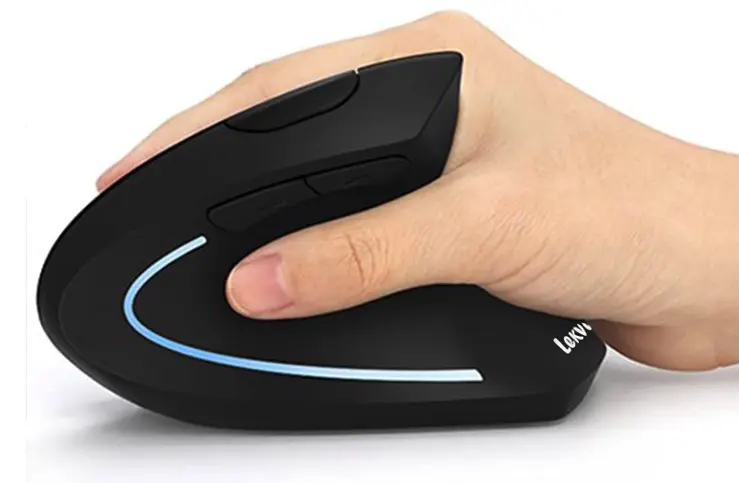
It comes with advanced page-forward and pages back functions that offer you convenient movement. You can use the typical 800/1200/1600 DPI levels. You can adjust the sensitivity of the mouse accordingly.
We delight to inform you that it comes with a sublime rechargeable battery. You do not have to purchase batteries separately, and it comes compatible with a wide range of operating systems, PCs, and laptops.
The maker offers you an unconditional 24-month product warranty. Besides, they also provide you with lifetime, easy-to-reach technical support. It is priced at less than $35, which makes it cheap and affordable.
Pros:-
- The model has a sleek and opulent design.
- The unit comes with a scientific ergonomic shape.
- It has advanced page-forward and pages back functions.
- It comes with typical 800/1200/1600 DPI levels.
- The product has an unconditional 24-month product warranty.
Cons:-
- When you have small hands, then it may affect your work.
The LEKVEY Vertical Wireless Mouse is a fantastic option when working on photoshop or illustrator. If then, you should make it a point to own a healthy ergonomic tool that does not cause strain on your wrists & hands.
9. DELUX Seeker Wireless Ergonomic Vertical Mouse
The final product of our list is the DELUX Seeker Wireless Ergonomic Vertical Mouse. It is the first vertical model to come fitted with an OLED screen that can offer you the data at a glance.
Now, you can check the battery capacity, DPI level, and connection mode. You can design experiences using the model, and it is designed with an ergo snail bionic structure. A notable specification of the unit is the 7200 DPI tracking sensor.
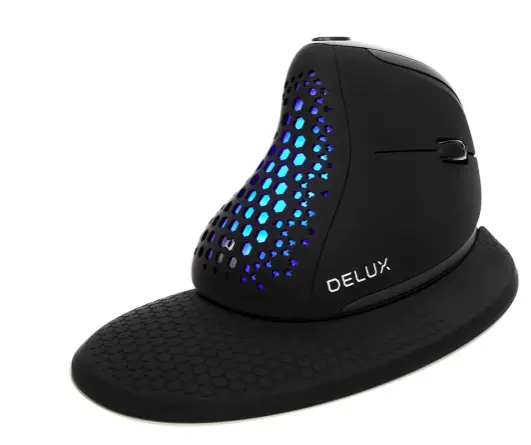
You can connect it to 4 devices using the USB-C wired, 2.4G wireless, and BT 5.0. The ergonomic unit has a new standard direction wheel that enables vertical and horizontal scrolling.
There are four sections for setting. You have the light section setting for the effects of the light and the button setting programming for the operation you want to do. It has a macro section creating the automation and a section adjusting DPI, polling rate, and scroll speed.
You can create your customization and improve your productivity. It is priced at less than $80. It is somewhat expensive for normal users.
But when you suffer from a wrist problem or arthritis, you may consider this model because of its opulent features.
Pros:-
- It is lightweight and portable.
- It has an OLED screen.
- The unit comes with a 7200 DPI tracking sensor.
- The model has a new direction regular wheel.
- The product comes having four sections for setting.
Cons:-
- It is somewhat pricey.
The DELUX Seeker Wireless Ergonomic Vertical Mouse is a good option. However, it may not be meant for everybody. It is pricey but has spectacular features like lightweight, an OLED screen, and a 7200 DPI tracking sensor.
📗FAQs
Which mouse is best for hand pain?
Logitech MX Vertical, Kensington Pro Fit Ergo, Microsoft Bluetooth Ergonomic, Microsoft Sculpt Comfort Mouse, etc., are a few mouse options for hand pain.
What is the best mouse to use for tendonitis?
If you have tendonitis, there are mouse options that can be helpful. The list includes R-Go Tools Break, J-Tech Digital V628 Ergonomic Mouse, Logitech MX Master 3, Evoluent Vertical Mouse Regular Size, Anker 2.4g Mouse, etc.
What type of mouse is best for your wrist?
The Trackball ergonomic mouse is the best if you are looking for a mouse, particularly for your wrist. It takes up less space on the desk and requires minimal wrist or arm movement. You can scroll the mouse for hours without stressing your wrist.
What type of mouse is best for ergonomics?
Logitech MX Master 3S is among the best ergonomic mouse. It has a right-handed ergonomic design. It is incredibly well built with a soft texture and solid plastic body.
Why is a vertical mouse better?
If you want to work faster, a vertical mouse can be beneficial. It requires less movement than a flat mouse and lets one scroll more comfortably. Therefore, you can work for a long at the computer without getting tired.
What is the best vertical mouse for arthritis?
The best vertical mouse for those with arthritis would be the Anker Ergonomic Optical USB Wired vertical mouse. The unit has been produced to help those with issues holding the mouse.
Besides, you can quickly secure the mouse in your hand without straining your muscles. The posture offered by it is also painless. You can move around the monitor effortlessly without hurting or causing pain in your hands.
What is the most comfortable mouse for arthritis?
The most comfortable mouse to use when you have arthritis would be the Carpal Tunnel Mouse Wrist Resting Ergonomics Quadra Clicks. It is a specialized mouse that is designed mainly for those of you having difficulties holding a mouse.
An additional grip on the mouse makes it easy for more prolonged use, too. Users have highly recommended this mouse, and doctors to feel it can help your cause. It is ideal for those of you who perform click-intensive work and play.
Can the use of traditional mouse cause arthritis?
As you age, you can find that your hands and wrists are getting older, which means you require a unique model to work efficiently. When you use a regular mouse for more than 10-15 years, then as you reach your 40s or 50s, you can notice some pain in your wrists.
This is when you might want to consider using a specially designed mouse for your work or gaming purposes. When you perform repetitive click work, it takes its toll on your fingers and the wrist region.
Are trackball mice better for arthritic hands?
There has to be more research done on this claim. But based on users’ feedback and reviews, we can say that the trackball models are somewhat better than the regular models. They can help you with a reduction in pain occurring in your hands and wrists.
We have some noteworthy models like the Carpal Tunnel Mouse Wrist Resting Ergonomics Quadra Clicks that are most suitable for use when you have carpal tunnel syndrome. But it is not a trackball model that needs you only to roll the ball.
What should be the ideal price point for a mouse for arthritis?
The ideal price point for a mouse for arthritis could be between $40 to $150, and we see no need to go about the $150 price range.
You can find models priced under $100 that can perform the task efficiently and smoothly. Of course, you may consider carefully reviewing all the products we have reviewed before making your decision.
Conclusion
This is it. We have ended our review on the best mouse for arthritis. We hope you found the post useful for your cause. If you haven’t decided, we suggest you reread the post.
Perhaps, you might have missed something. Working with an ergonomic mouse regularly can positively impact your overall health. Additionally, you are taking steps in the right direction in having your body in good condition.
We highly recommend using the Anker Ergonomic Optical USB Wired Vertical Mouse, the Carpal Tunnel Mouse Wrist Resting Ergonomics Quadra Clicks, and the Logitech MX Master 2S Wireless Mouse.
These models come with all the features you want to use when operating the mouse. Whether a professional gamer, content creator or graphic designer, you would be happy and satisfied using these models regularly.
Please get medical advice if you still have persistent pain in your arms, hands, and shoulders. Perhaps, it may be serious. Have you worked on any of the above models? Please tell us about your experience; we would love to hear all about it.