
























Today everything is virtually available, only a finger tap away! The ever-increasing need for picture-perfect makeup and flawless skin has slowly but steadily spurred the emergence of different skin care apps.
These amazingly smart apps have transformed your smartphone into a beauty expert you can turn to anytime and anywhere.
It becomes much easier and quicker but takes care of your skin without much effort, and only in a few taps with these apps.
Whether you want to slightly amp up your skincare routine, look your ultimate best all the time, or want to give that “oomph” factor to your beauty regime,
Here are some of the top skin care apps for Android and iOS that get you covered for everything you need to take complete care of your skin.
Best Skin Care Apps To Upgrade Your Skin Care Game
1. Skincare Routine
Creating your personalized skincare routine becomes much easier with this wonderful skincare application.
With the app, you can effortlessly create a routine to suit you best, check out the best ways to use different beauty and makeup products, and do much more. All you have to do is to add your favorite products to the routine.
And the app will automatically place them for morning and evening routines as recommended.
In the app, you can add custom skin care products from different brands and get the best suggestions for using them.
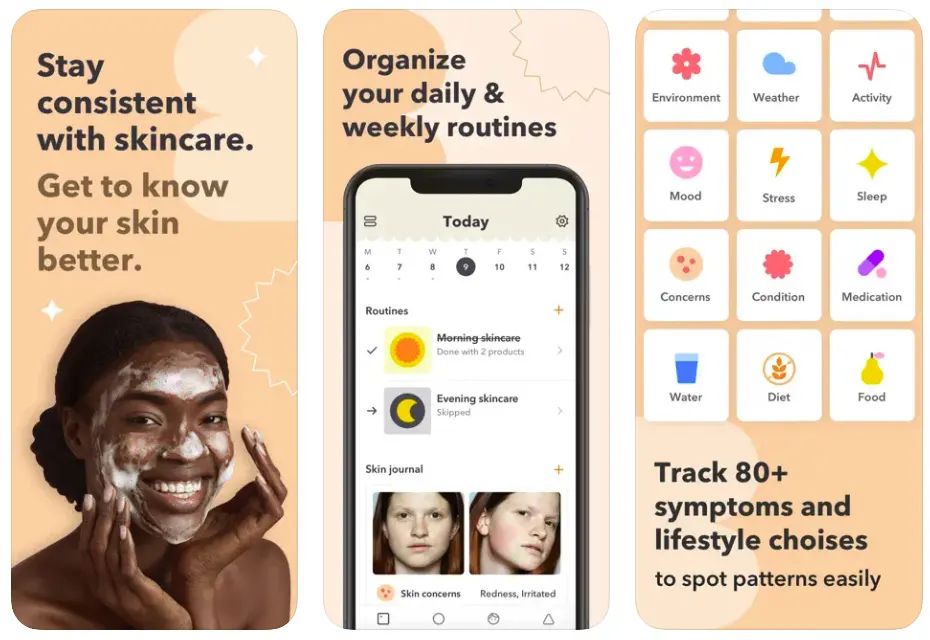
The products are perfectly listed in the app to help you use them in the right order, following the best advice on how and when to use them.
If you have been finding it difficult to keep track of the usage of products, you can effortlessly do that with the app. You can easily prevent conflict by knowing you have already used them.
The app also informs you of your skin’s progress, noticeable changes, and other important aspects. What else? You can even add photos of your changing skin to the diary tracker.
Features of Skincare Routine:-
- Enables you to create a healthy skincare routine
- Easy to add custom beauty products
- Avoid conflicts by keeping track of usage
- Diary tracker to effectively track your skin’s progress
- Powerful reminders and timers
Devices – Android and iOS Devices, Including iPhone and iPad
Ratings on Apple Store – 5.0 / 5 | Ratings on Google Play Store – 4.5/5
2. Skin Bliss: Cosmetics & Beauty
Skin Bliss is right up there with some top skin care apps available! You can rely on this app if you have tried different skin care products and cosmetics without much effect.
It is a game-changing beauty application that uses artificial intelligence to learn about your skin’s requirements and limitations.
It supports you with the most suitable skin care products. The app can be the perfect way to determine which skincare and cosmetic products you should use for your skin.
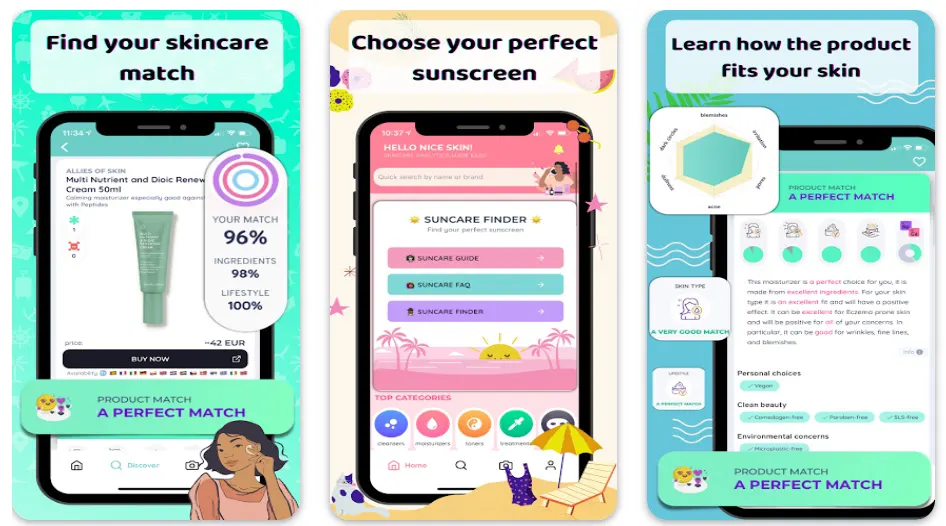
For the first time, it is more than just possible to discover beauty products and cosmetics based on the nature of your skin.
Whether you have been annoyed with oily skin, dryness, or wrinkles, or it is something different like eczema or rosacea, which has been haunting you for a long time, you can find the ultimate solution for each of them.
The innovative system of the app smartly identifies key ingredients and matches them according to the nature and condition of your skin.
Then, the app suggests the best possible skin care products exclusively for you!
And the best part is that you don’t have to spend much time finding the best products for your skin. Download the app, and keep your skincare expert in your pocket!
Features of Skin Bliss:-
- Get access to all your favorite skincare brands
- Check out the ingredients of products simply by scanning them
- Learn in detail about skincare ingredients, routines, and more
- Professional skin care tips hey exclusively for you
- Additional tips for pregnant and breastfeeding moms
Device – Android and iOS
Ratings on Apple Store – 4.9 / 5 | Ratings on Google Play Store – 4.4 / 5
3. FeelinMySkin
FeelinMySkin is one of the most loved skin care apps offering a wide range of features in a very simple and sophisticated user interface. It is a very special skincare app your skin deserves.
From creating healthy skin care routines to staying consistent, checking out ingredients and expirations, tracking product usage and skin changes, accessing ingredients purposes, and professional skin care tips, you have everything you require to take care of your skin properly.
With the app, you can plan your morning and evening routine effortlessly. Journal your skin changes, and stay on top of your beauty regime without any problem whatsoever.
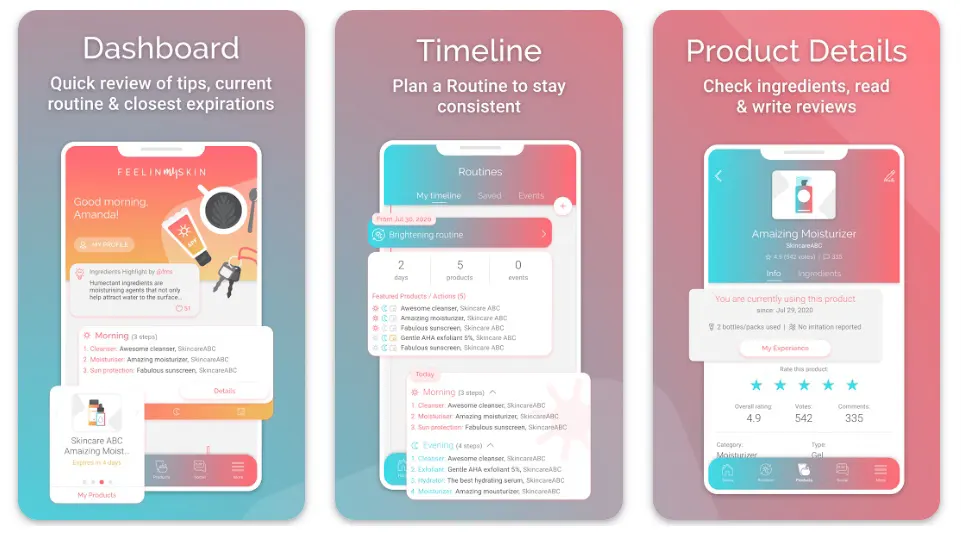
The app allows you to upload photos of your skin changes over time for effective tracking. What else? The app also informs you about different relations between your skin and other daily life factors.
To avoid product misuse, you can rely on the app to get an accurate calculation and product usage repetitions for each day. You can even track opened and finished and expiration dates for each product.
What else? The expert provides many professional skincare tips; you can check them out whenever you want!
If you get confused about different products, you can organize them according to different categories for various purposes and even timing.
Features of FeelinMySkin:-
- Easy to plan your morning and evening routine
- Start journaling your skin changes
- Track product repetitions to avoid misuse
- Organize your skin care products according to different categories
- Discover exclusive skin care tips
Device – Android and iOS
Ratings on Apple Store – 4.9 / 5 | Ratings on Google Play Store – 4.3 / 5
4. Think Dirty – Shop Clean
Ingredients of your skin care products play an important role in maintaining your skin health. If you are not good enough at using products with safe ingredients, you may have to deal with different types of adverse effects.
And, if you are looking for an app specifically to track the ingredients used in your skincare and makeup products, you can check out the “Think Dirty” app!
The app makes it surprisingly easy to track potentially problematic or dirty ingredients simply by scanning the barcode.
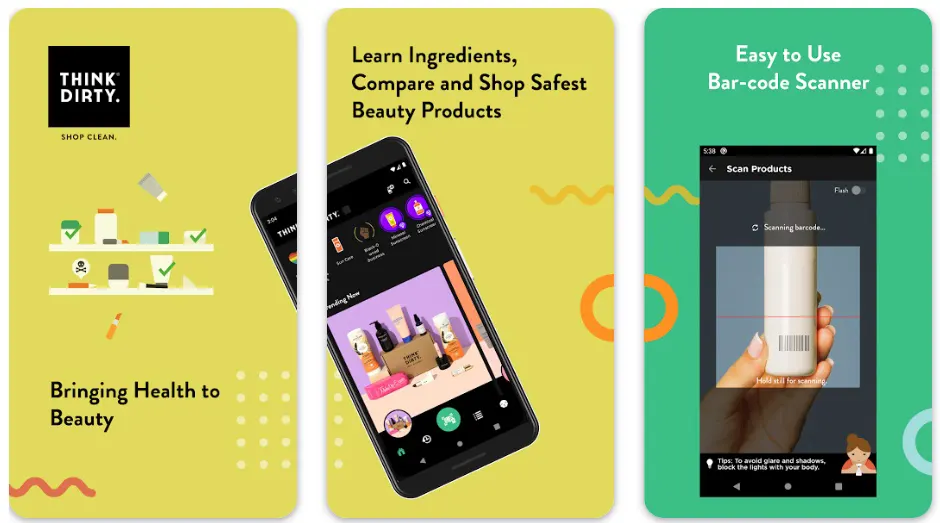
It carefully checks and verifies the ingredient labels and helps you with a rating from 0 to 10 using a powerful “Dirty Meter.”
The app can be the easiest and most reliable way to learn about the potentially harmful ingredients in your personal care and beauty products.
The best part about the app is that it is an independent source, and there is no chance of conflict with any skincare brand.
The app’s database includes over 350,000 personal care and cosmetic products, mostly from The United States and Canada.
So, if you are unsure about the safety of ingredients used in a particular product, you can check it out with Think Dirty!
Features of Think Dirty:-
- A comprehensive rating system with Dirty Meter
- Barcode scanning for more than 350,000 products
- Innovative shopping list to make your shopping easier and faster
- Allows you to search products by ingredients
- Easy to visualize your skincare progress
Devices – Android and iOS Devices, Including iPhone and iPad
Ratings on Apple Store – 4.7 / 5 | Ratings on Google Play Store – 4.3/5
5. The Derma Co
The Derma Co. is one of the most methodical skin care apps backed by science.
The app offers a complete range of skincare products formulated with completely safe, highly effective, and potent active ingredients.
With these products, you can finally fight against different skin conditions like acne, acne marks, scars, open pores, pigmentation, and dull skin.
With these expertly prepared products, you can now live a filter-free life!
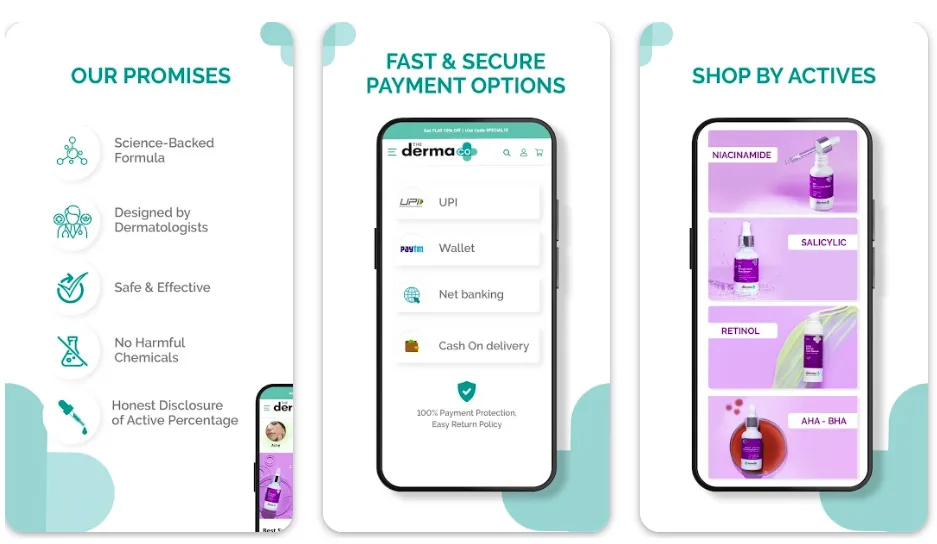
The app ensures complete transparency and authenticity by accurately mentioning the exact percentage of active ingredients in all products.
You can effortlessly shop for products like moisturizers, serums, cleansers, masks, toners, sunscreens, and more.
Having these products in your beauty and skincare kit, you can finally give your skin the care and love it deserves.
The Derma Co. application also gives you a pleasing and hassle-free shopping experience. You can explore various affordable deals on over 50 skincare products.
Ordering on the app is as simple as it gets; you can even track your orders effortlessly, return the orders you don’t want, and even track your refund.
Features of The Derma Co:-
- User-friendly interface offering more than 50 products
- Products are designed only by dermatologists
- Prepared without using harmful chemicals
- Transparency in disclosure of the active percentage
- Exclusive offers on various skin care products
Device – Android and iOS
Ratings on Apple Store – 4.6 / 5 | Ratings on Google Play Store – 4.3 / 5
6. The Moms Co. – Skin Care Shop
Are you searching for natural, dermatologically tested, effective, and toxin-free products to care for your and your baby’s skin? You can surely have a look at The Moms Co!
It is one of the unique skin care apps offering a complete range of products for moms and babies. Products like skin care, face care, baby care, hair care, and home care are easily available at highly competitive prices on the app.
Millions of mothers across the world have already loved the app, and it’s time for you to have a try!
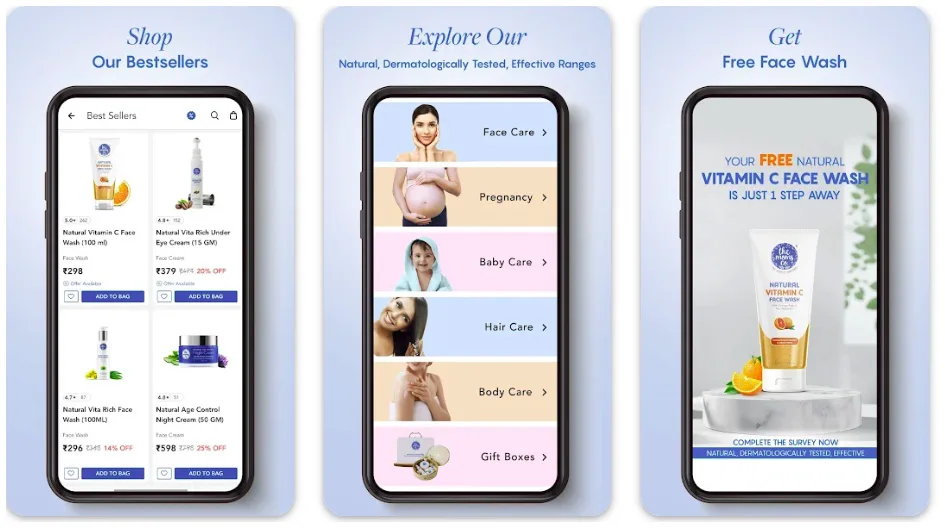
Products offered by the app are only prepared with natural and toxin-free ingredients and meet the highest standard of recommended safety levels globally.
All the products are dermatologically tested and completely safe for mothers and babies.
In addition to a wide range of skincare products, the app is also known for offering hassle-free shopping with exclusive discounts.
You can check out your favorite products whenever and wherever you want and order them at the best prices.
Features of The Moms Co:-
- Bestseller skin care products in one place
- Effective, natural, dermatologically tested ranges
- Exclusive rewards and gifts on every order
- The hassle-free online shopping experience
- Convenient tracking of orders
Device – Android
Ratings on Google Play Store – 4.6 / 5 | 500,000+ Downloads
7. forYou: Face Massage, Skin Care
If you are trying to build a healthy skincare routine for dreaming of healthy-, young- and good-looking skin, or cannot afford frequent visits to cosmetologists or even don’t have enough time to spend on your skin, forYou is the app you should have a look at!
The app ensures you follow a regular and effective skincare routine to ensure your skin is always at its best.
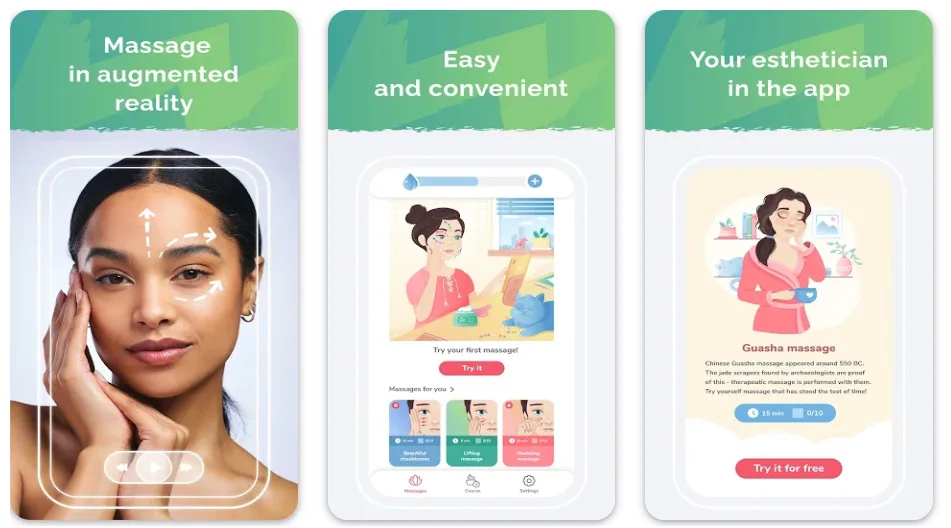
With the app, you can finally master the complete range of facial massage exercises and stimulate even the deepest layers of your skin.
Just like facial yoga, face building can be highly effective at improving the overall texture of your skin!
And the app makes everything super easy for you and requires you to spend only up to 20 minutes per day for three weeks, and you will notice the difference!
The app can help you to save a lot of money on plastic surgeries, expensive cosmetic procedures, and even electric massagers.
You even don’t have to think about those painful facial injections anymore! Simply follow the facial exercise routine suggested by the app and completely transform your facial skin.
Features of forYou:-
- Facial massage powered by augmented reality
- Easy, convenient, and effective exercises
- Powerful water tracker for skin radiance
- Personal, customizable massage schedule
- Useful skin care content by dermatologists
Device – Android
Ratings on Google Play Store – 4.4 / 5 | 500,000+ Downloads
8. Charm: Skincare Routine 360°
If you find it difficult to follow a healthy skincare routine, here is one of the most effective skin care apps!
With the app, you can track your skincare routine with artificial intelligence and check out the complete range of skincare articles, DIY home treatments, and more!
The app can be immensely helpful for you to create a healthy skincare regime.
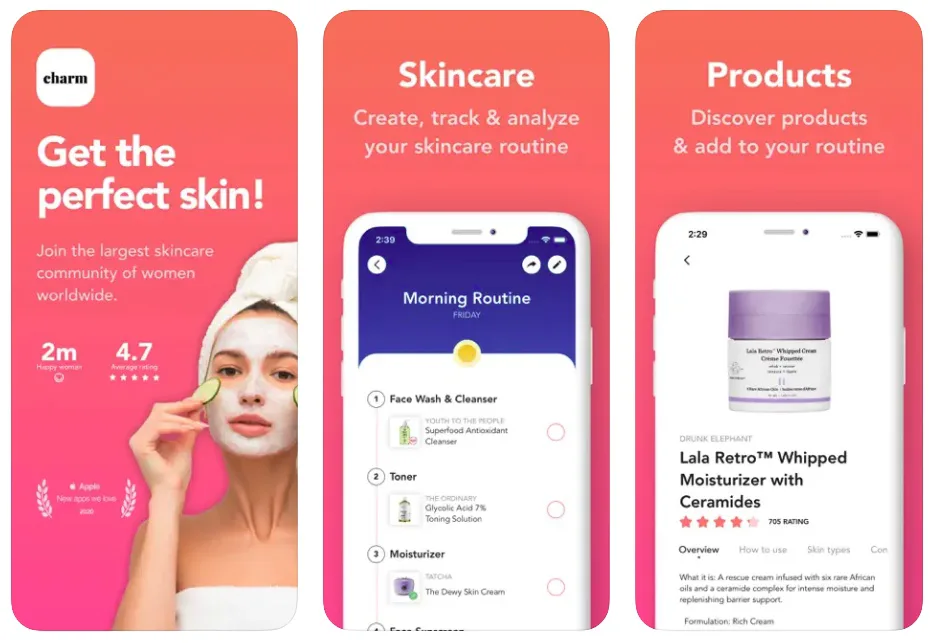
By downloading the app, you can be a part of the largest skincare and beauty community of females worldwide.
You can now get the best routines and personalized care and stay on top of your skin health without much effort!
As many as more than two million women are using the app for their daily skincare regime. You can get a complete range of products and an accurate routine according to your skin type and concerns.
More than 100 step-by-step guides are used and proven by well-known celebrities and are exclusively created by beauty professionals.
Additionally, it has 50 plus beauty tips for your face, body, hair, lips, nails, and feet.
Additionally, the app features 20 exclusive reminders to ensure you are always on top of your skincare routine.
Features of Charm:-
- It makes it easy to create, analyze, and track your skincare
- Complete range of safe skin care products
- Effectively logs and measures your progress
- Easy-to-follow DIY treatments
- Skin diary to understand your skin
Devices – iOS Devices, Including iPhone and iPad
Ratings on Apple Store – 4.4 / 5
9. CureSkin: Skin & Hair Care App
CureSkin is also one of the most trusted skin care apps you can try to improve your skincare regime and, ultimately, your overall skin.
If you are worried about common skin problems like dark spots, dull skin, pimples, excessive facial growth, wrinkles, pigmentation, scars, rashes, blemishes, dark circles, etc., you can get some much-needed help from the app.
You no longer need to experiment with your skin as the app supports you with a scientific, trusted approach backed and recommended by as many as 5 million users!
Getting rid of your skin problems with the app is as simple as possible. You must download the app, select the problem from a long list, and give detailed insight.
And the app will help you with the best suggestions. Based on your report, you can also get a personalized treatment kit prepared by one of the expert dermatologists.
And lastly, you can easily order your personalized kit to get it delivered right to your doorstep!

Features of CureSkin:-
- Effective help from certified dermatologists
- Intelligent skin analysis with a detailed report
- Monthly follow-up reports of your skin progress
- Step-by-step guide by professionals
- Personalized skin care kit delivered to your doorstep
Device – Android and iOS
Ratings on Google Play Store – 4.3 / 5 | Ratings on Apple Store – 3.9 / 5
10. Luvly: Face Yoga Program
Facial exercises are also very effective at taking care of your skin, in addition to a wide range of skincare products.
And, Luvly is your one-stop destination for finding science-based, proven, and effective exercises to deal with different skin problems.
All you have to do is spend only 15 minutes a day to finally eliminate the problems you have been dealing with for a long time.
The app is more than just suitable for people of all ages with all types of skins, and it can make you look more confident, younger, relaxed, and happy!
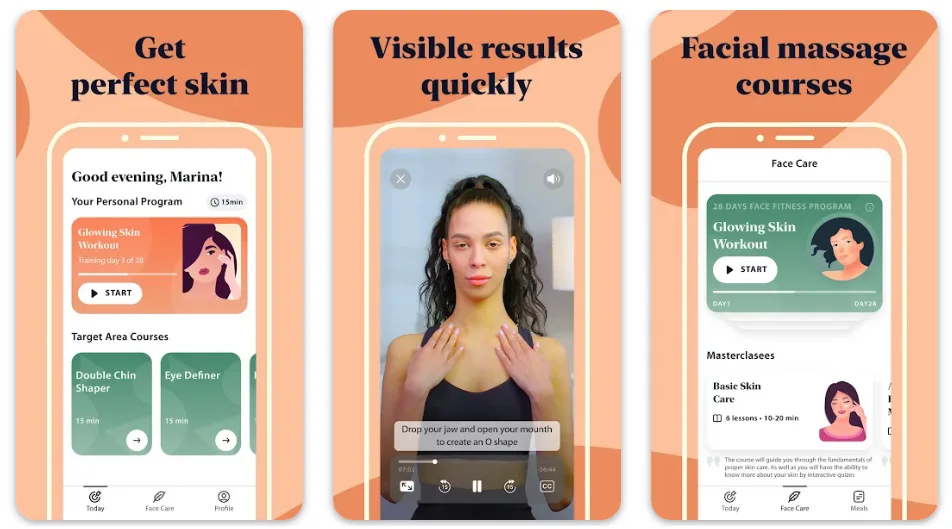
With experts’ insights at every step of your beauty regime, you can finally achieve all your skin care goals quickly and safely.
You can get personalized facial exercise programs tailored to your skin type and problem areas.
The app has many video courses for relaxing, lifting, de-puffing, and anti-aging. As far as the effectiveness of these exercises is concerned, they are prepared only by certified dermatologists.
You can also explore a massive collection of meal plans developed by nutritionists. In short, Luvly offers everything you need to transform your skin once again!
Features of Luvly:-
- Personalized face exercise programs
- Informative video courses for various skin conditions
- Meal plans developed by nutritionists
- Effective facial massage techniques
- Easy to track your skincare progress
Device – Android and iOS
Ratings on Apple Store – 4.2 / 5 | Ratings on Google Play Store – 4.1 / 5
11. TroveSkin: Skincare Coach
I’ll close out my review with the last app on my list – TroveSkin. If you have tried different methods to get healthier and clearer skin without much success, it’s high time you should try this app!
Don’t know if a particular skin product is suitable for your skin? Do you wonder how factors like sleep, diet, stress, etc., trigger skin problems? TroveSkin will answer all your questions with some logic.
That’s not all! The app also supports your skincare regime with personalized recommendations.
With the app, you can finally access some of the best product suggestions based on your skin type and condition. You can also access various skincare recommendations depending on your dietary preferences, routine, and skin conditions.
The app also makes it easy for you to track the usage of beauty and skin care products. What else? You can even check out the product expiry dates and receive timely skin care reminders through the app!
There are various power tools and a progress tracker to track all your progress and compare the changes.

Features of TroveSkin:-
- Suitable skin care product recommendations
- Easy to track product expiry dates
- Receive timely reminders to stay on top of your beauty regime
- Selfie comparisons to effectively track your progress
- Different methods to identify your skin triggers
Device – Android and iOS
Ratings on Apple Store – 4.2 / 5 | Ratings on Google Play Store – 3.9 / 5
App For Skincare Ingredients
Several apps are available for skincare ingredients that can help you make informed decisions about the products you use on your skin.
Here are some popular options:
Think Dirty – This app allows you to scan the barcode or search for a product and get a rating based on the potential harm of its ingredients.
CosmEthics – CosmEthics allows you to scan a product and see a rating of its ingredients based on their safety, health impact, and environmental impact.
SkinSAFE – SkinSAFE allows you to scan or search for products and get a rating based on the potential allergens or irritants in the ingredients.
EWG Healthy Living – This app allows you to search for products and see a rating of their ingredients based on their potential hazards.
Incidecoder – Incidecoder provides detailed information about skincare ingredients and helps you understand their benefits and potential drawbacks.
Skincare routine apps
Several skincare routine apps are available on both iOS and Android platforms.
Here are some popular ones:-
Think Dirty – This app helps you to identify the toxic ingredients in your skincare products and suggests safer alternatives.
SkinVision – This app uses AI to analyze your moles and spots to detect skin cancer early.
Skinbetter – This app provides customized skincare routines based on your skin type, concerns, and preferences.
YouCam Makeup – This app allows you to try on makeup and skincare products virtually before purchasing them.
HiMirror – This app pairs with a smart mirror that analyzes your skin’s condition and suggests personalized skincare routines.
La Roche-Posay My Skin Track UV – This app pairs with a wearable device that tracks sun exposure and provides personalized sun safety recommendations.
✅FAQ For Best Skin Care Apps
Is there an app for skincare routines?
Yes, there are several apps available for skin care routines. These apps can help you create a customized routine, set reminders for when to apply different products and track your progress. Some popular options include: “Curology”, “Skincare Routine”, and “Skincare by Hyram”.
Is there an app that tells you what your skin needs?
Yes, apps that analyze your skin and recommend products based on your needs are available. These apps use algorithms and/or AI technology to provide personalized recommendations. Some popular options include: “Y’OUR”, “Skinsei”, and “Dermalogica Face Mapping”.
Which app is best for glowing skin?
Several apps claim to help improve the appearance of your skin for a glowing complexion. However, the effectiveness of these apps may vary depending on the individual. Some popular options include: “Face Yoga”, “Glow Recipe”, and “Olay Skin Advisor”.
How do you keep track of your skincare routine?
Keeping track of your skincare routine can be done through various methods. Some people prefer a physical journal or planner, while others use apps specifically designed for tracking routines.
Another option is to set reminders on your phone or calendar to ensure you don’t miss any steps.
here’s a table that outlines how you can keep track of your skincare routine:-
| Method | Description |
|---|---|
| Pen and Paper | This is a simple and traditional method of keeping track of your skincare routine. You can create a table or list on paper or in a notebook to note your routine. This method is great for those who prefer writing things down and enjoy a physical copy of their routine. |
| Digital Apps | There are several digital apps available that can help you keep track of your skincare routine. These apps allow you to input the products you use, set reminders for when to use them, and track your progress. Examples of such apps are “My Skin,” “Skin Diary,” and “Think Dirty.” |
| Spreadsheet | You can also create a spreadsheet on a program like Microsoft Excel or Google Sheets to keep track of your skincare routine. This method is useful for those who prefer a more organized and detailed approach. You can include columns for the product name, the time of day you use it, and any notes or comments you have about the product. |
| Skincare Journal | A skincare journal is a more elaborate version of pen and paper. You can use a blank notebook or a bullet journal to create a dedicated space for your skincare routine. You can note down the products you use, their effects on your skin, and any changes you notice. This method is great for those who enjoy journaling and want to make their skincare routine a mindful and reflective practice. |
| Skincare Tracker Template | Several templates are available online that you can download and print to keep track of your skincare routine. These templates are pre-designed with sections for product name, use frequency, and notes. You can find free templates on websites like Pinterest and Etsy or create your own using a word processor. |
What is the app everyone is using on their face?
Several apps are popular for editing and enhancing photos of the face. One such app is “Facetune”. However, it is important to remember that using apps to alter your appearance can be misleading and set unrealistic expectations.
Is there an app to analyze skin conditions?
Yes, there are several apps available to analyze skin conditions. These apps use AI technology to analyze your skin and recommend products and routines. Some popular options include: “SkinVision”, “Aysa”, and “First Derm”.
Is there a free app to identify skin problems?
Yes, there are several free apps available to help identify skin problems. These apps can analyze images of your skin and provide information on potential issues. Some popular options include: “Miiskin”, “SkinVision”, and “First Derm”.
Is there an app that tracks face changes?
Yes, there are several apps available that can track face changes. These apps use AI technology to track changes in skin appearance, including wrinkles and fine lines. Some popular options include: “Everaging”, “FaceApp”, and “YouCam Makeup”.
What app makes you look flawless?
There are several apps available that claim to make you look flawless in photos. One such app is “AirBrush”. However, it is important to remember that editing your appearance can set unrealistic expectations and may be misleading.
What app makes your skin look flawless?
There are several apps available that claim to make your skin look flawless in photos. One such app is “Perfect365”. However, it is important to remember that editing your appearance can set unrealistic expectations and may be misleading.
What apps make your face look better?
There are several apps available that can enhance the appearance of your face in photos. Some popular options include: “YouCam Makeup”, “Facetune”, and “BeautyPlus”.
What are the 7 step skin care regimen?
The 7-step skin care regimen is a routine that includes the following steps: 1) oil cleanser, 2) water-based cleanser, 3) exfoliator, 4) toner, 5) essence, 6) serum, and 7) moisturizer. This routine is designed to help keep the skin clean, hydrated, and nourished.
How do I organize all of my beauty products?
Organizing beauty products can be done through a variety of methods. One effective method is to categorize your products by type (e.g. cleansers, moisturizers, serums, etc.) and store them in separate drawers or compartments.
You can also label each container or drawer to make it easy to find what you need. Another option is to use clear, stackable containers or shelves to keep everything visible and easily accessible.
What are the 4 daily skin care steps?
The 4 daily skin care steps are: 1) cleansing, 2) toning, 3) treating, and 4) moisturizing. This routine is designed to help remove dirt and impurities, balance the skin’s pH, address specific concerns (such as acne or wrinkles), and provide hydration.
What is the beauty filter that everyone is using?
Several beauty filters are available, but one that has gained popularity is the “Glam” filter on Snapchat. This filter enhances the appearance of the skin, eyes, and lips for a more glamorous look.
What is the app that makes your face look younger?
There are several apps available that claim to make your face look younger in photos. One popular option is “FaceApp”, which uses AI technology to apply filters that simulate a more youthful appearance.
What is the best filter app to make you look younger?
The best filter app to make you look younger is subjective and depends on individual preferences. Some popular options include “FaceApp”, “YouCam Makeup”, and “Facetune”.
Is there a dermatology app?
Yes, there are several dermatology apps available that provide virtual consultations with licensed dermatologists.
These apps can help diagnose and treat various skin conditions from the comfort of your home. Some popular options include: “DermatologistOnCall”, “First Derm”, and “Spruce”.
How can I check my skin condition?
You can check your skin condition by performing a self-examination. Look for color, texture, or appearance changes of moles or lesions.
You can also use apps that analyze images of your skin and provide information on potential issues. It’s important to note that a dermatologist can provide a more thorough examination and diagnosis.
How accurate is skin screener app?
The accuracy of skin screener apps can vary depending on the technology and algorithms used. While these apps can provide some insight into potential skin issues, it is important to remember that they should not replace a consultation with a licensed dermatologist.
Is Faceover free?
Faceover is not a free app. It is available for purchase on the App Store for $4.99.
What is the celebrity face changing app?
One popular celebrity face changing app is “Zao”. This app uses AI technology to superimpose your face onto the body of a celebrity in a video or image.
What app shows you what you really look like?
Several apps are available that show you what you look like. However, it is important to remember that using these apps can be misleading and may not accurately reflect your appearance.
What is the new filter everyone is using?
The new filter everyone is using may vary depending on current trends and popularity. However, filters that enhance the appearance of the skin and provide a more glamorous look tend to be popular.
What app gets wrinkles out?
There are several apps available that claim to reduce the appearance of wrinkles in photos. One such app is “Facetune”, which includes tools for smoothing out wrinkles and fine lines.
What is the best face and body editing app?
The best face and body editing app is subjective and depends on individual preferences. Some popular options include “AirBrush”, “YouCam Perfect”, and “Facetune”.
Which app is best beauty app?
Some popular options include “YouCam Makeup”, “Perfect365”, and “Facetune”. These apps can help enhance the appearance of the skin, eyes, and lips in photos.
Is there an app that makes you look better in photos?
Yes, there are several apps available that can help enhance your appearance in photos. These apps can smooth out skin, whiten teeth, and enhance eye color, among other things. Some popular options include “AirBrush”, “YouCam Perfect”, and “Facetune”.
Is there an app to track beauty products?
Yes, there are several apps available that can help you track your beauty products. Some popular options include MyBeautyCache, Cosmetify, and Beauty Keeper.
These apps allow you to input your products, categorize them by type or brand, and track when you purchased them and when they expired.
Some apps offer additional features, such as ingredient analysis and product recommendations based on skin type.
How do you keep track of skin care products?
One way to keep track of your skincare products is to create a spreadsheet or list with all the products you use, along with their expiration dates and purchase dates. Alternatively, you can use a dedicated app for tracking beauty products, such as MyBeautyCache or Beauty Keeper.
Is there an app that tells you what skin care you need?
Several apps can help you determine what skin care products you need based on your skin type, concerns, and preferences. Some popular options include Skincare Routine, GoodSkin Labs, and MySkin.
These apps may ask you questions about your skin and then provide personalized product recommendations.
What is the app that tracks acne progress?
Several apps can help you track your acne progress, such as Acne Tracker, Pimple Tracker, and Skin Diary. These apps allow you to take photos of your skin, track changes over time, and log the products you use and any lifestyle factors that may affect your skin.
Is the think dirty app free?
The Think Dirty app is free to download and use, although a paid version called Think Dirty Plus offers additional features such as personalized product recommendations.
What is a skincare diary?
A skincare diary is a log or record of your daily skin care routine and any changes or improvements in your skin over time. This can be done in a notebook or using a dedicated app such as Skin Diary or My Skin Track UV.
How do you store a lot of beauty products?
One way to store many beauty products is to use organizers such as makeup bags, drawers, or shelves. You can also categorize your products by type or brand and store them in separate containers or compartments.
What is the name of the app that you use to scan beauty products to see if they’re good or bad?
Think Dirty is an app that scans beauty products to determine their safety and potential health hazards.
What is the app everyone is using on their face?
It’s difficult to determine which app everyone uses on their face, as many different beauty and skin care apps are available. However, some popular options include SkinBetter, SkinVision, and ModiFace.
What is the Google skin app called?
Google does not have a dedicated skin app, although they do offer features such as skin tone detection in Google Photos.
What apps are like CureSkin?
Some apps that are similar to CureSkin include SkinKraft, Kiehl’s Virtual Try-On, and BareMinerals Made-2-Fit.
Is there an app to track skin changes?
Yes, several apps can help you track changes in your skin over time, such as Skin Diary, SkinVision, and SkinBetter.
What app scans skin products and rates them?
Think Dirty is the app that scans skin products and rates them based on safety and potential health hazards.
Is there an app for skin care routine?
Yes, there are several apps available that can help you create and track your skin care routine, such as Skincare Routine, GoodSkin Labs, and MySkin.
What is the Tiktok skin care routine order?
The Tiktok skin care routine typically follows a specific order: cleanse, tone, treat, moisturize, and protect. This means starting with a gentle cleanser, followed by a toner to balance the skin’s pH, and then applying any treatment products such as serums or spot treatments.
After that, a moisturizer is applied to hydrate the skin, followed by a sunscreen to protect from UV damage.
How do you keep track of your skin care routine?
One way to keep track of your skin care routine is to create a daily or weekly schedule that outlines which products to use and when.
You can also use a skincare diary or app to log your routine and track any changes or improvements in your skin over time.
Is there an app that tells you what your skin needs?
Several apps are available to help you determine your skin needs based on your skin type, concerns, and preferences. Some popular options include SkinBetter, SkinVision, and ModiFace.
What is the app everyone is using on their face?
It’s difficult to determine which app everyone uses on their face, as many different beauty and skin care apps are available. However, some popular options include SkinBetter, SkinVision, and ModiFace.
Is the Yuka app legit?
Yes, the Yuka app is a legitimate app that analyzes the ingredients in food and beauty products and provides a rating based on their potential health hazards.
What is the skincare 1 rule?
The skincare “one rule” is always to wear sunscreen during the day, as UV damage is the number one cause of premature aging and skin damage.
What is the rule of 3 for skincare?
The “rule of 3” for skincare refers to using three products in your routine: a cleanser, a moisturizer, and a sunscreen. These three products are considered the most essential for maintaining healthy skin.
What is the 7 skin routine?
The 7 skin routine is a Korean skincare technique that involves applying several layers of hydrating toner or essence to boost moisture levels and improve skin texture.
How do I organize all of my beauty products?
One way to organize your beauty products is to categorize them by type or brand and store them in separate containers or compartments. You can also use organizers such as makeup bags, drawers, or shelves to keep everything tidy and accessible.
What is a skincare diary?
A skincare diary is a log or record of your daily skin care routine and any changes or improvements in your skin over time. This can be done in a notebook or using a dedicated app such as Skin Diary or My Skin Track UV.
What should your daily skin routine look like?
A daily skin care routine typically involves cleansing the skin, toning to balance pH levels, treating with any serums or spot treatments, moisturizing to hydrate the skin, and protecting from UV damage with sunscreen.
Is there an app to analyze skin conditions?
Yes, several apps can help analyze your skin condition, such as SkinVision, SkinBetter, and ModiFace.
Is there an app that tracks face changes?
Yes, several apps can help you track changes in your face over time, such as Skin Diary, SkinVision, and SkinBetter. These apps typically allow you to take photos of your face and track changes in skin texture, tone, and other factors.
Conclusion
That’s all about the best skin care apps. You can try these wonderful apps to elevate your overall skincare regime.
From managing different types of common skin conditions to getting some much-needed expert tips to even checking out the ingredients of skincare products before using them, you can find everything on these apps.
Hopefully, I have helped you with more than just enough options regarding skincare applications.