
















You found this article because you need to do Free IQ Tests With Instant Results. No worries, but first let me offer some context.
Do people often compliment you on your intelligence and brilliance? Do you ever have the feeling that you’re wiser than others or than you seem to be? Have you ever questioned your own intelligence?
You no longer need to travel great distances or fork out so much money to test your intellect, thanks to technological advancements. You may take a variety of free IQ tests with instant results that indicate how well you did.
However, finding the proper tests that utilize appropriate methods to assess your intelligence quotient and provide genuine and reliable findings is a problem.
But don’t worry; I have done all the legwork for you and compiled a list of the finest IQ tests available to you at all times and for free.
Are you ready to find out how clever you actually are? Continue reading!
Free IQ Tests With Instant Results: Our Pick👌
1. A Real Me – Test to know yourself
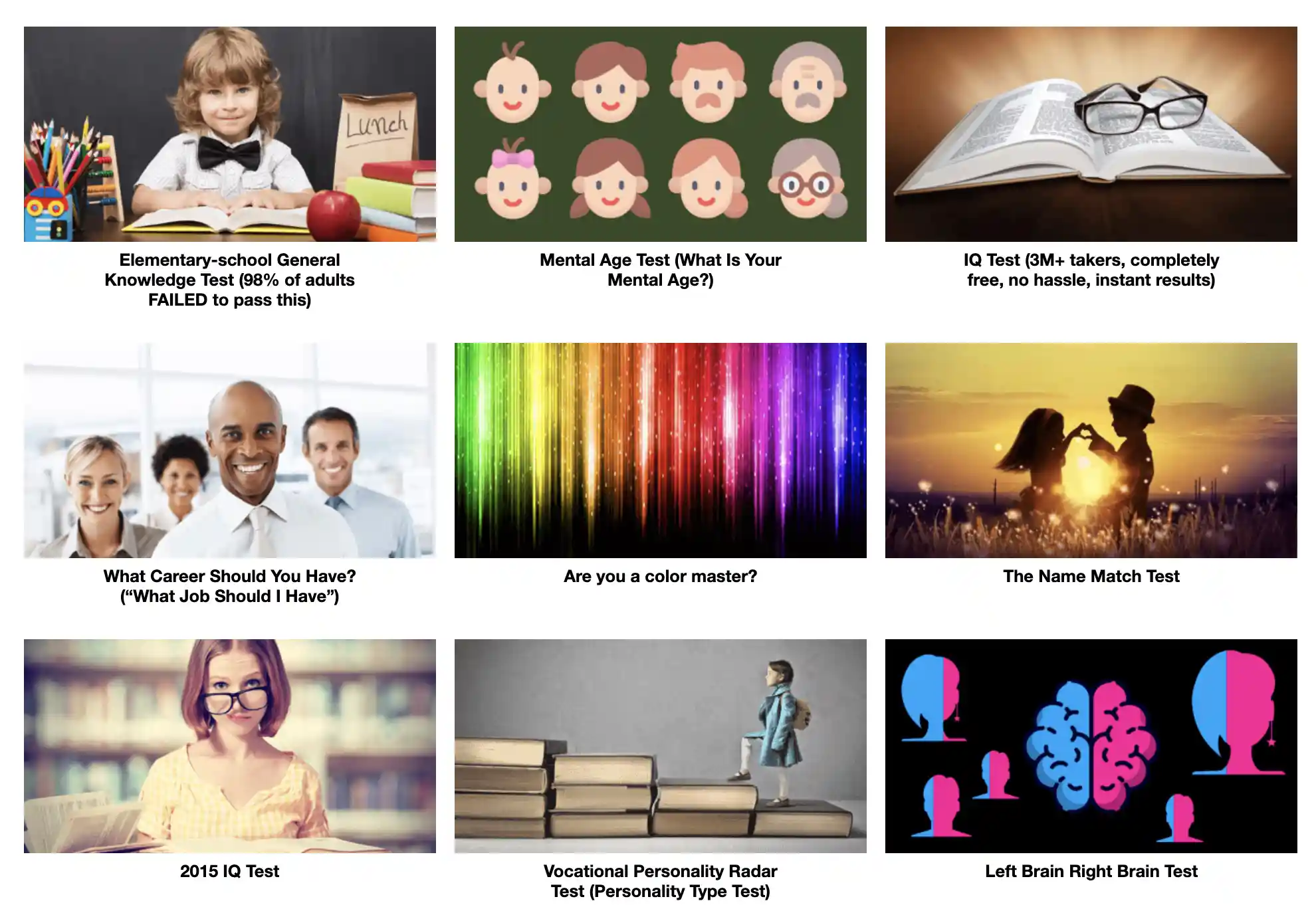
Since the introduction of A Real Me in 2014, over three million individuals have employed the IQ test tool in determining their level of intelligence.
Before you may see your test result, the platform does not ask you to provide personal information such as an email address or payment card number. After you finish the exam, it instantly shows your results.
According to this platform, completing their IQ test and learning the result should take you around 10 minutes on average.
To add to the fun, the tool also includes IQ charts, data, and Celebrity IQ scores, so you can see how your IQ compares to those of your favorite celebrities.
There are also a number of other free and entertaining tests available on the platform, so don’t forget to have a look.
This resource has made my list of free IQ tests with instant results because of the utility it provides a user.
2. Intellitest
Intellitest measures your reasoning, logic, language comprehension, memory, and spatial recognition abilities to determine the overall intelligence quotient. The platform’s testing procedure is simple and straightforward.
Users only need to answer a handful of questions as accurately as possible, and their results will be shown immediately.
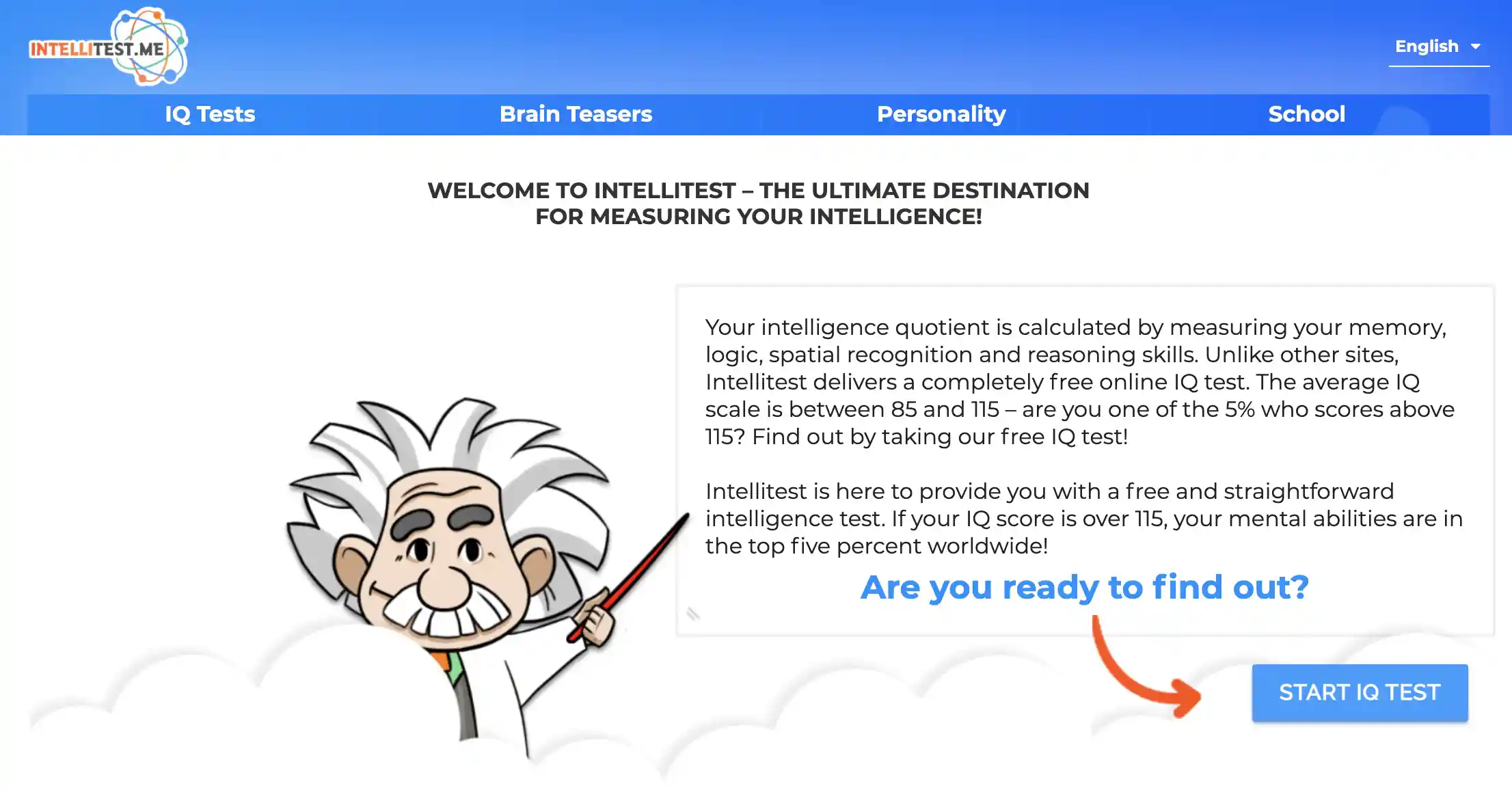
The program has gathered a lot of data because it has been employed by over 3.5 million individuals from all around the world. It utilizes this information to update and improve its IQ test in order to provide users with an accurate estimate of their IQ level.
The average IQ score on Intellitest’s scale varies from 85 to 115. If you’re fortunate, you may even get a higher score and win a place among the coveted 5% of individuals worldwide with IQ scores over 115.
This resource has made my list free IQ tests with instant results because of how robust it has become over the years in delivering accurate IQ readings to users.
3. SeeMyPersonality: Take a highly accurate free personality test
This premium evaluation tool is a worthwhile tool for people searching for a fun exam to help them assess their IQ level.
SeeMyPersonality employs a variety of activities to assess several aspects of intelligence, including arithmetic ability, short-term memory, spatial awareness, and analytical reasoning. It also assesses your vocabulary, creativity, vision, and graphic design abilities.
There is a time restriction on how much time you may spend on each segment. Instructions and practice questions are also provided to assist you to understand what you’ll be doing.
This online tool will compare users’ results to those of their peers and produce a normalized IQ score for them once they submit their response to the test questions.
If a user gets a poor score, the platform offers guidelines and suggestions that they may use to improve their cognitive skills and improve their test scores in the future.
4. 123Test
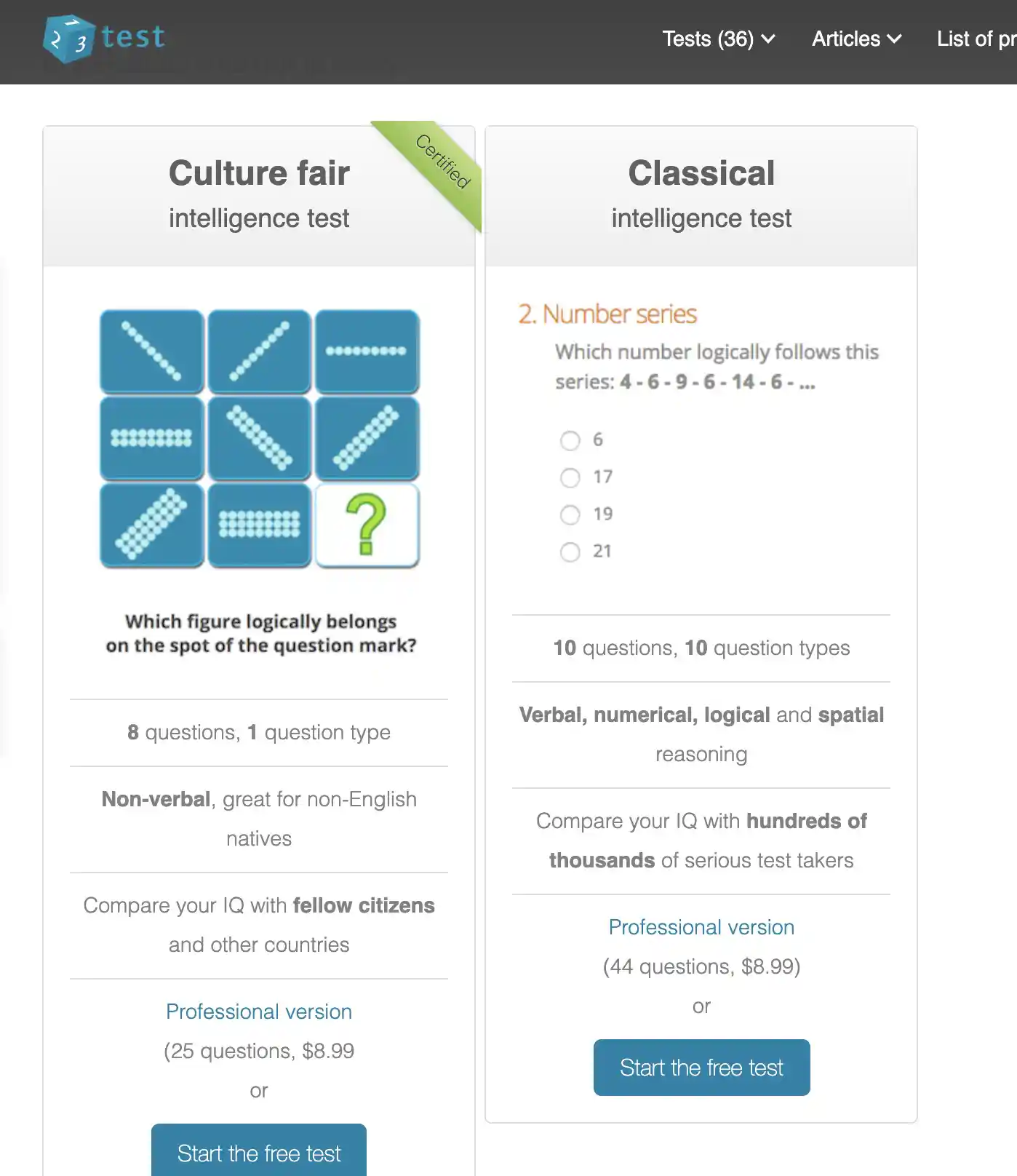
You may take one of two kinds of free IQ tests on this platform: a culturally fair intelligence exam or a traditional intelligence test.
The traditional IQ test asks questions on numerical and logical thinking, and also verbal and spatial abilities, to determine overall IQ. The culturally fair exam, on the other hand, assesses the ability to think deductively or inductively.
The culturally fair exam on 123Test asks users to respond to eight non-verbal questions, so it may be completed by individuals who do not speak English.
If users choose to take the traditional exam, they will be given 10 questions to answer, each with a distinct question type.
The IQ range will be displayed after they have completed any of the exams. Users have the option of printing, saving, or emailing their test results to anyone they choose.
The test results will never be shared or leaked to unauthorized third parties because 123Test ensures user privacy.
123Test may also offer further explanations on the significance of the IQ score if a user is unsure about some of the specifics in the findings or just want to understand more about it; a reason this resource has made my list of free IQ tests with instant results.
5. Free IQ Test
For its IQ test (Visit Here), this psychometric assessment software offers users Twenty questions to respond to. The speed with which they complete the exam and the accuracy with which users answer each question will determine the final score.
Keep in mind that after users have gone to the next question on FreeIQTest.info, they won’t be able to alter their answers.
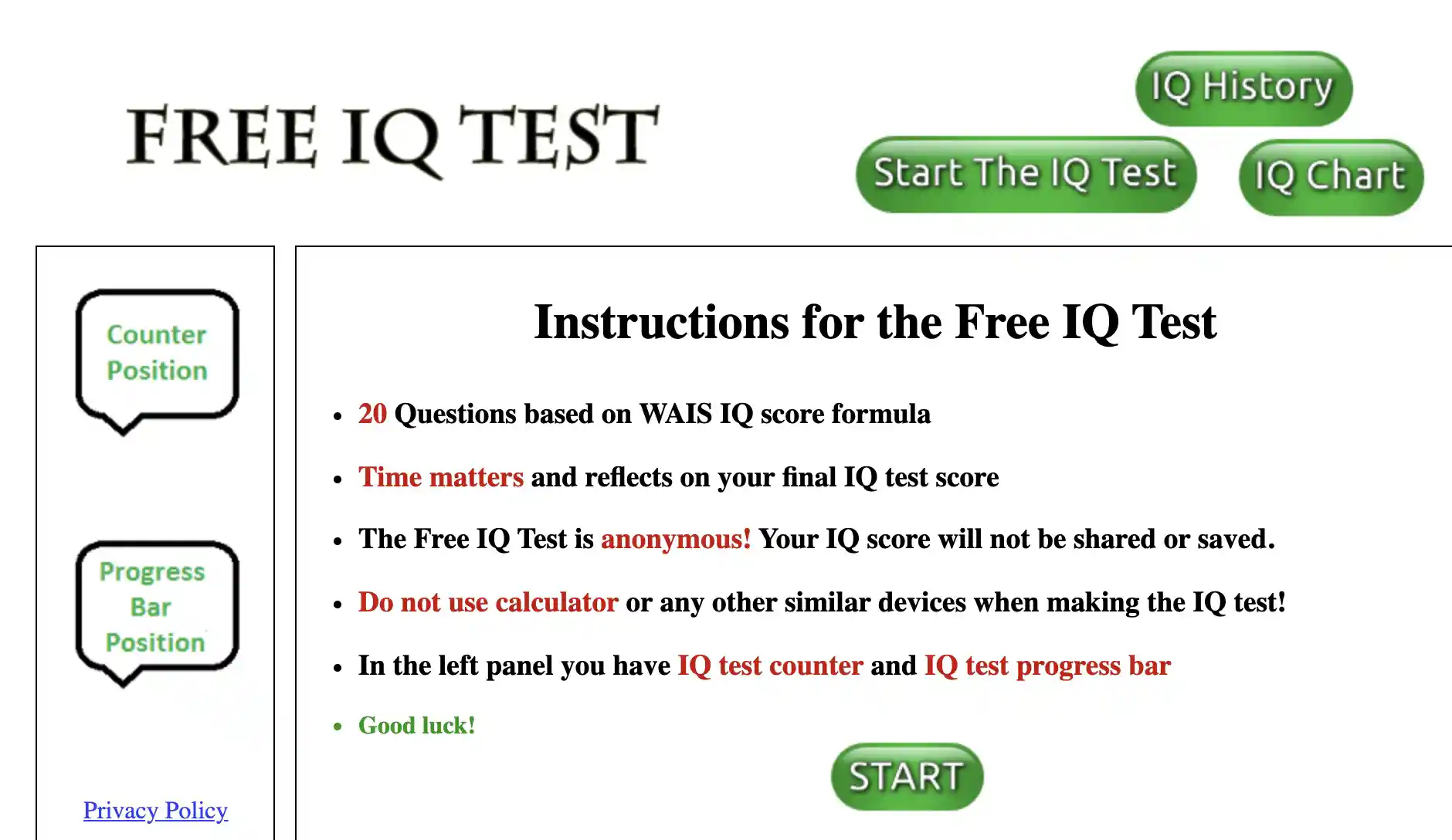
At the end of the IQ exam, they’ll see their IQ score, and would also be shown the time it took to complete it, and the IQ status, which ranges from Average, Severely Challenged to Gifted.
They’ll also get a shareable IQ badge that they could display to friends or post on social media; a reason this resource has made my list of free IQ tests with instant results.
6. MyIQTested: Highly Accurate Free IQ Test
With MyIQTested, anyone can have their IQ tested and find out where their intellectual strengths and weaknesses are. In a couple of minutes, this professionally developed tool may give an exact assessment of one’s brilliance.
MyIQTested has been operating for more than a decade and has established itself as a reliable testing instrument. Its difficult tests will put a user’s memory, reasoning, vision, understanding, spatial connections, and other skills to the test.
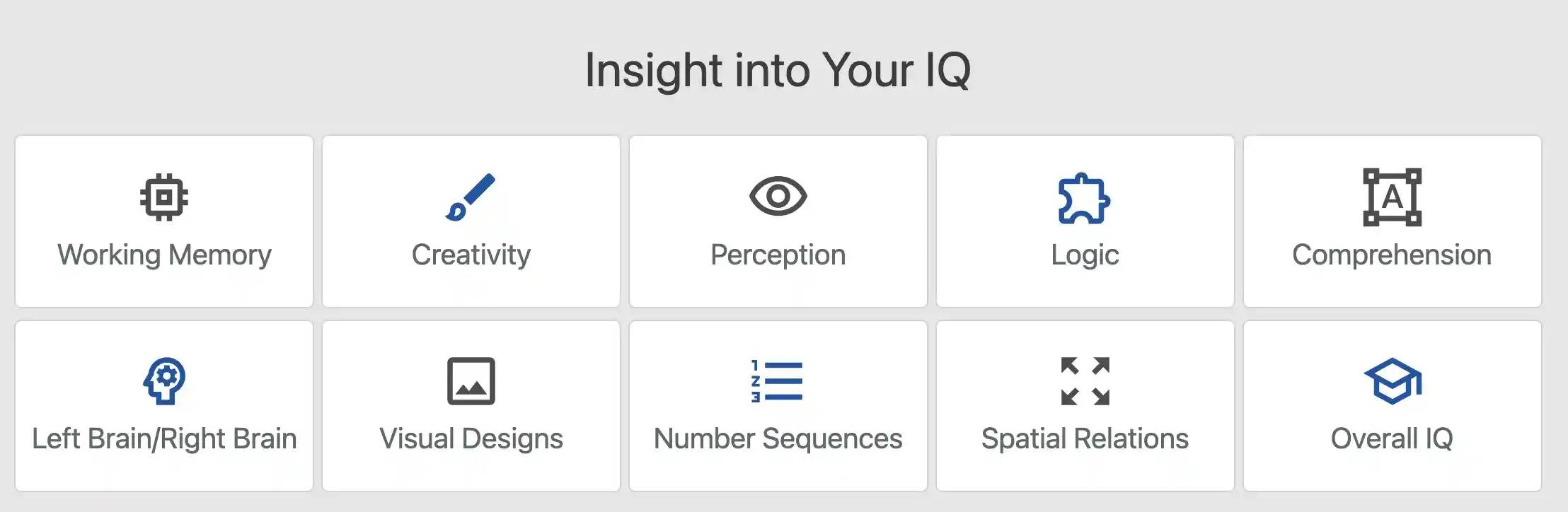
One of the best features of MyIQTested is that it categorizes user results depending on which side of the brain they utilized to answer the questions. It also compares their IQ to the findings of other people with comparable backgrounds and ages.
Users will like playing around with its intelligence tests if especially if they enjoy solving difficult problems and exercising the brain. Don’t be shocked if you keep coming back to attempt to improve on your previous score.
7. Brainalytics free IQ test
Brainalytics offers the most advanced and sophisticated IQ test online.
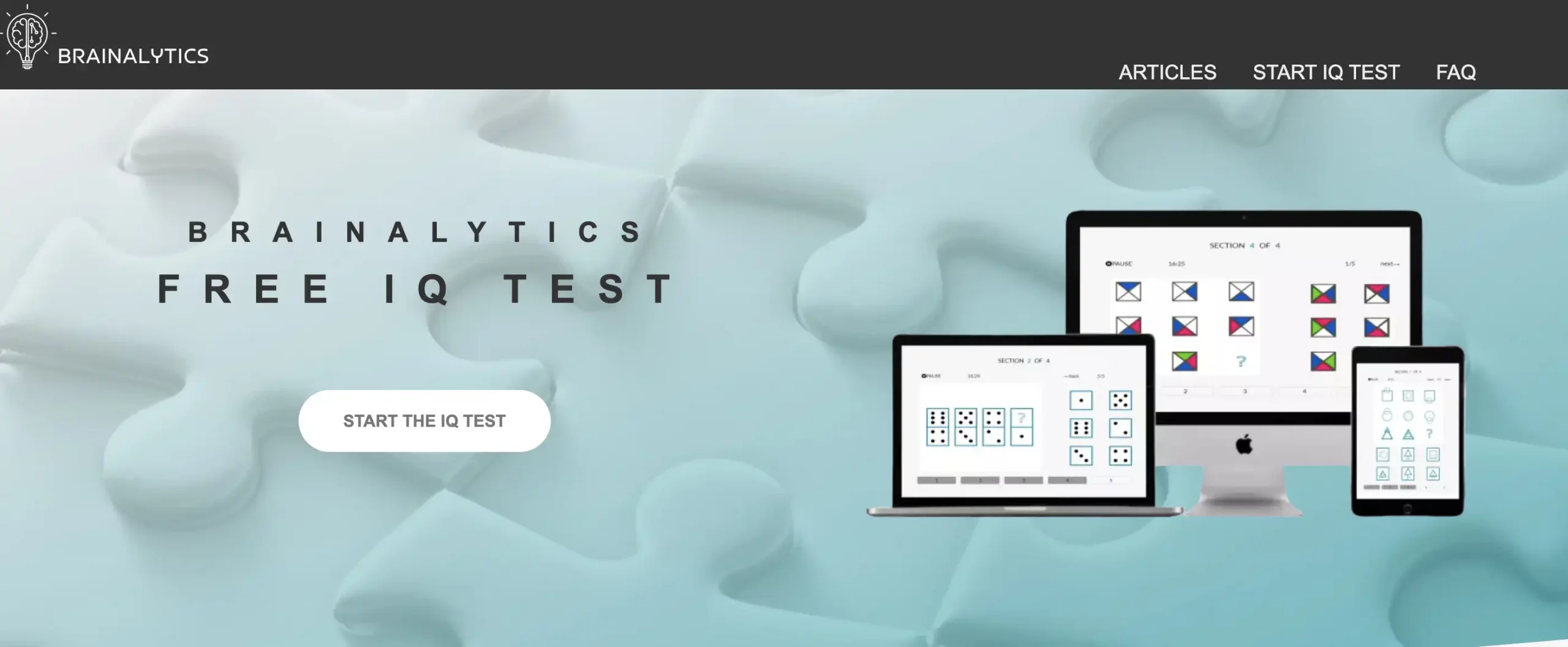
In addition, the platform publishes content on new findings on IQ tests and provides articles with extended answers to questions in the field of intelligence.
The test is divided into four segments. Each of the segments contains five questions so the total number of questions in the test is 20.
Brainalytics’ algorithm selects the most relevant questions that are right for you.
The more you can solve questions correctly, the higher the level of difficulty of the IQ test. This clever approach allows the platform to get a precise IQ assessment with only 20 questions.
The IQ test questions examine diverse aspects such as Abstract Reasoning, Pattern Recognition, Spatial Orientation, and Analytical Thinking.
Each of the four sections is time-limited – be careful not to surpass it.
Our recommendation is not to dwell on questions that take you a long time to solve, but to move on to the following questions.
The test is culturally fair – it does not include English vocabulary questions so it is also suitable for people whose English is not their native language.
Instantly after completing the IQ test, you will get your IQ results without the need for registration or email address.
Only your age is required.😁
Your results consist of your IQ analysis and IQ score. You will get a broad view of your ranking compared to the population.
In addition, you will receive all the solutions to the questions you have solved, along with a detailed explanation of where you got inaccuracies.
Brainalytics’ team ensures that testing scores are accurate.
They perform data research regularly to make sure there is a match between the questions’ difficulty and the IQ results of the users.
8. IQ Test Center
There are more than a dozen different IQ tests available at IQ Test Center for individuals of all ages. Users can discover a decent intelligence test on this site whether they’re adults seeking to test their IQ or a parent looking to assess their child’s intellectual abilities.
To pass the exams, users don’t need to have any prior understanding of language, literature, or mathematics. The test questions are designed to assess the user’s logical reasoning abilities in order to establish their level of intelligence.
For an adult, plan on taking 15 minutes to take the IQ test, following which you’ll be able to see your results right away.
9. Brain Metrix
Brain Metrix is another fantastic free IQ test that provides immediate results. It asks users Twenty questions made up of pictures and numbers and then assesses their intellect based on the responses.
After they’ve finished the questions, they would scroll down to the bottom of the page and click the “Show my IQ score” option to get the results.
Aside from IQ exams, there are a variety of other enjoyable things to occupy a user’s thoughts and pass the time. Sudoku, chess, brain exercises, IQ scale, Rubik’s cube, memory game, arithmetic difficulties, the reflex test, and concentration games are all examples of this.
One disadvantage of Brain Metrix is that the responses to each question are not shown. This implies users won’t be able to identify which responses were correct and which were incorrect.
10. PsychTests
For those seeking a genuine challenge, PsychTests provides difficult questions intended to engage the brain and evaluate overall intellectual capacity.
The platform’s traditional IQ test includes Fifty-Seven questions with no time restriction. However, most individuals finish the exam in approximately 60 minutes, so set aside enough time before beginning.
The questions will cover a wide range of topics, including spatial relations, arithmetic, logical thinking, linguistic ability, information retention, and problem-solving abilities.
PsychTests will give users a short report with their IQ score and the percentile they fall into once they complete the IQ test. Users must pay for the entire results in order to get a comprehensive report detailing performance in each exam area.
11. IQ Test Labs
This test is useful for determining the differences in a user’s ability to complete different analytical tasks. The primary focus of IQ Test Labs is on assessing users’ cognitive abilities.
IQ Test Labs provides 30 objective questions, all of which are worth the same amount of marks but vary in the level of difficulty. According to the platform’s estimates, completing the test and viewing the results take 10 to 15 minutes.
IQ Test Labs also provides practice questions to help you train the brain and improve user IQ test scores. Users also have the possibility to take quizzes to improve their verbal reasoning, pattern recognition skills, and mathematical skills.
The platform is simple to use, with a user interface that is simple to explore and master. To keep the fun going, check out IQ Test Labs’ trivia, puzzles, mind games, brainteaser, and chart section. These options are why it makes my list of free IQ tests with instant results.
12. IQ Test Prep
IQ Test Prep is an interesting method to learn about various kinds of IQ tests and their history while also learning about your intellect level. On the site, users may take a free test and receive immediate results with an exact estimation of their IQ range.
The platform also shows users where their results fall among the wide variety of IQ levels that are accessible. They’ll need to answer Fifty questions in 12 minutes to pass IQ Exam Prep’s free IQ test.
This means users will need to answer each question as fast as possible since the exam will automatically end when the timer counter hits 12 minutes, regardless of whether they’ve completed all of the questions.
While exploring Free IQ Tests With Instant Results to our readers, I found an awesome video on “9 Riddles Only People with High IQ Can Solve” which is worth watching.

13. FunEducation
To measure cognitive performance, FunEducation utilizes various factors including letter/number sequencing, spatial/verbal reasoning, quantitative, word analysis, and quantitative abilities.
To arrive at the final intelligence scores, a user’s raw IQ test score will be scaled and evaluated against the normal distribution of test results from other users.
Users will be asked to answer Fourty-Three questions to determine where they lie in the IQ range. Some of the questions are multiple-choice, while others may need you to write in your own response.
Based on the various question types, the test report will be divided into groups. So users will be able to see what questions they answered incorrectly and which ones they nailed.
For users who want to discover how individuals with their education level, nationality, gender, age, and occupation fare, this is the right choice. Using bar graphs, FunEducation allows them to compare the results to these demographics.
FunEducation also provides a number of testing options to assist you in determining your personality type. Taking them will assist you in determining which characteristics are your strong suit and which ones need improvement; hence why it makes my list of free IQ tests with instant results.
14. Test-Guide
This tool was created by a group of academics who are dedicated to assisting pupils in improving their cognitive skills and passing their examinations. Test-Guide has been around for more than a decade and is widely regarded as being one of the finest free IQ tests available.
Test-Guide features a user interface that is easy to use and browse. To find the intellect and personality area, just browse through the different exam categories provided on the site.
Users will be able to take a free test to assess their intellect. After they’ve finished the exam, they’ll get their results right away. Another wonderful feature of Exam-Guide is that it offers many suggestions for improving your test results.
15. IQTest
Another excellent resource for psychometric testing is IQTest. Rather than multichoice questions, like a lot of other IQ test platforms do, this platform asks users to react to Thirty-Eight assertions.
A user must assess the validity of each assertion and determine whether they believe it is true or untrue. Instead of using a paper, calculator, or pen to reply to the statements, IQTest advises that users use just their intellect.
They’ll also have to work fast since the site utilizes a timer. However, they must also take the time to thoroughly examine each point before responding.
It’s important to remember that finishing the exam fast will result in a higher IQ score. And being too sluggish will have a detrimental impact on your outcomes. So, before starting, users must be set to give the exam their undivided attention.
Users must enter their name and email address after finishing the assessment in order to have the IQ test deliver the results immediately.
16. Simple-IQ
Do you have a high enough IQ to be considered a genius? You may find out by taking a test on SimpleIQ. This website’s IQ test is totally free and has no age limits, so anybody may take it.
Before users take the Simple-IQ exam, they do not need an account on the platform. All they need is to pick on one of the various tests and they’re ready to start.
The testing method used by Simple-IQ is unique. It asks users to decipher the meanings of the letters in each sentence and input them correctly in the answer box.
You may boast about being a genius if you answer 19 or more questions correctly. There’s no need to rush since the site’s IQ tests have no time limitations. Take your time and pay close attention to each question.
17. MentalUP
Join the millions of people around the world who use MentalUP to determine their intelligence quotient. MentalUP’s free IQ test evaluates verbal, focus, visual, memory, and logic intelligence abilities.
Each component has detailed instructions, making the exam simple to comprehend for both adults and children. Furthermore, MentalUP evaluates each ability in 60 seconds, so the IQ exam will only take a few minutes to complete.
Make sure your surroundings are calm and quiet before beginning the IQ exam so you can focus on the quiz. Your results will be shown immediately after you complete the exam.
You may compare your results to those of other individuals your age and utilize the information to enhance your cognitive abilities via brain workouts.
18. IQExam.co
IQExam.co is among the finest accurate and free IQ tests available, created by a group of McGill University student researchers.
Give this tool a go if you want to learn more about your cognitive skills. IQExam.co has a total of Thirty questions, all of which are based on patterns. Simply choose the best potential response from the list of possibilities.
To get your IQ score, the questions will assess your spatial awareness and visual abilities. You’ll get your exact IQ test results certificate after the exam is finished.
The intelligence tests on IQExam.co is not timed, so there’s no need to hurry through the questions and finish them in the allowed time. You have the option of going as slowly or as quickly as you like. All that counts is that you concentrate.
IQExam.co also enables you to keep track of all the IQ tests you take on the site. You may then compare your test results over time to observe how your cognitive skills have progressed.
19. Genius Tests
Genius Tests enable you to assess your intellect and get immediate feedback on which cognitive skills you excel in and how bright you are.
There are two distinct ways to test your IQ on the site. The first is a Fifty-question full-length quiz that you must complete in 12 minutes. The second is a Twenty-Five-question fast quiz with a 6-minute timeframe.
Keep in mind that in Genius Tests, you can’t alter your response to the previous question. So double-check your answer before moving on, and avoid inadvertently pressing the Submit button.
Following the exam, you will get your results, which will include your test score as well as your IQ percentile. The platform rates you “genius level” when your IQ score ranks within or above the 98th percentile, and you may join high IQ organizations.
20. Free-IQTest.net
Users just need to input their date of birth to take the IQ test provided by Free-IQTest.net. After that, they’ll be asked 20 questions, some of which will be multiple-choice and some of which will be true or false statements.
The exam comes with a timer that keeps track of how long users spend responding to questions and how long it takes them to complete them.
A user’s IQ score will be shown after they’ve completed the exam. You can see which questions you got right and which ones you got incorrect. Free-IQTest.net will also display the predicted IQ scores of historical figures.
To enhance your mental skills, you may also sign up to get one IQ test question by email each day.
21. Memorado
Memorado believes that everyone is beautifully unique and that everyone should be able to easily and quickly discover their IQ level. This is why it offers a free IQ test.
To utilize Memorado, you must go through a series of hoops and frills. The website has 18 multiple-choice questions that will put your reasoning, memory, response time, quickness, and attention to the test.
You’ll get your IQ score and a brief explanation of where you sit on the worldwide IQ scale after you’ve completed the exam. Memorado also enables you to instantly publish your exam results on social media sites like Twitter and Facebook.
22. TipTopGlobe
The TipTopGlobe Intelligence Test has Forty questions and takes up to Thirty minutes to complete. It is recommended that you complete the exam without using a calculator or paper, as this will allow for a more accurate evaluation of real results.
The site mentions the Flynn Effect, which is a phenomenon in which the population’s average IQ has been rising at a rate of around three points each decade, with the majority of the increases occurring towards the lower end of the IQ scale.
This is known as the Flynn Effect, although it’s unclear if the population is becoming smarter, whether the changes are due to the IQ tests employed, or if something else is at play.
The Wechsler Test and the Stanford-Binet Test are the two most widely used IQ assessments. The Stanford-Binet Test integrates Alfred-early Binet’s work.
The Binet-Simon Intelligence Scale was created by Binet and his colleague Theodore Simon. The purpose of the first exam was to identify which youngsters would need further educational assistance.
Lewis M. Terman, a Stanford University professor, proposed the idea in 1916, claiming that a person’s intellect might be evaluated on an Intelligence Quotient (IQ) scale.
In addition to the free IQ test, the TipTopGlobe website has a comprehensive list of celebrities and their IQs, so you can see how you compare to people like Abraham Lincoln, Bill Gates, and Leonardo da Vinci.
23. Mensa Workout
Mensa is one of the world’s largest high-IQ membership organizations. In order to join, prospective members must typically take a supervised exam at a test center.
A person with an IQ in the top 2% in the globe is eligible to join Mensa, which offers a variety of activities and clubs for its members.
While the Mensa website does not provide practice or online exams, it does feature an online exercise. This is a set of 18 questions that are comparable to ones you’d see on a supervised exam and are used to determine whether or not you’d do well on the real thing.
Although the Mensa Workout questions are simpler than the actual Mensa test, they do offer you a good sense of what to anticipate if you take the Mensa exam. The site will also inform you if you are likely to get a high enough exam score to be admitted to Mensa.
Final Thoughts on Free IQ Tests With Instant Results
The typical person’s IQ is approximately 100, whereas those with a high IQ have a score of 120 or above. In addition, IQ scores of 70 and lower are deemed poor.
Understanding where you rank on the IQ scale may assist you better fulfill your educational and intellectual requirements while also improving your life.
The free IQ tests mentioned above may help you rapidly determine your level of intelligence. They all have their own method for assessing intelligence, so try as many as you want until you discover the right one for you.
Don’t be disappointed if your IQ result is lower than you expected. You can constantly improve your IQ by doing various workouts and training. Keep in mind that emotional quotient, self-discipline, and other talents may get you just as far, if not farther, than IQ alone.
Please let me know in the comments any other free IQ tests with instant results you may have tried.