























Do you feel something isn’t right with your health? Don’t you have enough time to visit your doctor even for some common and seasonal symptoms? How about noting down your symptoms like never before?
Gone are the days when you had to keep a health diary or journal to keep track of your symptoms or health patterns. Nowadays, like almost every other aspect of your life, your smartphone is more than ready to take over, or has it already taken over?
Tracking your symptoms can be immensely helpful not only for you but for your doctor as well to ensure proper and timely treatment.
Regular recording of symptoms can help you to be fully aware of how your body is doing. What precautions and management do your body needs? Symptom tracking is more about avoiding health-related complacency than fearing your symptoms.
And guess what? There are more than a dozen of symptom checker apps that help you to track your symptoms systemically and scientifically.
These apps allow you to check your and your loved ones’ symptoms regularly and help you to keep your doctor informed about your health patterns.
They are surprisingly easy to use, have so many medical conditions and symptoms in their databases, and are trustworthy as far as your data is concerned. So, let’s have a detailed look at each of them and find out which suits you the best!
Best Symptom Checker Apps – Our Top Pick 👌
1. Ada – Check Your Health
Check your symptoms anywhere, anytime, at home, at the office, on the go, or while traveling! Ada is a fast, reliable, AI-powered symptom checker that can be your best companion twenty-four-seven for correctly checking all your symptoms.
Ada allows you to check your and your loved ones’ symptoms and determine the potential cause(s). Whatever is troubling you, from a stomach bug to headache, nausea, or dizziness, Ada’s extraordinary symptom checker can help you with all the required answers.
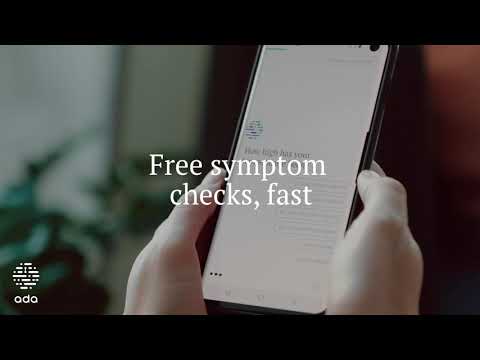
The app also tells you if there is something serious about your health or if it’s time to see a doctor for proper diagnosis and treatment.
Developed by none other than a trusted team of doctors, Ada is very reliable and is already used by millions of people all around the world.
Why is Ada the Number One Symptom Checker App?
- Smart results based on proper analysis of your symptoms with a huge medical database
- Personalized and detailed health information
- Unique and personalized guide
- Detailed assessment of your family members and friends
- It gives relevant information that can be helpful for your doctor too
- No doubt whatsoever when it comes to data security and privacy
Devices – Android and IOS
Ratings:- Google Play Store – 4.8 / 5, Ratings on Apple Store – 4.8 / 5
Download the App from Google Play Store
Download the App from Apple App Store
2. Symptomate
Symptomate is one of the most advanced apps that checks your symptoms with the help of artificial intelligence.
The app is free, reliable, fast, and anonymous. Developed and verified by a team of doctors, Symptomate is featured with more than 700 medical conditions and can help you check your health condition quickly!
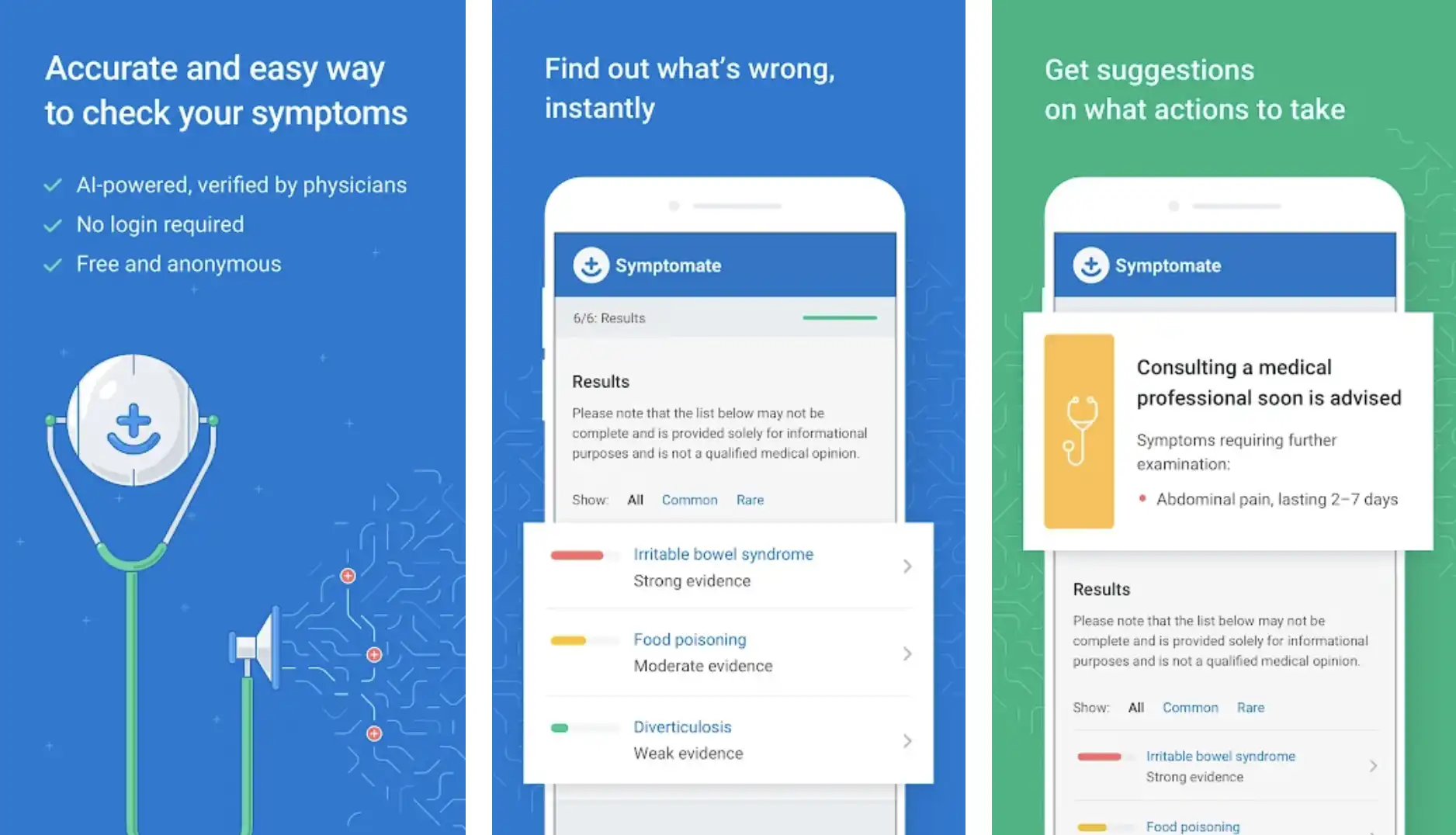
What more? There is also a library of illnesses, symptoms, medications, and doctors. The huge amount of medical information is free to access and very easy to find.
The app performs like first aid and not as a treatment. Using the app, you can find the possible causes of some common seasonal symptoms.
You can learn with the help of this app about the seriousness of your symptoms and when is the right time to see a doctor. It also tells you whether you should meet a specialist or if your condition is treatable at a general practitioner’s clinic.
The app asks basic and relevant questions about your health, checks the information against its huge medical database, and comes up with some very smart and reliable suggestions.
Why is Symptomate a Very Popular Symptom Checker App?
- Personalized health information
- Smart results with the combination of artificial intelligence and medical knowledge
- Learns and improves every day
- A database of more than 700 health conditions and 1,300 symptoms
- Available in multiple languages, including US English
Devices – Android and IOS
Ratings:- Google Play Store – 4.6 / 5, Ratings on Apple Store – 4.6 / 5
Download the App from Google Play Store
Download the App from Apple App Store
3. Symptom Checker – free multiple symptom checker
Symptom checker is another very smart and unique application that intelligently combines artificial intelligence and expert doctors’ medical knowledge and accurately checks your symptoms.
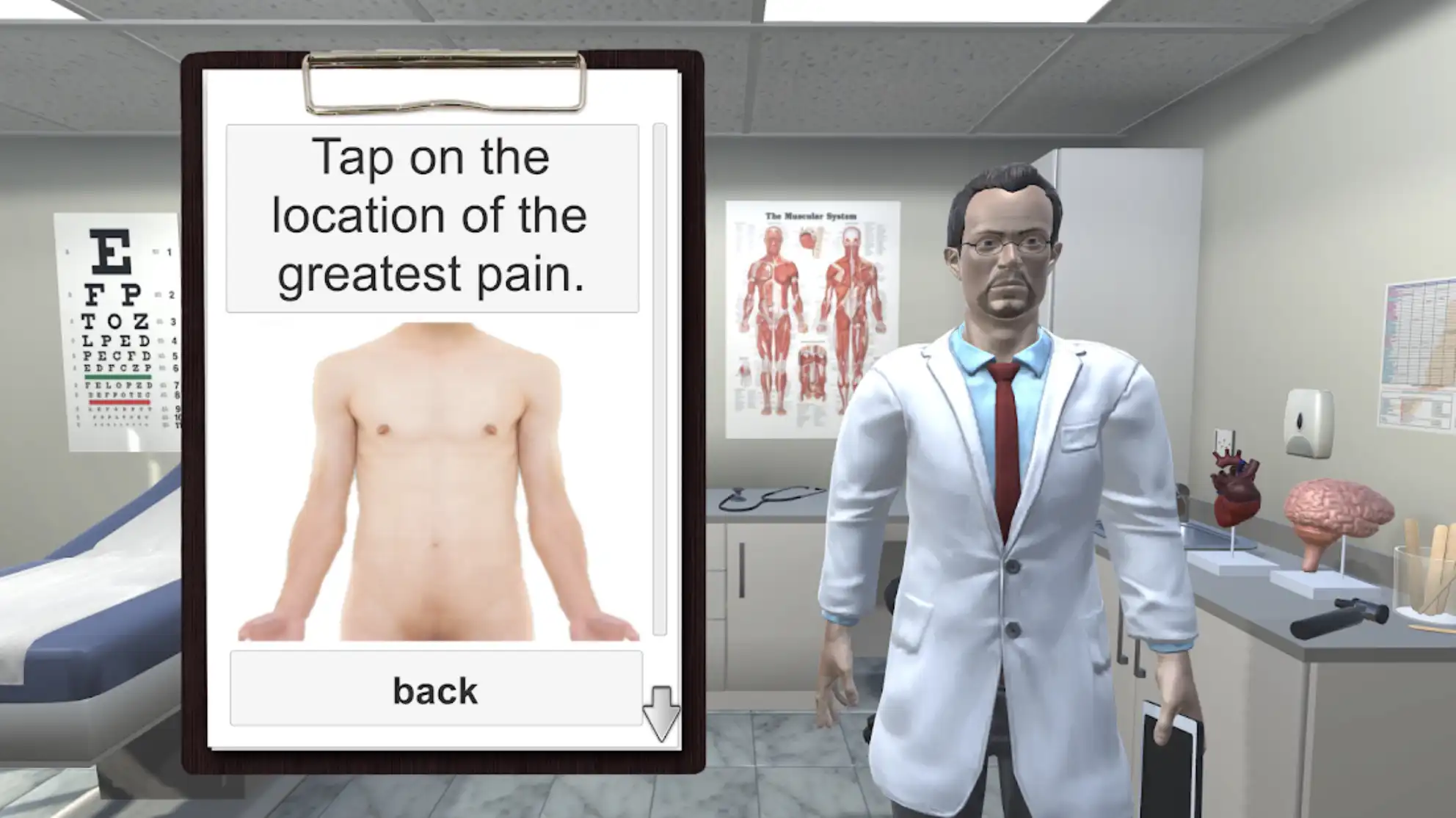
The app performs like a simulation of the conversation between a doctor and a patient. You have to answer some basic questions related to your health.
Symptom Checker is designed to find the suspected diagnosis based on the information provided by the users.
The app helps you to understand what your doctor may ask in a certain health condition. It works by synchronizing your symptoms with a massive database of more than 1500 symptoms and medical conditions combinations.
Features of Symptom Checker:-
- Designed exclusively by professional doctors
- Evaluation of the symptoms with a huge medical database
- Simulated interaction between doctor and patient
- Individual answers based purely on individual questions
- Risk assessment of several common diseases and conditions
- Medical advice on when you should meet your doctor
Device – Android
Ratings:- Google Play Store – 4.5 / 5, 5,00,000+ Downloads
Download the App from Google Play Store
4. WebMD: Check Symptoms, Rx Savings & Find Doctors
Designed by one of the leading medical websites, WebMD is another very useful application for accurately checking symptoms.
The app extensively checks your symptoms, learns about them in detail, suggests possible lab tests, and finds specialist doctors in your area!
WebMD also helps you to learn how to identify the symptoms and, more importantly, some very effective ways of avoiding the diseases.
With time, you will also have a basic idea about some common chronic diseases.
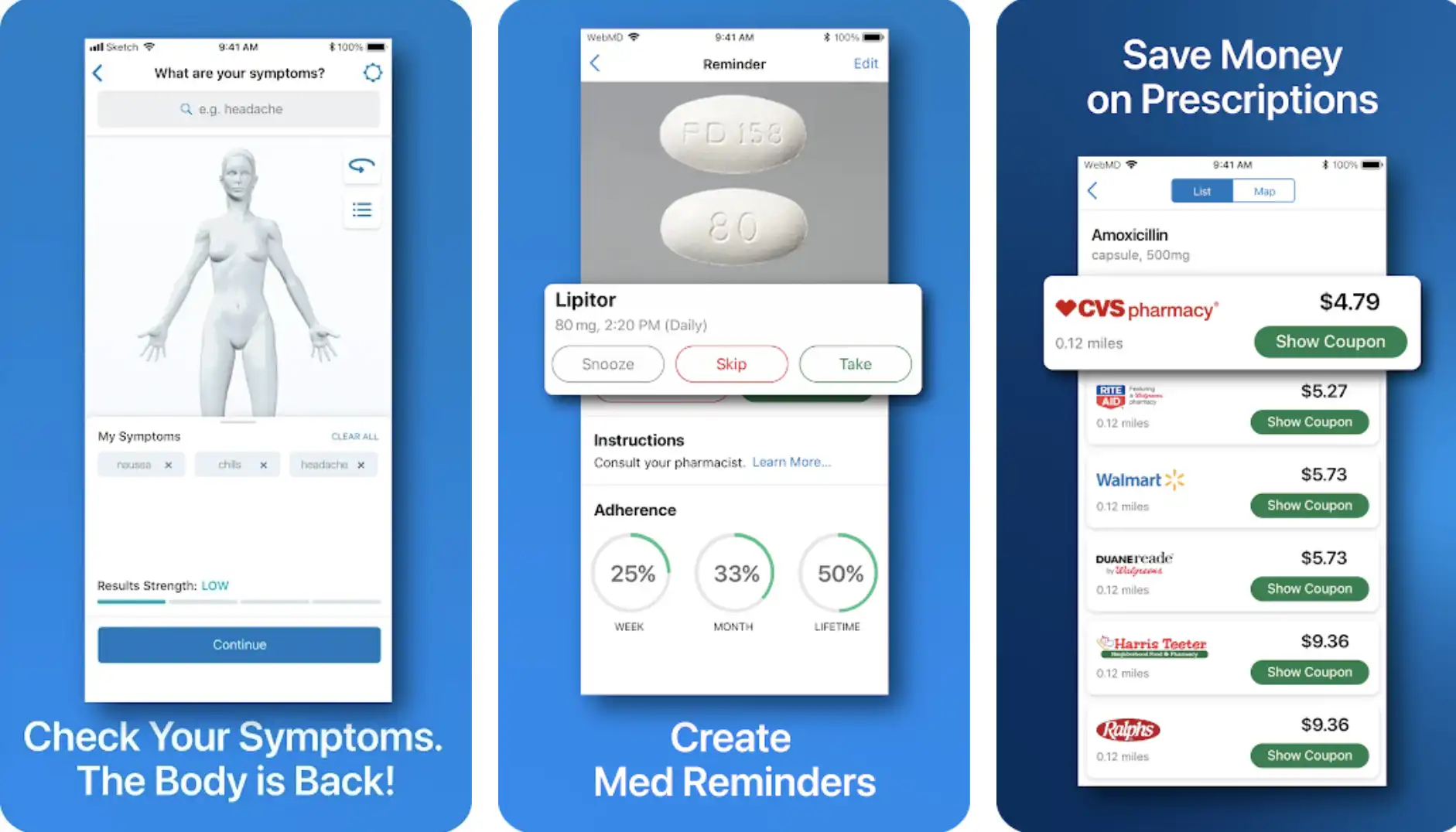
The app is designed primarily for checking symptoms but is not limited to it. You can access some very useful medical recommendations, drug analogs, medical news, and self-management of some very common acute diseases through one of the most popular apps.
The medical dictionary of WebMD contains hundreds of symptoms and illnesses and can help you to deal with them without visiting your doctor. Or you can even prepare yourself for a timely visit with the help of this app.
Features of WebMD: Check Symptoms, Rx Savings, & Find Doctors
- A very effective symptom checker
- Packed with some very useful additional features as well
- Customizable medical reminders
- Medically reviewed analysis of medical conditions and symptoms
- Drug interaction checker to know about potentially harmful combinations of drugs
Devices – Android and IOS
Ratings:- Google Play Store – 4.4 / 5, Ratings on Apple Store – 4.7 / 5
Download the App from Google Play Store
Download the App from Apple App Store
5. mySymptoms – Food Diary & Symptoms Tracker
It is one of the most reliable symptom apps for those struggling with inflammatory bowel syndrome or any other issue related to their digestive health.
The app allows you to record, track, and analyze your meals, moods, and symptoms to get detailed insights into your overall digestive health.
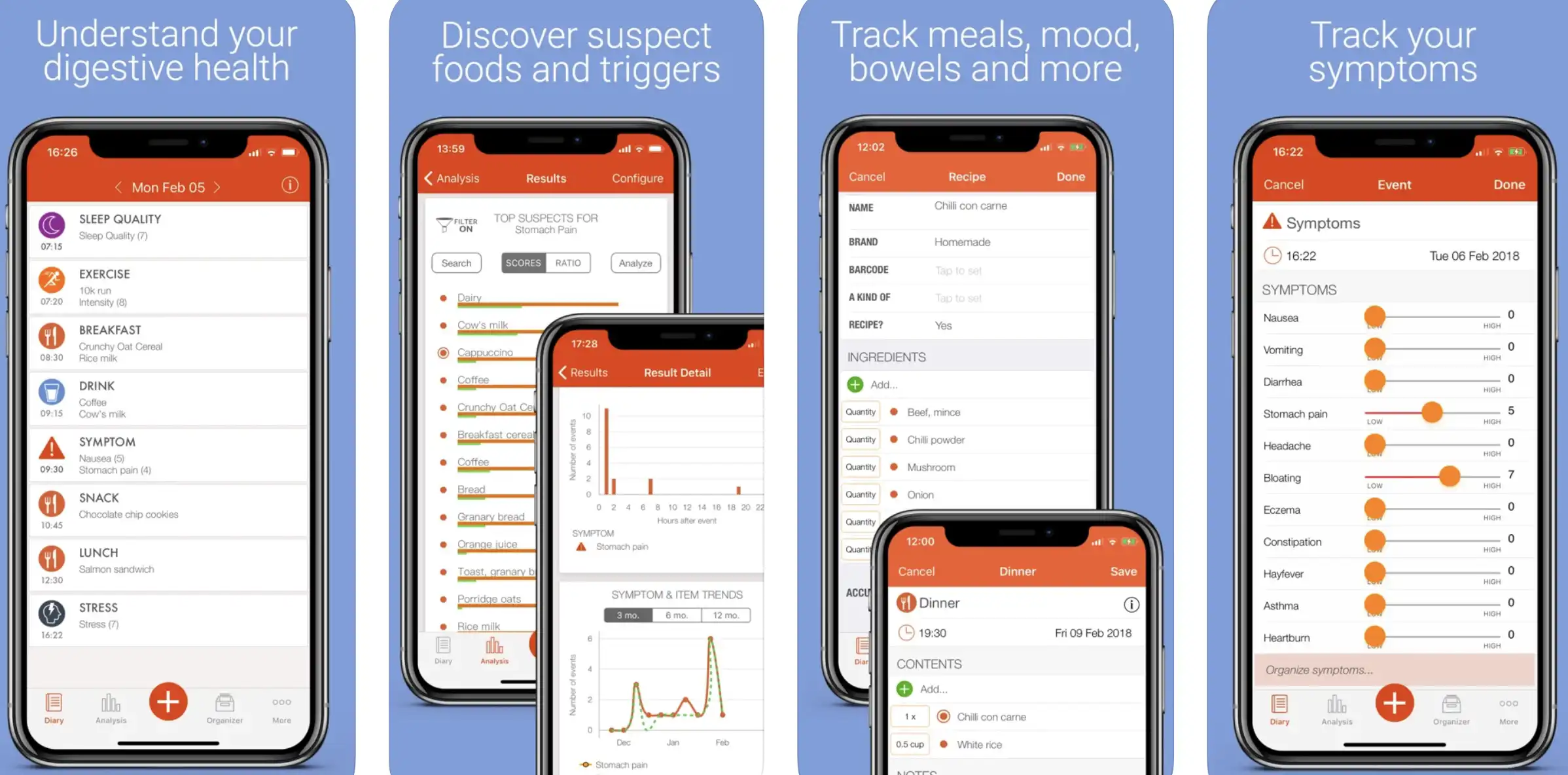
mySymptoms app makes it easy, simple, and straightforward to study what you eat, how you feel during certain situations, and how even your emotional health is directly linked to your digestive health.
The app is, however, designed to focus on digestive symptoms only. But, it does what it promises and can be a great buddy for those who always struggle with digestive complaints.
It gives you detailed information about your health based o your digestive symptoms. Also, it offers you an option of downloading the report in PDF format – which can be immensely helpful when you visit your doctor next time!
Some useful features of mySymptoms – Food Diary & Symptom Tracker
- You can record almost everything, like meals, medications, exercise, stress, environmental factors, etc., in the app
- It allows you to record different aspects of the symptoms, including duration and intensity.
- You can also record your sleep quality, energy, and patterns of bowel movements
- Easy to check and edit your diary entries
Devices – Android and IOS
Ratings:- Google Play Store – 4.4 / 5, Ratings on Apple Store – 4.7 / 5
Free, In-app Purchases for Android Users and Paid – $4.99 for Apple Users
Download the App from Google Play Store
Download the App from Apple App Store
6. Common Symptom Guide
One of the best symptom checker apps specifically designed for some of the most common pediatric and adult symptoms
The Common Symptom Guide is one of the easiest and most trusted reference applications for patients and doctors. The app helps its users to accurately and quickly evaluate the symptoms.
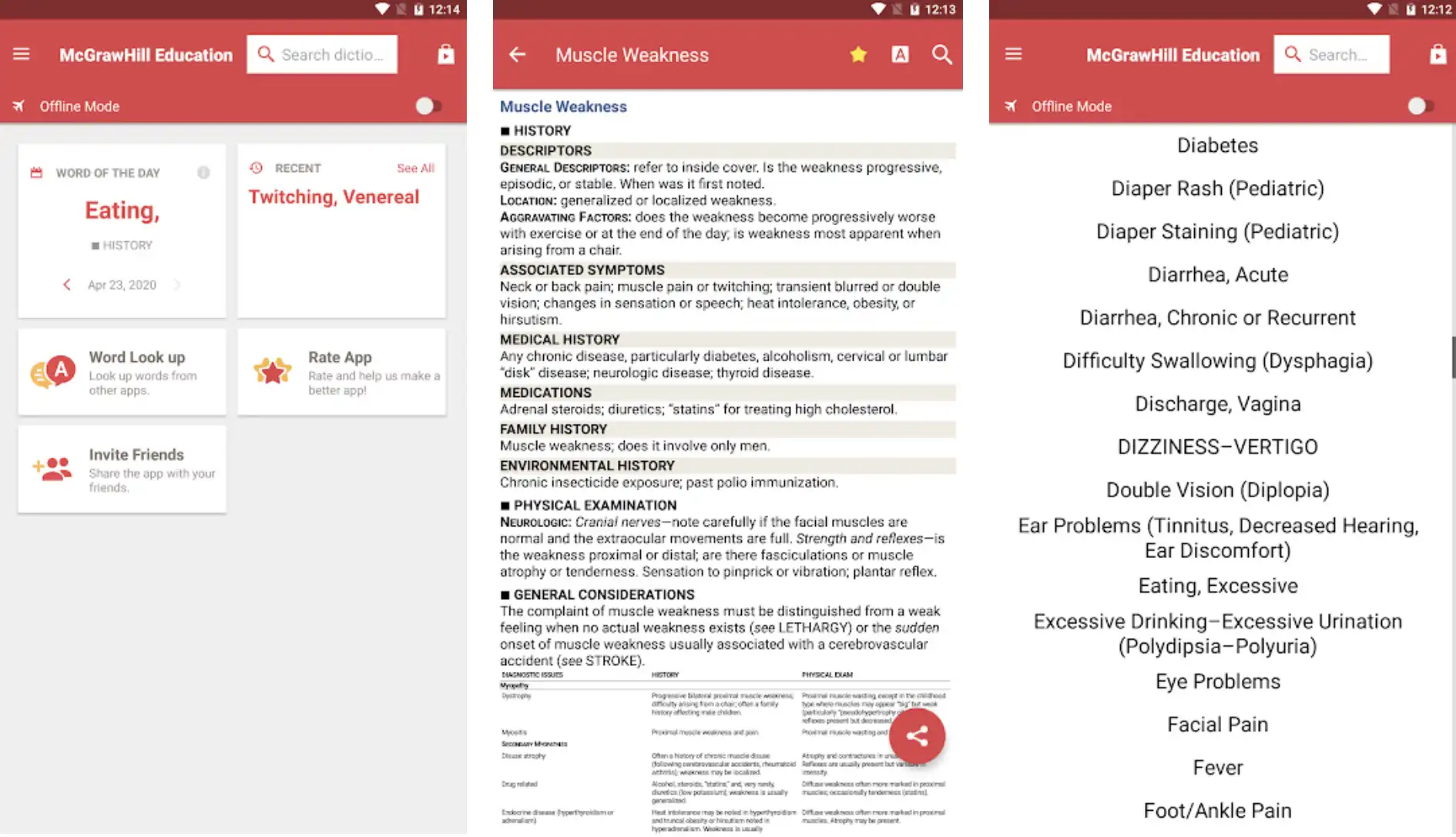
The app contains common health-related questions, physical findings, and diagnoses for hundreds of common pediatric and adult health symptoms.
The app is smartly designed to offer you a very comprehensive search experience inside the app. The medical dictionary combines many search tools to match and suggest what you are trying to find.
“Keyword lookup” and “Search autocomplete” features allow the users to search within phrases and compound words.
Some Key Features:-
- A detailed history of the symptoms
- Proper analysis thorough physical examination
- Some very useful additional information
- Up-to-date, evidence-based, important medical references
- Very easy to find the symptoms
Device – Android
Ratings:- Google Play Store – 4.3 / 5 | 1,00,000+ Downloads
Download the App from Google Play Store
7. Healthily with Dettol – The Self-Care App
It is developed by Your.MD, Healthily with Dettol is among the most useful apps that help you with complete and reliable information about your health.

The app is also very good at creatively reducing your anxiety, especially in emergencies. The award-winning self-care app can be very helpful for you if you are struggling to take care of yourself, irrespective of where you are!
The health journals and trackers in the app are designed to keep you healthier, smarter, and happier, and that too, with the slightest of adjustments in your daily life.
If you have got some questions related to your health, you can easily ask the chatbot and get some very useful and relevant answers. You also get valuable suggestions on when you should go to meet your doctor.
Self-care is not only helpful for your overall health, but it can also be a great support for your doctor too!
You can easily discover some important tips and information about self-care from one of the world’s simplest and safest databases to improve your overall health conditions.
The app innovatively motivates you to pay extra attention to your health. It teaches you how to avoid possible health-related complacency.
In short, Healthily with Dettol is one of the complete symptom checker apps you can get!
Some extraordinary features of Healthily with Dettol:-
- Motivates you for a healthy lifestyle
- Detailed recording and analysis of all your symptoms
- Your data is confidential with the app
- Very accurate, to-the-point information
- Fast and reliable answers from the chatbot
Devices – Android and IOS
Ratings:- Google Play Store – 4.0 / 5, Ratings on Apple Store – 4.8 / 5
Download the App from Google Play Store
Download the App from Apple App Store
8. Caidr: A Search Platform for Smart Self-Care
Use Caidr to check your health status and track your symptoms accurately. Caidr is a very smart self-care application.
The app smartly uses artificial intelligence developed by a team of expert doctors and allows you to track your symptoms correctly.
With easily searchable medical content and high-quality self-care products, the app focuses on the most important aspects of your health.
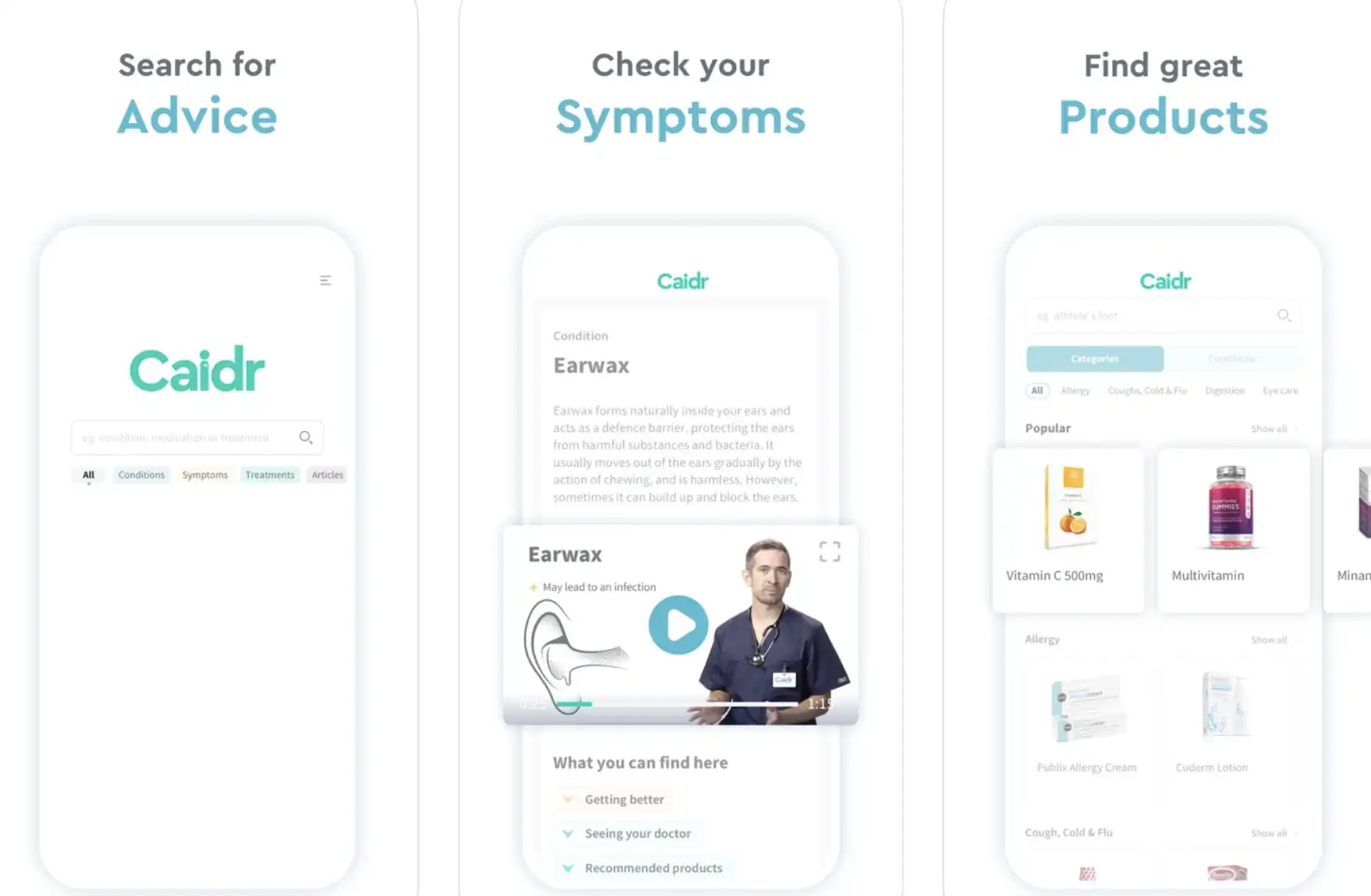
The app library is more than useful for learning about different diseases, their symptoms, their seriousness, potential causes, the fate of the diseases, and a lot more. With the help of this app, you can easily track all your symptoms, moods, illnesses, and much more.
There is an AI-powered bot that smartly answers all your questions related to particular symptoms or diseases. All your queries and requests are saved automatically in the “history” section of the app.
You can always check this section to learn more about your health dynamics and the evolution of symptoms. Other relevant details, including confirmed illnesses and other history fed by you, are stored here in this section.
The app also suggests the specialists you should see for a particular disease or condition. What more? Caidr is one of the most trusted apps for effective home management of mild symptoms!
All you have to do is honestly feed in all the required information. And then, the app is smart enough to read your symptoms accurately.
Some Highlights of the Caidr App:-
- Designed by a dedicated team of family doctors, pharmacists, and other medical experts
- Modern search platform with complete medical information
- A great platform to find very useful self-care products
- You can also check some important local “know-hows” while traveling
- Up-to-date tips and tricks to keep you healthy and happy
Devices – Android and IOS
Ratings:- Google Play Store – 4.1 / 5, Ratings on Apple Store – 4.6 / 5
Download the App from Google Play Store
Download the App from Apple App Store
9. CareClinic: Tracker, Reminder, Medicine, Symptoms
CareClinic is a lot more than just a symptom tracker app. It is one of the most reliable, multi-feature health and wellness apps that allows you to track, measure, learn, and improve your overall health.
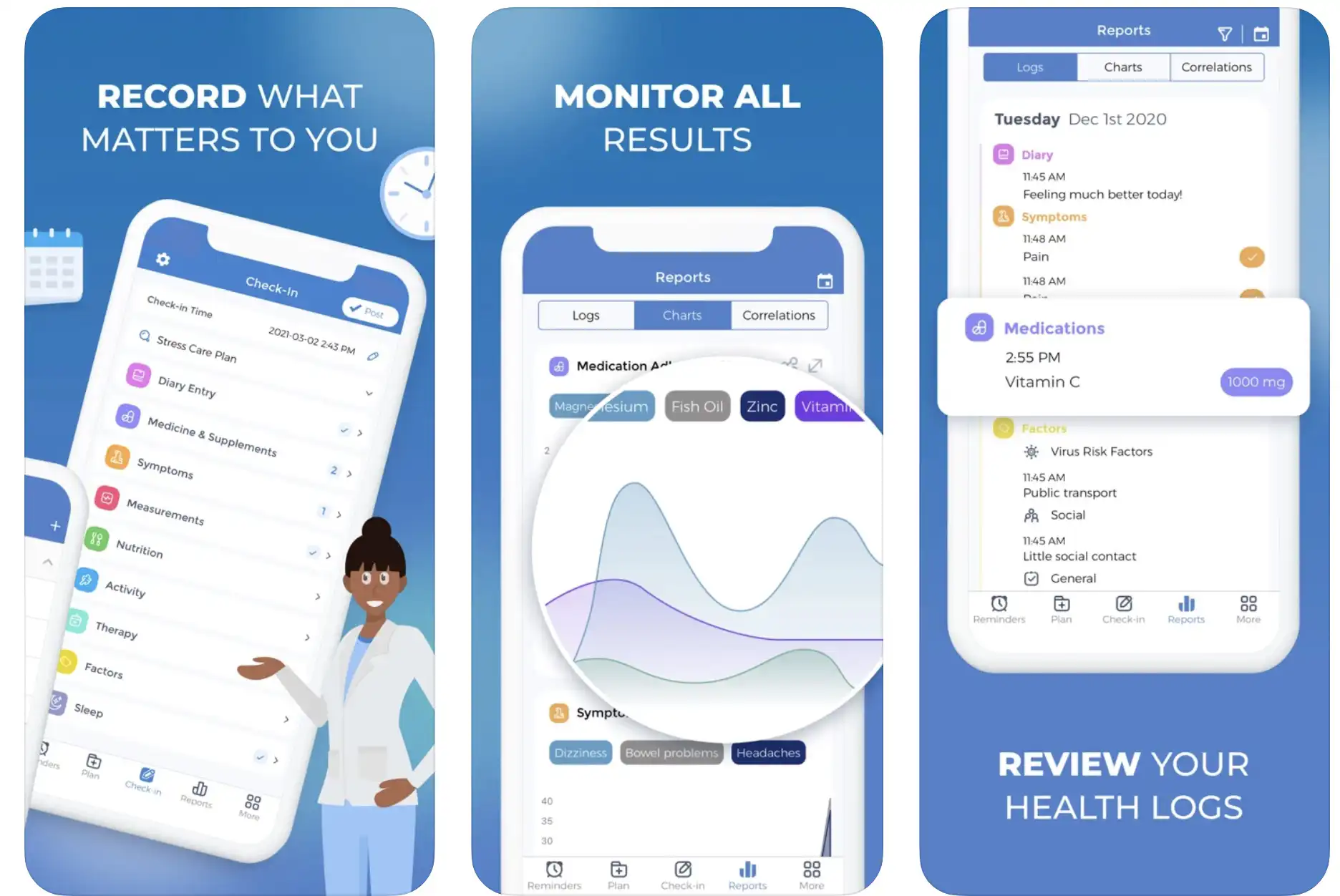
The app tracks your symptoms and records your physical activities, habits, and other custom values.
CareClinic app is especially known for its’ simple, intuitive, and straightforward data entry and offers health symptoms like few apps.
Users can easily discover various aspects of a particular symptom, including factors and triggers that directly or indirectly impact the symptoms.
The app is also featured a comprehensive, customizable medication reminder. You have the option of changing or customizing the reminders without any problem.
What more? If you want, you can also share your health logs and data with your family and doctor using the Careteam feature of the app.
This feature provides much-needed support for patients to analyze their symptoms, progress, and medication schedule properly.
Whether you want to use this app to track the timing or severity of your symptoms, see your progress, or even use it for medication reminders, the app won’t disappoint you.
Track your symptoms, supplements, vitamins, conditions, nutrition, daily vitals, baby symptoms, pregnancy, and other important details like never before!
Features of CareClinic: Tracker, Reminder, Medicine, Symptoms:-
- Create a customized treatment plan based on inserts from your doctor
- Organize your medications in one place
- Daily check-in diary for proper health analysis
- A multi-feature health tracker app
- Allows you to share your health data with your family and doctor
Devices – Android and IOS
Ratings:- Google Play Store – 4.1 / 5, Ratings on Apple Store – 4.7 / 5
Download the App from Google Play Store
Download the App from Apple App Store
While exploring Best symptom checker nhs For Taking Care of Your Health to our readers, I found an awesome video on “Remove Toxins from Your Kidneys, Liver and Bladder Gently Yet Effectively,” which is worth watching.

10. Mediktor
Solve your mind’s health-related puzzles through your symptoms with one of the easiest apps!
Mediktor allows you to check your symptoms for free. You can easily share the results with a healthcare professional for proper health assessment, diagnosis, and treatment.
The app will be helpful for you as well as your doctor to make the best decisions.

You can give your input about the symptoms, intensity, and the factors aggravating them. The AI-powered chatbot collects all the information given to you.
It gives the best possible recommendations, including the possible diseases or conditions you are suffering from, their fate, and when you should see a doctor.
The extensive medical dictionary in the app helps you to have a basic idea about certain conditions through the proper description. You can even talk to a doctor and interact with your condition through the app.
All the details and data are confidential and secure. If you are not feeling well, one of the specialists will help you with the best way of dealing with your problem.
Features of Mediktor:-
- AI-powered platform with a decent natural language interpretation
- Real-time and secure chat platform for doctors and patients
- Compatible with Apple Health App
- Intuitive, effective, and thorough symptom checking
Devices – Android and IOS
Ratings:- Google Play Store – 3.8 / 5, Ratings on Apple Store – 4.7 / 5
Download the App from Google Play Store
Download the App from Apple App Store
11. Kinsa – Health & Symptoms Guide
If you are not feeling well or noticing unusual physical signs or symptoms, you can get some help instantly from the Kinsa app – your health guide right in your pocket!
From the initial signs of sickness through recovery, complete cure, and beyond, the app can help you properly overcome all types of health complications.
The app easily tracks symptoms, temperature, and even medications! Follow the medical chart, and always take medicines on time with Kinsa!
The app can be more than handy for tracking important details, including when the symptoms began, when your fever comes and goes, when you need to take medicines, and more!
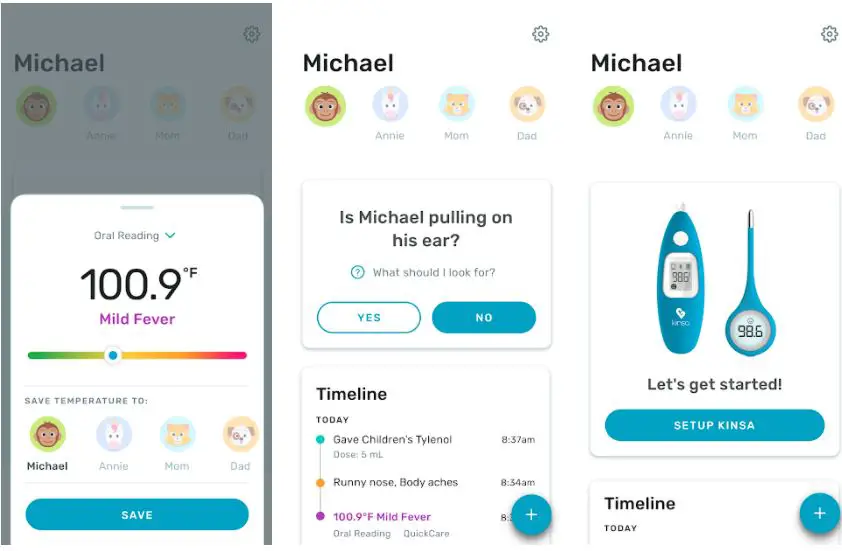
You can also share all your symptoms, complications, medication schedule, and more with your doctor and caretaker.
Undoubtedly, one of the best apps for tracking and organizing your and your family’s health history! And the best part about the app is it also suggests some of the most effective ways of taking care of yourself and your loved ones.
The app keeps all your health data and logs in one place, making it easy to track all important aspects of your health. Make doctor appointments quickly, and explore all medical equipment at the best prices.
The Kinsa app works perfectly with award-winning, popular Smart thermometers, QucikCare, and QuickScan from Kinsa. All in all, a complete symptom checker app with some exciting features.
Features of Kinsa:-
- An effective, very useful symptom tracker app
- It helps you to check what diseases are common around you
- A reliable platform, especially for small families
- Temperature, medicines, and recovery tracker
- Book an appointment with the best physician near you
Devices – Android and IOS
Ratings on Apple Store – 4.8 / 5 | Ratings on Google Play Store – 4.6 / 5
Download the App from Google Play Store
Download the App from Apple App Store
The Conclusion
Digital health journals or symptom checkers make it easy and time-saving for patients to keep track of their symptoms.
These are some of the best symptom checker apps available on Google Play Store and Apple Store, and they do what they are designed to do – they track your symptoms rather effectively and accurately.
These apps allow you to share your health information with your doctor and your strong support circle. And the best part is they are very secure as far as data storage is concerned.
For patients, these AI-powered smart checker apps can also encourage proper self-management. You can easily see how your symptoms evolve and what are the factors that affect them negatively.
The apps also suggest the right time to visit a doctor, which can be mighty effective for your health.
Hopefully, we have helped you with some amazing symptom checker applications. And, like always, we leave the task of choosing the most suitable one for you! From our point of view, Ada – Check Your Health is the best bet without any doubt
📗FAQ
What is the most accurate symptom checker?
AskMD is the most accurate symptom checker, with an accuracy rate of 68%. DocResponse, iTriage, Mayo Clinic, Family Doctor, and Healthline are also up there as far as accuracy is concerned.
Is there an app that can diagnose you?
Ada is a free symptom checker that can help diagnose different types of minor symptoms. However, you should never rely on technology if you feel something serious. Contact your healthcare provider without any delay.
Is there a site where I can list symptoms?
Symptomate allows you to list your symptoms with an accurate and fast assessment. The assessment will also help you to know the possible causes of various symptoms.
Is Symptomate free?
Yes, Symptomate is free and very reliable, fast, and anonymous. It is one of the most advanced symptom checkers and uses artificial intelligence to study your symptoms associated with more than 700 conditions.
What is the best free symptom checker?
WebMD, AskMD, Symptomate, Everyday Health Symptom Checker, Symcat, Symptify, etc., are among the best free symptom checkers.
What is the best symptom checker app?
Ada, Symptomate, WebMD, mySymptoms, CareClinic, and Mediktor, etc. are some of the best symptom checker apps you can rely on to get to know different types of common health conditions.
How accurate is WebMD?
WebMD is not among the most accurate symptom checker apps with a symptom accuracy rate of only 38%. AskMD, DocResponse, Mayo Clinic, Healthline etc. are more accurate than WebMD.
Is Symcat free?
Yes, Symcat is free of cost and helps you check a wide range of symptoms on your smartphone without visiting a doctor.
Is there an app to put in symptoms?
Ada is one of the world’s most popular applications for listing your symptoms. Other reliable symptoms checking apps include AksMD, WebMD, Symptomate, and CareClinic etc.
What is Digital symptom tracking?
A digital symptom tracker is an application or software that enables you to self-report various medical events and track symptoms.
You can use these apps or software to keep track of changes in symptoms and help your doctor to get potentially accurate treatment.
Is CareClinic app free?
You can seamlessly track unlimited symptoms in the free version of CareClinic app, including making a diary of your symptoms.
How do you keep a symptom journal?
Writing your symptoms in a journal or diary is the most popular way. You can also try adding your symptoms to a spreadsheet and save it on your PC.
Otherwise, keeping track of your symptoms with the help of a symptom tracker app like Ada, AskMD, WebM, Symptomate, etc., is possibly the easiest and most effective way.
Is there a health journal app?
Yes, there are numerous health journal apps easily available. These include Medical News & Journal, Flexible Journal, jDay Health Journal, CareClinic, etc.
What should be included in a symptom tracker?
You should add various factors related to your health, including current symptoms, their timings, factors that increase or decrease the intensity of symptoms, associated symptoms, alleviating factors, triggers, lifestyle considerations, etc.
What is a symptom diary?
A symptom diary usually tracks everything related to a particular disease or condition, including current symptoms, intensity, duration, triggers, alleviating factors, etc.
What symptom checker do doctors use?
Depending on the circumstances, doctors employ a variety of symptom checks. Some doctors use specialized computer systems to diagnose particular medical problems based on the symptoms a patient is exhibiting.
Other clinicians use reference materials like medical textbooks or online databases to aid in patient diagnosis.
Additionally, some medical professionals might combine a few of these resources to diagnose a patient.
The particular symptom checker that a doctor utilizes will ultimately depend on their training, expertise, and the patient’s unique requirements.
Is there a site where I can list symptoms?
Numerous websites let you keep track of and list your symptoms. These websites can track your symptoms over time and communicate them to your doctor.
Some of these websites are made to assist you in diagnosing your medical concerns.
If you search for “symptom tracker” or “symptom journal,” you can find several choices.
You can keep track of your symptoms and keep an eye on your health by visiting these websites on a computer or mobile device.
Is there an app that can diagnose you?
Numerous apps on the market assert to be able to identify medical issues. However, it’s crucial to remember that these applications shouldn’t be utilized without consulting a licensed medical expert.
Even though some of these applications might offer helpful information or direction, they cannot detect medical disorders with the same accuracy and competence as a qualified doctor.
It is always better to speak with a trained healthcare professional if you have any health concerns.
A FEW WORDS OF CAUTION
All of these apps are designed for checking symptoms solely for self-management purposes. None of these apps are designed for treating any disease at home whatsoever. The Technical Ustad website or the writer never encourages readers to ignore the importance of a medical practitioner or a medical system.
Irrespective of the extraordinary advancement of technology, proper treatment is only possible through doctors. So, we suggest you be cautious when using any of these apps.
Overreliance on them can be dangerous for you and your loved ones! Stay healthy, stay safe, and avoid any health-related complacency!