






















In today’s hyper-connected and fast-paced world, our reading lists grow longer while our free time becomes increasingly scarce. You’ve bought books, hoping to dive deep into their wisdom, but they collect dust on your shelf. The challenge? Finding the time to read and absorb them all.
Imagine the frustration of missing out on profound insights, the thrill of new ideas, or even just the pleasure of engaging stories simply because our schedules are overloaded. We all wish for a way to extract the essence of those unread books without spending hours, if not days, on them.
Enter Book Summary Apps – the game-changer for book lovers and knowledge seekers alike. These apps promise to deliver the core ideas of those pending books in digestible summaries, letting you glean the knowledge you crave in just a fraction of the time.
Ready to dive into the world of book summary apps and revolutionize your reading habits? Let’s explore.
The Rise of Book Summary Apps
In an era of information inundation, the Rise of Book Summary Apps marks a consequential juncture in knowledge acquisition. With their brief yet comprehensive digests, these apps cater to the contemporary thirst for insight, enabling users to glean the essence of literary works without plunging into the depths of entire tomes.
Gone are the days of laborious page-flipping and time-consuming perusal. Book Summary Apps have emerged as the harbingers of expedited learning, distilling intricate narratives and ideas into bite-sized capsules of wisdom. They provide an antidote to the perennial struggle of balancing a perpetually accelerating lifestyle with the desire for intellectual enrichment.
The allure lies in brevity and the artful extraction of key tenets. These apps wield linguistic finesse to encapsulate the crescendos and cadences that authors meticulously cultivate. With algorithmic acumen, they decipher narratives, unfurling layers of meaning and unfathomable subtext while retaining the author’s distinctive voice.
Amid this transformation, concerns of intellectual diminishment loom as skeptics wonder if distilled versions can supplant the genuine intellectual odyssey.
However, proponents argue that Book Summary Apps are catalysts, not substitutes, for literary exploration. They spark curiosity, functioning as compasses guiding readers toward texts that resonate with their newfound insights.
From classics to contemporaries, the repertoire of covered literature is ever-expanding. Book Summary Apps traverse genres and epochs, becoming indispensable companions for students, professionals, and fans. The synergy of technology and erudition has engendered a symbiotic relationship that has the potential to reshape the modern reading landscape.
In conclusion, the Rise of Book Summary Apps encapsulates more than a technological trend; it signifies a profound shift in how knowledge is acquired and digested. As these apps proliferate, their role in democratizing erudition and fostering a society of well-informed minds becomes increasingly evident.
In a world where time is a premium, and the pursuit of knowledge is unceasing, these apps stand as beacons of intellectual enrichment, illuminating the path to enlightenment through succinct virtual pages.
Benefits of Using Book Summary Apps
In the fast-paced realm of contemporary information consumption, leveraging the power of Book Summary Apps unveils an array of advantages for the modern intellect.
These apps, fortified with their curated insights and cognitive shortcuts, offer an expedited avenue to literary enlightenment, transcending the boundaries of time and enabling individuals to amass knowledge with unparalleled efficiency.
Efficiency Amplified: Book Summary Apps’ foremost allure lies in their ability to distill voluminous narratives into concise yet insightful capsules. These digital aides meticulously extract the pith of intricate prose, sparing readers the labyrinthine journey through entire volumes. This efficiency extends beyond time-saving, cultivating a sense of accomplishment in traversing a diverse literary landscape.
Multifaceted Engagement: Through the prism of these apps, readers are exposed to a multifaceted engagement with many subjects. From philosophy to psychology, history to science, the breadth of covered genres empowers individuals to indulge in a spectrum of intellectual pursuits, fostering a holistic cognitive development that defies conventional boundaries.
Enhanced Retention: Cognitive science underscores the efficacy of summative comprehension in bolstering information retention. Book Summary Apps, with their knack for distilling complex concepts into understandable units, harness this cognitive phenomenon, augmenting the assimilation and retention of key ideas—a mental repository primed for future reference.
Curatorial Precision: These apps wield a curator’s finesse, sieving through vast literary landscapes to offer readers a refined selection of seminal texts. In a world cluttered with information, the curation aspect of these apps functions as a lighthouse, guiding users to literary shores of enduring significance.
Time Maximization: Modern life is an intricate tapestry of obligations and aspirations. Book Summary Apps allow individuals to maximize time without compromising intellectual enrichment. The brief nature of these summaries aligns with the cadence of contemporary existence, ensuring that intellectual pursuits harmonize with daily demands.
Catalysts for Exploration: Rather than substituting the act of reading, these apps function as catalysts for further exploration. By encapsulating a work’s essence, they ignite a spark of curiosity, inviting readers to embark on an intellectual odyssey, thereby deepening the understanding seeded by the summaries.
In conclusion, the Benefits of Using Book Summary Apps underscore their transformative influence on the modern pursuit of knowledge. Efficiency, engagement, retention, curation, and time optimization converge to sculpt a landscape where erudition thrives without temporal constraint.
As the digital realm continues to evolve, these apps are emblematic of a paradigm shift in literary engagement—an evolution characterized by distilled wisdom, intellectual empowerment, and an unquenchable thirst for insight.
Review of The Best Book Summary Apps
1. Blinkist: Big Ideas in 15 Min
In the ever-accelerating pace of modern life, Blinkist emerges as the epitome of a Best Book Summary App, revolutionizing how knowledge is acquired and digested. With its ingenious fusion of brevity and insight, Blinkist is a beacon for those seeking intellectual growth within time constraints.
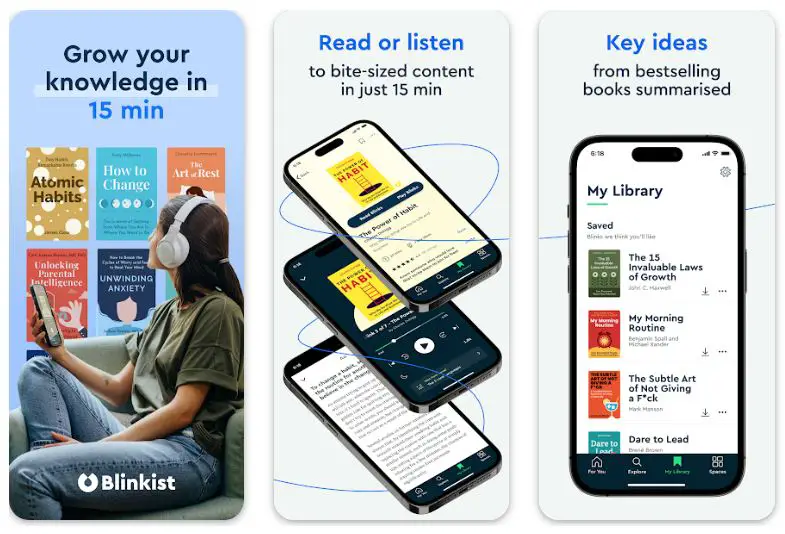
Efficiency Redefined: At the heart of Blinkist lies a remarkable efficiency that transcends traditional reading. This app curates an extensive library of non-fiction works, distilling them into bite-sized capsules of wisdom. Users can grasp diverse subjects’ core ideas during a commute or a coffee break in minutes.
Cognitive Enrichment: The app’s summaries are not mere abstractions but a testament to its editorial finesse. Each Blink encapsulates the quintessence of an author’s argument, preserving the cadence of their prose and unraveling the nuances that make the original work remarkable.
Learning Diversity: Blinkist stands as a digital agora, inviting users to explore an array of subjects ranging from psychology to entrepreneurship, history to self-help. This eclectic diversity equips users with cross-disciplinary insights, nurturing a holistic cognitive growth that bridges conventional silos of knowledge.
Personalized Learning: Catering to individual learning styles, the app offers audio and text formats, enhancing accessibility and accommodating auditory learners. The adaptive experience allows users to choose between summaries and full-text versions, fostering engagement tailored to their preferences.
Time as an Asset: In an era where time is a precious currency, Blinkist operates as a time-saving treasure. The app’s summaries encapsulate the essence of a book without compromising depth. This enables users to invest their time judiciously, curating a personal curriculum that transcends the constraints of a clock.
Curiosity Ignited: Far from replacing traditional reading, Blinkist serves as an ignition for intellectual curiosity. Each summary functions as a spark, kindling the desire to explore the full work and embark on an uncharted intellectual adventure.
Blinkist as a Best Book Summary App embodies the confluence of technology and erudition, simplifying knowledge acquisition without diluting its potency. As it redefines the contours of reading in the digital age, Blinkist empowers users to unlock profound ideas and forge an unbreakable bond with literature, all within the fleeting moments of a dynamic existence.
Experience the future of learning in the palm of your hand—a symphony of wisdom that transcends time constraints.
In the ever-accelerating pace of modern life, Blinkist has emerged as a transformative tool for knowledge acquisition. However, like any innovation, it comes with its pros and cons. Here, we delve into the advantages and limitations of using Blinkist as a book summary app.
Pros:-
Efficiency Redefined: Blinkist condenses extensive non-fiction works into concise summaries, offering users the efficiency to explore many topics quickly.
Cognitive Enrichment: The app’s well-crafted summaries delve into the core ideas of an author’s work, preserving the essence of their writing style and conveying the depth of their insights.
Learning Diversity: With a wide range of subjects from psychology to history to self-help, Blinkist encourages users to embrace diverse learning, fostering holistic intellectual growth.
Time Management: For busy individuals, accessing key ideas without committing to entire books is a boon. Blinkist allows users to maximize their time without sacrificing learning opportunities.
Curiosity Cultivation: Blinkist serves as a gateway to further exploration. Its summaries often spark curiosity, motivating readers to delve into the original works and embark on a broader intellectual journey.
Cons:-
Depth Limitation: While Blinkist excels in condensing complex ideas, it may not capture the complete depth and nuance of the original work, leaving readers with a somewhat abridged understanding.
Subjective Selection: The curated content on Blinkist might not align with individual preferences, limiting exposure to works that fall outside the app’s purview.
Omission of Context: In some cases, key ideas can lose context in the summarization process, potentially leading to misinterpretation of the author’s intent.
Substitution vs. Supplement: The risk of viewing Blinkist summaries as substitutes for full texts is real. While they can be excellent supplements, complete reliance on summaries may hinder deeper engagement with literature.
Limited Fiction Coverage: Blinkist is primarily tailored for non-fiction works. As a result, readers looking for literary exploration might find the app’s offerings limited.
In conclusion, Blinkist is a remarkable innovation that brings convenience and accessibility to knowledge consumption. Its succinct summaries offer many advantages, from efficient learning to cultivating curiosity. However, potential limitations like depth constraints and the risk of substituting summaries for full texts should be considered.
Blinkist can be a powerful tool in a reader’s arsenal, balancing time constraints and intellectual enrichment. As with any tool, making conscious and informed choices about its usage ensures its benefits are fully harnessed while its limitations are navigated skillfully.
Download The App From Google Play Store
Download The App From Apple App Store
2. Headway
In the bustling landscape of intellectual exploration, Headway emerges as an exceptional platform, redefining the art of knowledge assimilation. As a haven for bibliophiles and seekers of wisdom, this app transcends traditional learning methods, propelling users on a captivating odyssey of learning enrichment.
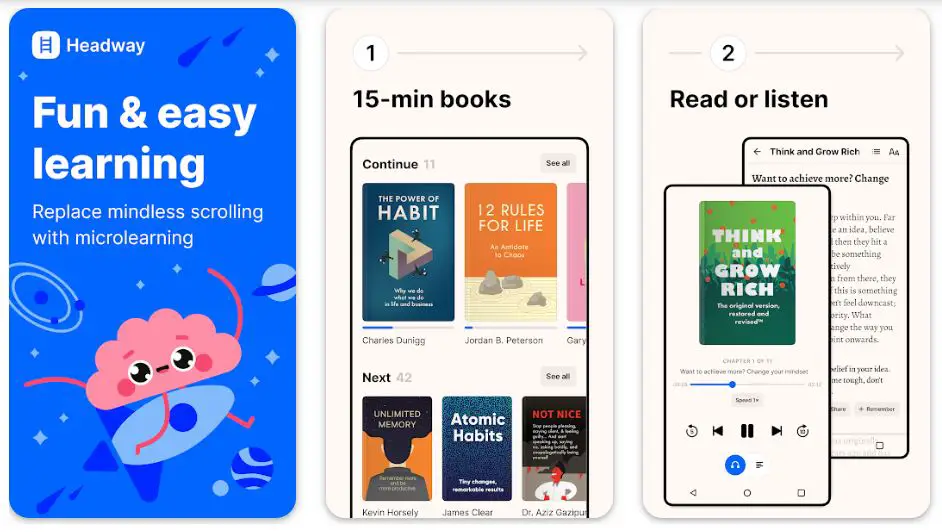
Elevated Learning Experience: At the core of Headway lies an elevated learning experience, where each day unveils a new chapter of discovery. With its comprehensive library of book summaries, this app curates a symphony of ideas that cater to diverse intellectual palettes.
Intellectual Alchemy: Headway employs intellectual alchemy, transforming complex ideas into concise, profound summaries. This synthesis preserves the essence of an author’s narrative prowess, granting users the ability to imbibe intricate ideas with unparalleled efficacy.
Diverse Literary Landscape: Beyond mere brevity, Headway offers a glimpse into a vast literary cosmos. Covering genres from psychology to business, history to self-improvement, the app fosters a multifaceted engagement that broadens the horizons of curious minds.
Curated Wisdom: In a world saturated with information, Headway shines as a beacon of curated wisdom, guiding users towards works of enduring value. The app’s meticulous curation filters out the noise, ensuring each summary resonates with intellectual depth.
Daily Ritual of Enlightenment: Headway isn’t just an app; it’s a daily enlightenment ritual. Its bite-sized summaries fit seamlessly into the rhythm of life, offering a dose of inspiration that sparks curiosity and invites further exploration.
Comprehensive Accessibility: With versions tailored for both Android and Apple devices, Headway ensures comprehensive accessibility. Whether on smartphones or tablets, users can savor the delight of learning at their own pace.
Headway is a testament to the harmonious integration of technology and learning. At the crossroads of digital innovation and intellectual enrichment, it invites users to embark on a journey transcending mere information consumption.
With its amalgamation of curated wisdom, daily enlightenment, and diverse subject matter, Headway is a remarkable companion for those seeking to dynamically and engagingly unravel the tapestry of knowledge.
In intellectual exploration, Headway presents an intriguing proposition for avid learners. However, like any tool, it comes with its own set of advantages and limitations.
Here, we delve into the pros and cons of embracing Headway as a companion on your journey of knowledge.
Pros:-
Daily Doses of Learning: One of the standout features of Headway is its provision of daily book summaries. This offers a structured approach to learning, encouraging users to engage with new ideas consistently.
Time Efficiency: The succinct summaries provide time efficiency, enabling users to glean insights from diverse books without the commitment of reading entire volumes.
Diverse Subjects: Headway boasts many subjects, from psychology to science to personal development. This diversity ensures users can explore various topics, fostering well-rounded intellectual growth.
Curated Quality: The app’s commitment to curating quality content means that users are exposed to summaries that distill the essence of the original works, offering valuable insights.
Convenient Accessibility: With versions available for Android and Apple devices, Headway ensures accessibility for a broad range of users, allowing learning on the go.
Cons:-
Limited Depth: While the summaries aim to capture the core ideas, they might lack the depth and nuances that come with reading the full text. Complex ideas could be oversimplified.
Loss of Context: In the summarization process, some context might be lost, leading to misinterpretation of the author’s intentions.
Preference Variation: The curated summaries might not align with every individual’s reading preferences. Some might miss out on exposure to works that fall outside the scope of the app’s selection.
Substitution Risk: Depending solely on summaries might lead to substituting full-text reading, potentially hindering deeper engagement and understanding.
Lack of Interactivity: Headway offers a passive learning experience through summaries. It might not provide the interactive engagement of actively reading and reflecting on a complete book.
In conclusion, Headway offers a unique approach to intellectual growth, providing users with daily learning doses and diverse subject matter. While it excels in efficiency and curation, limitations like depth constraints and the risk of substituting summaries for full texts should be considered.
It can be a valuable tool for those seeking regular insights but should ideally complement rather than replace traditional reading for a holistic learning experience.
Download The App From Google Play Store
Download The App From Apple App Store
3. StoryShots
In the ever-evolving landscape of knowledge consumption, StoryShots emerges as the quintessential app for book enthusiasts seeking to distill wisdom in a time-efficient manner.
This remarkable app, available for Android and iPhone, redefines the art of literary comprehension, positioning itself as the best app that summarizes books with unparalleled finesse.
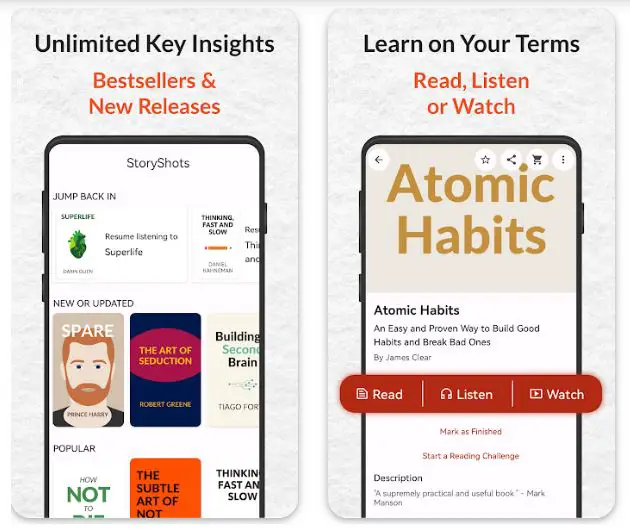
Unveiling Concise Brilliance: At its core, StoryShots serves as a beacon of concise brilliance, encapsulating the essence of full-length books within a compact yet potent format. The app’s summaries are more than mere abstractions; they distill authors’ insights, unfurling the intricacies of their narratives.
Cross-Platform Accessibility: With versions tailored for Android and iPhone, StoryShots democratizes learning by ensuring accessibility across major mobile platforms. The seamless transition between devices ensures that users can immerse themselves in the world of ideas regardless of their preferred operating system.
Cognitive Precision: What sets StoryShots apart is its commitment to cognitive precision. Each summary is meticulously crafted to capture the surface-level concepts and the underlying layers of thought that authors weave into their writings.
Enhanced Learning Efficacy: StoryShots empowers users to embrace enhanced learning efficacy by curating a diverse array of book summaries. The app transcends traditional learning methodologies, allowing users to delve into many topics without compromising depth.
Elevated Intellectual Engagement: Beyond mere summaries, StoryShots fosters an elevated intellectual engagement. Users are prompted to reflect on profound ideas, stimulating a dialogue between the text and the reader’s cognitive landscape.
Visual and Auditory Learning: StoryShots acknowledges the diversity of learning styles by offering text and audio formats. This feature enhances accessibility, catering to those who thrive through both visual and auditory avenues of comprehension.
In essence, StoryShots stands as a beacon of innovation in book summarization, catering to the modern reader’s thirst for knowledge while accommodating the constraints of a dynamic lifestyle.
As it continues to evolve and expand its library of summaries, it reaffirms its position as the best app that summarizes books for Android and iPhone, offering a gateway to intellectual enrichment that fits snugly into the palm of your hand.
As a beacon of book summarization, StoryShots holds the promise of swift knowledge absorption. However, like any tool, it bears both advantages and limitations.
Here, we explore the pros and cons of embracing StoryShots as your companion on the journey of intellectual exploration.
Pros:-
Efficiency Redefined: The hallmark of StoryShots is its ability to distill complex ideas into concise summaries, offering an efficiency that aligns with modern life’s pace.
Wide Subject Spectrum: The app’s curated summaries span diverse genres, from psychology to business to self-help, fostering a multifaceted engagement that caters to diverse interests.
Time Optimization: With its succinct summaries, StoryShots allows users to optimize time, making it feasible to delve into many books without the commitment of full-length reading.
Comprehensive Accessibility: With versions tailored for Android and iPhone, the app ensures comprehensive accessibility, allowing users on different platforms to benefit.
Cognitive Stimulation: By encapsulating the original work’s essence, StoryShots stimulates cognitive engagement, sparking curiosity and reflection.
Cons:-
Depth Limitation: While the summaries provide a glimpse into the authors’ ideas, they might lack the depth and nuances of the full text.
Loss of Context: Complex ideas could lose context in the summarization process, potentially leading to a misinterpretation of the author’s intentions.
Subjective Selection: The app’s curated content might not align with every individual’s preferences, limiting exposure to works outside its selection.
Substitution Risk: Depending solely on summaries might lead to a substitution of complete reading, potentially hindering deeper engagement and understanding.
Passive Learning: The app offers a relatively passive learning experience, lacking the interactive engagement of active reading.
In conclusion, StoryShots offers a unique avenue for knowledge absorption, catering to the modern reader’s need for swift insights. Its efficiency, subject diversity, and accessibility are strong points.
However, potential limitations like depth constraints and the risk of substituting summaries for full texts should be considered. StoryShots can be a valuable tool to complement traditional reading, balancing time constraints and intellectual enrichment.
Download The App From Google Play Store
Download The App From Apple App Store
4. Retell – Key Ideas in 15 Mins
Retell emerges as a frontrunner among book summarization apps in the dynamic landscape of intellectual exploration. With its innovative approach and commitment to delivering insights, Retell is the best app to summarize books, inviting readers into a realm of knowledge distilled to its essence.
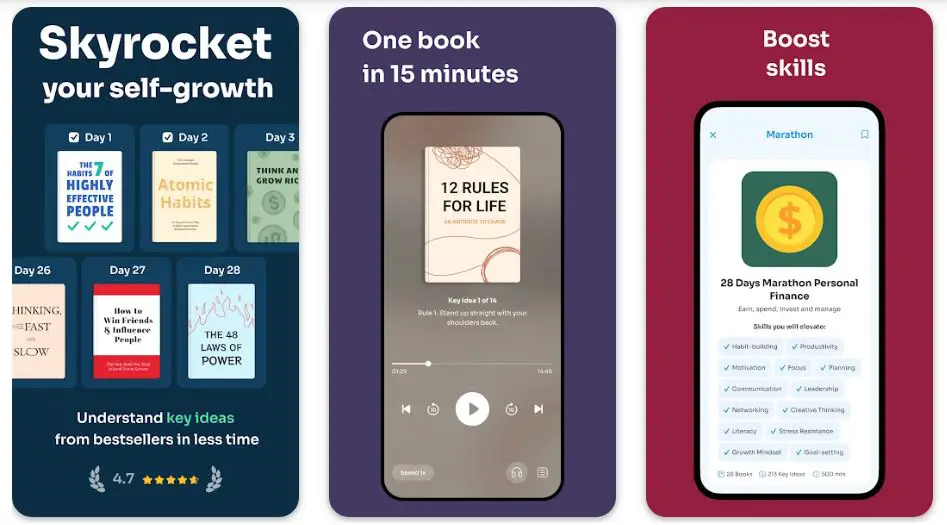
Intellectual Refinement: At its core, Retell is an exemplar of intellectual refinement, presenting readers with concise yet comprehensive summaries that capture the heart of each book’s message. It transforms the act of summarization into an art, maintaining the integrity of the author’s original thought while streamlining content.
Curated Insight: The app offers more than mere brevity; it is a gateway to curated insight. Each summary is a carefully woven tapestry that unites key concepts, fostering a nuanced understanding that mirrors the immersive experience of reading the full work.
Cognitive Alchemy: With a touch of cognitive alchemy, Retell transforms complex ideas into accessible knowledge nuggets. The app’s proficiency in translating intricate prose into easily digestible fragments empowers users to engage deeply with diverse topics.
Versatile Learning: Retell caters to a broad spectrum of learners. Whether you’re an auditory learner seeking audio summaries or a visual learner who prefers text, the app’s adaptability accommodates your preferred mode of versatile learning.
Time-Smart Wisdom: In an era where time is a precious commodity, Retell offers the luxury of accessing wisdom without the temporal investment required for full-text reading. It unlocks the doors to many ideas in a fraction of the time.
Interactive Exploration: Beyond summarization, Retell fosters interactive exploration. The app’s summaries often serve as catalysts, igniting the reader’s curiosity and prompting them to dive deeper into subjects of interest.
In summary, Retell stands as a testament to the harmonious synergy of technology and intellectual growth. As the best app to summarize books, it offers a transformative platform for those seeking efficient knowledge absorption without compromising the integrity of the content.
Through its curated insight, cognitive finesse, and adaptability, Retell delivers summaries and opens doors to a world of ideas that spark curiosity and enrich the pursuit of knowledge.
As a trailblazing book summarization app, Retell brings the promise of streamlined learning. However, like any tool, it comes with merits and considerations.
Here, we delve into the pros and cons of embracing Retell as your guide on intellectual discovery.
Pros:-
Intellectual Precision: Retell excels in distilling complex ideas into intellectual precision, offering concise summaries that encapsulate the essence of each book’s core concepts.
Curated Clarity: The app offers more than just summaries; it provides curated clarity, presenting insights that resonate beyond surface-level understanding.
Adaptive Learning: Whether you’re an auditory or visual learner, Retell caters to various learning styles, ensuring adaptive learning that suits individual preferences.
Time Optimization: With its concise summaries, Retell enables time optimization, allowing users to explore many ideas without committing to full-length reading.
Interactive Engagement: Beyond summarization, the app fosters interactive engagement, sparking curiosity and prompting readers to explore further.
Cons:-
Depth Constraint: While summaries offer a glimpse into book content, they might lack the depth and nuances of incomplete works.
Loss of Context: Some context could be lost in the summarization process, potentially leading to a misinterpretation of the author’s intentions.
Subjective Selection: The app’s curated content might not align with every reader’s preferences, potentially limiting exposure to diverse works.
Substitution Risk: Relying solely on summaries could lead to a substitution of full-text reading, which might hinder a deeper understanding of complex ideas.
Passive Learning: The app primarily offers a passive learning experience, lacking the interactive engagement of active reading and reflection.
In conclusion, Retell offers an innovative approach to knowledge absorption, catering to the modern reader’s need for efficient insights. Its intellectual precision, adaptive learning, and interactive engagement are strong points.
However, potential limitations like depth constraints and the risk of substituting summaries for full texts should be considered. Retell can be an invaluable tool to complement traditional reading, providing an optimal balance between time constraints and intellectual enrichment.
Download The App From Google Play Store
Download The App From Apple App Store
5. 12min: Book Summaries & Ideas
12min: Book Summaries & Ideas emerge as a trailblazing beacon in intellectual exploration, offering a unique portal to unlock a treasure trove of insights.
With its innovative approach to summarizing books, this app transcends conventional learning methods, encapsulating the spirit of full texts within succinct summaries.
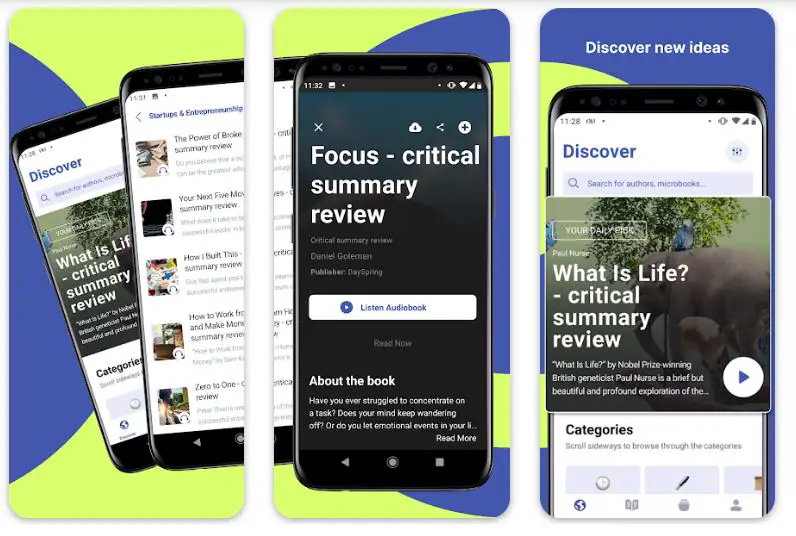
Efficiency Refined: At the heart of 12min lies an extraordinary efficiency, condensing entire books into bite-sized summaries that capture the essence of each work. This empowers users to embark on a comprehensive intellectual journey in a fraction of the time.
Cognitive Distillation: The app’s prowess extends beyond brevity—a form of cognitive distillation. Each summary is a carefully crafted masterpiece that distills complex ideas into easily digestible fragments, allowing readers to absorb profound concepts effortlessly.
Multifaceted Exploration: 12min isn’t confined to any one domain. It offers a multifaceted exploration of topics ranging from psychology to entrepreneurship, history to personal development, catering to diverse intellectual curiosities.
Curatorial Excellence: With an impeccable eye for curation, 12min presents a selection of summaries that exemplify curatorial excellence. Users are guided towards works of enduring value, ensuring that each summary resonates with thought-provoking insights.
Adaptive Accessibility: Whether on Android or Apple devices—iPhone, iPad, Apple Watch, or Messages—12min ensures adaptive accessibility. This availability across multiple platforms empowers users to integrate knowledge absorption into their daily lives seamlessly.
Catalyst for Deeper Learning: Beyond mere summarization, 12min catalyzes deeper learning. Its succinct summaries often serve as stepping stones, inciting readers to venture into the world of full texts and embark on a comprehensive intellectual odyssey.
In essence, 12min: Book Summaries & Ideas is a testament to the harmonious integration of technology and intellectual enrichment. As it continues to redefine the contours of book summarization, it invites users to embrace a realm of knowledge that transcends time constraints.
Through its distilled insights, cognitive finesse, and adaptability, 12min offers summaries and opens the doors to a world of ideas that spark curiosity and enrich the pursuit of knowledge.
As a pioneering app in condensed learning, 12min: Book Summaries & Ideas offers the promise of efficient knowledge absorption. Yet, like any tool, it carries both advantages and considerations.
Here, we delve into the pros and cons of embracing 12min as a companion on your intellectual journey.
Pros:-
Efficiency Perfected: The hallmark of 12min is its ability to distill elaborate concepts into concise summaries, saving users substantial time while delivering comprehensive insights.
Cognitive Enrichment: The app excels not just in brevity but also in cognitive enrichment. Each summary retains the essence of the original text, ensuring a profound understanding of the core ideas.
Diverse Learning: Covering an array of subjects from psychology to entrepreneurship, 12min fosters diverse learning, catering to users with a spectrum of intellectual interests.
Curatorial Excellence: The app’s curation elevates it further, guiding users toward summaries representing curatorial excellence. Readers gain access to works of enduring significance.
Multi-Platform Accessibility: Available on Android, iPhone, iPad, Apple Watch, and Messages, 12min ensures multi-platform accessibility, seamlessly integrating learning into users’ daily routines.
Cons:-
Depth Constraint: While the summaries provide a glimpse into the book’s content, they might lack the depth and intricacies that come with full-text reading.
Contextual Loss: In the summarization process, some context could be lost, potentially leading to a misinterpretation of the author’s intentions.
Subjective Selection: The app’s curated content might not align with every reader’s preferences, potentially limiting exposure to a broader range of works.
Substitution Risk: Depending solely on summaries might encourage substituting full-text reading, potentially hindering deeper engagement with complex ideas.
Passive Engagement: The app predominantly offers a passive learning experience, missing the interactive engagement that active reading and reflection provide.
In conclusion, 12min: Book Summaries & Ideas offers an innovative route to learning, catering to the contemporary reader’s need for swift insights. Its efficiency, cognitive depth, and curatorial finesse are commendable.
However, potential limitations like depth constraints and the risk of substituting summaries for full texts should be acknowledged. 12min can be a potent tool to supplement traditional reading, balancing time constraints and intellectual enrichment.
Download The App From Google Play Store
Download The App From Apple App Store
6. getAbstract
In the ever-evolving landscape of intellectual exploration, getAbstract emerges as a trailblazing force, redefining the art of knowledge assimilation. As a haven for curious minds, this app transcends conventional learning methods, propelling users into a realm of curated wisdom and cognitive enrichment.
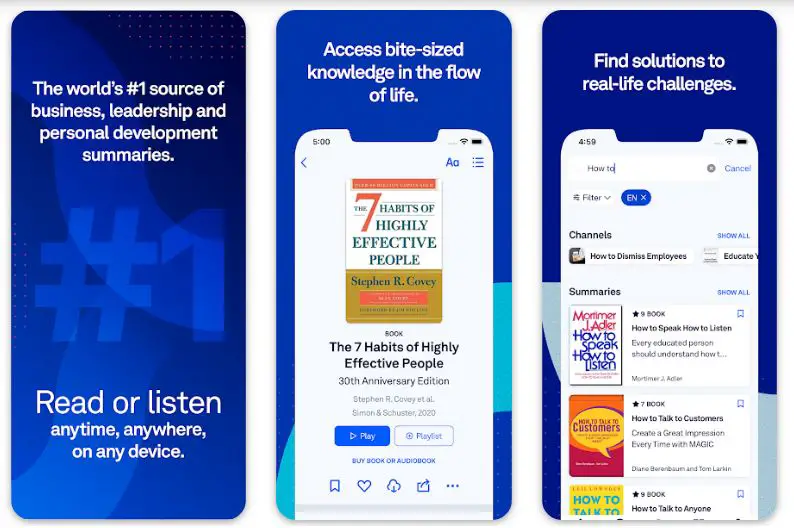
Efficiency Redefined: At the heart of getAbstract lies a remarkable efficiency that transforms how we absorb information. The app condenses an extensive range of non-fiction works into bite-sized summaries, enabling users to grasp the core ideas of diverse subjects within a fraction of the time.
Curated Brilliance: What sets getAbstract apart is its commitment to curated brilliance. Each summary encapsulates the essence of an author’s narrative prowess, preserving the nuances that make the original work exceptional.
Learning Diversity: getAbstract stands as a digital library, inviting users to explore an array of subjects spanning from leadership to technology, economics to psychology. This eclectic diversity empowers users with cross-disciplinary insights, fostering holistic intellectual growth.
Adaptive Access: With versions tailored for Android and iPhone, getAbstract ensures adaptive access to its treasure trove of summaries. This versatile availability allows users to engage with knowledge on their preferred devices.
Quality over Quantity: Amid the information deluge, getAbstract is a beacon of quality over quantity. Its curation filters out the noise, offering users a selection of summaries that resonate with intellectual depth.
Catalyst for Intellectual Exploration: Beyond serving as a mere summarization app, getAbstract catalyzes intellectual exploration. Each summary sparks curiosity, inviting users to embark on a deeper journey into the world of ideas.
In essence, getAbstract transcends the boundaries of traditional learning. As it continues to redefine the contours of knowledge consumption, it invites users to embrace a world of ideas that transcends time constraints.
Through its curated brilliance, cognitive finesse, and adaptability, getAbstract empowers users to unlock profound insights and forge an unbreakable bond with literature, all within the dynamic rhythm of modern life.
getAbstract stands as a pinnacle in knowledge summarization, offering a platform for swift intellectual enrichment. Yet, like any tool, it comes with both advantages and considerations.
Here, we explore the pros and cons of embracing getAbstract as a guide on your learning journey.
Pros:-
Efficiency Perfected: The hallmark of getAbstract is its ability to distill complex concepts into bite-sized summaries, efficiently using users’ time while delivering comprehensive insights.
Curated Excellence: The app goes beyond mere brevity to offer curated excellence. Each summary retains the original work’s essence, ensuring the preservation of the author’s core ideas.
Diverse Learning: Covering a broad spectrum of subjects from leadership to technology, getAbstract fosters diverse learning, catering to a wide range of intellectual interests.
Adaptive Accessibility: With versions available for Android and iPhone, the app ensures adaptive accessibility, allowing users to engage with knowledge on their preferred devices.
Quality Curation: Amid the sea of information, getAbstract excels in quality curation, presenting users with summaries that embody intellectual depth and enduring significance.
Cons:-
Depth Limitation: While the summaries offer insights into book content, they might lack the depth and nuances that come with full-text reading.
Contextual Reduction: The summarization process could reduce context, potentially leading to a misinterpretation of the author’s original intentions.
Subjective Selection: The app’s curated content might not align with every user’s preferences, potentially limiting exposure to a broader range of works.
Risk of Substitution: Relying solely on summaries might encourage substituting complete reading, hindering deeper engagement with intricate ideas.
Passive Learning: The app primarily offers a passive learning experience, lacking the interactive engagement of active reading and reflection.
In conclusion, getAbstract offers a revolutionary approach to knowledge acquisition, catering to the modern reader’s desire for swift insights. Its efficiency, curated excellence, and adaptive accessibility are its strengths.
However, potential limitations such as depth constraints and the risk of substituting summaries for full texts should be acknowledged. getAbstract can be a valuable tool to supplement traditional reading, balancing time constraints and intellectual enrichment.
Download The App From Google Play Store
Download The App From Apple App Store
7. Storytel
In the ever-evolving realm of knowledge consumption, Storytel emerges as a distinguished powerhouse, redefining the art of learning through audiobook summaries.
Positioned as one of the best audio book summary apps, Storytel enriches the modern reader’s experience with a symphony of ideas presented in an engaging auditory format.
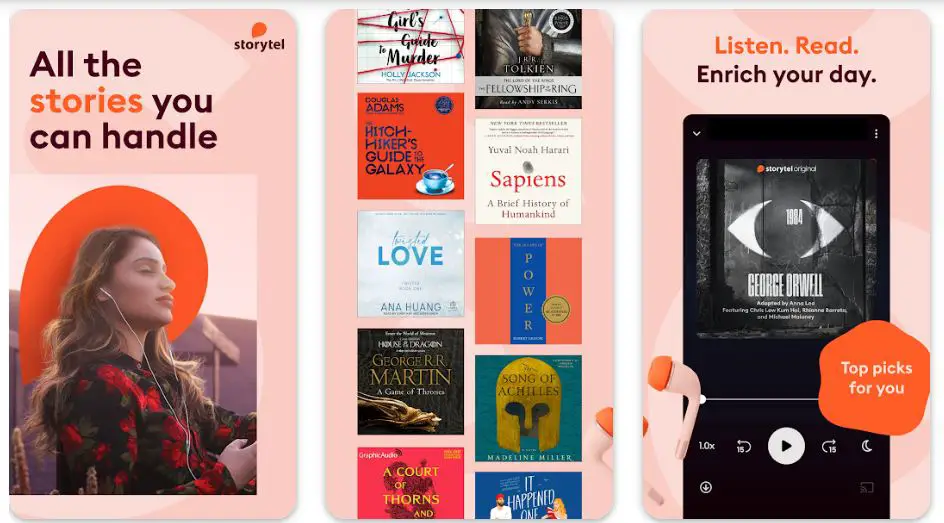
Auditory Enlightenment: At its core, Storytel embodies auditory enlightenment, revolutionizing how information is absorbed. The app transforms book summaries into captivating audio narratives, catering to individuals who thrive through auditory learning.
Efficient Knowledge Assimilation: The hallmark of Storytel lies in its ability to facilitate efficient knowledge assimilation. Users can delve into the essence of various books without committing to the time investment required for full-text reading.
Immersive Narration: Through the magic of immersive narration, Storytel transports listeners into a world of ideas as if conversing with the authors themselves. This unique experience bridges the gap between content and audience.
Adaptive Exploration: The app offers a treasure trove of summaries across genres, from fiction to non-fiction, fostering adaptive exploration that caters to diverse intellectual interests.
On-the-Go Learning: One of the key advantages of Storytel is its compatibility with the modern lifestyle. Users can indulge in learning while on the move, transforming mundane commutes or daily chores into opportunities for intellectual enrichment.
Multisensory Engagement: Unlike traditional text-based summaries, Storytel enhances comprehension through multisensory engagement. The combined impact of auditory and cognitive stimuli deepens understanding and retention.
Storytel stands as a bridge between technology and learning, inviting users to embark on a journey that transcends traditional methods. As it continues to redefine the contours of audiobook summaries, it invites readers to embrace knowledge in an immersive and dynamic manner.
Through its auditory enlightenment, efficient assimilation, and adaptive exploration, Storytel offers summaries and invites users to participate in a harmonious symphony of ideas that resonate long after the final note.
Storytel is a testament to the fusion of technology and learning, offering an immersive experience through audiobook summaries. As one of the best audio book summary apps, it has advantages and considerations.
Here, we delve into the pros and cons of embracing Storytel as your gateway to knowledge.
Pros:-
Auditory Enrichment: Storytel excels in auditory enrichment, providing users with a unique learning experience through engaging audiobook summaries.
Time Efficiency: The app allows for time-efficient learning, enabling users to delve into the core ideas of various books without dedicating hours to full-text reading.
Immersive Learning: Through immersive narration, Storytel transports listeners into the heart of the content, enhancing comprehension and engagement.
Diverse Exploration: The app’s wide array of summaries spans genres, inviting users to explore topics that cater to varied intellectual interests.
Convenient Accessibility: Users can engage with content on the go, transforming idle moments into opportunities for convenient learning.
Cons:-
Depth Constraint: While the audiobook summaries offer insights, they might lack the depth and nuances in full-text works.
Auditory Preference: The auditory format might not be ideal for all learners, potentially excluding those who favor visual or other learning modalities.
Limited Interactivity: The nature of audio summaries might lead to limited interactivity compared to actively reading and reflecting on complete texts.
Subjective Selection: The app’s curated content might not resonate with every individual’s preferences, potentially limiting exposure to diverse works.
Dependency Risk: Relying solely on audiobook summaries might lead to a dependency on summarized content, potentially overlooking the value of full-length reading.
In conclusion, Storytel offers a distinctive approach to knowledge absorption, appealing to auditory learners and those seeking efficient insights. Its immersive nature, time efficiency, and diverse exploration are its strengths.
However, potential limitations such as depth constraints and the risk of substituting summaries for full texts should be acknowledged. Storytel can serve as an enriching tool to complement traditional reading, striking a balance between convenience and intellectual enrichment.
Download The App From Google Play Store
Download The App From Apple App Store
8. Deepstash
In the dynamic landscape of self-improvement, Deepstash: Smarter Every Day! Emerges as a beacon of cognitive enrichment. With its innovative knowledge-sharing approach, this app transcends conventional learning methods, fostering a culture of continuous learning and growth.
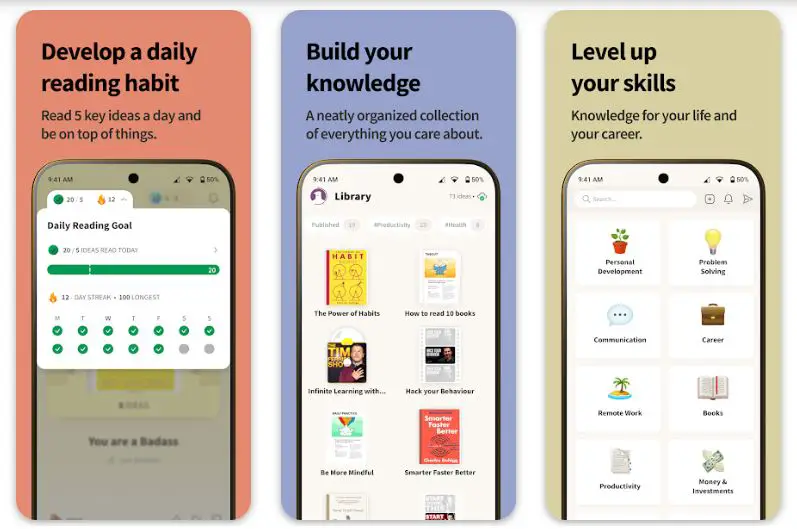
Cognitive Elevator: At the heart of Deepstash lies a commitment to being a cognitive elevator. It elevates users’ intellectual prowess by offering curated insights that challenge the status quo and stimulate intellectual curiosity.
Microlearning Brilliance: The app excels in microlearning brilliance, delivering bite-sized knowledge gems that can be consumed on the go. This approach to learning aligns perfectly with the fast-paced rhythm of modern life.
Ideas Unleashed: Deepstash is a treasure trove of ideas waiting to be unleashed. It serves as a repository of insights across diverse domains, inviting users to embark on a journey of exploration and introspection.
Adaptive Learning: With versions available for both Android and iPhone, Deepstash ensures adaptive learning that caters to individual preferences, making knowledge accessible at the user’s convenience.
Intellectual Growth: By embracing Deepstash, users commit to continuous intellectual growth. The app’s curated content catalyzes personal development and transformative thinking.
Smarter Every Day: As the name suggests, Deepstash: Smarter Every Day! Lives up to its promise of making users “smarter every day”. The app’s content facilitates daily intellectual empowerment, creating a sharper mindset.
In essence, Deepstash: Smarter Every Day! Stands as a bridge between technology and intellectual evolution, inviting users to embark on a journey of knowledge and self-discovery. As it redefines microlearning’s contours, it extends an invitation to embrace knowledge as a constant companion.
Through its cognitive elevator, microlearning brilliance, and adaptive accessibility, Deepstash offers insights and empowers users to cultivate a growth mindset and continuous self-improvement.
Deepstash: Smarter Every Day! Stands as a beacon of cognitive growth, offering a platform for continuous learning. Yet, like any tool, it comes with both advantages and considerations.
Here, we explore the pros and cons of embracing Deepstash as your companion on the path to intellectual enrichment.
Pros:-
Cognitive Enrichment: Deepstash excels in cognitive enrichment, providing users with a curated stream of insights that stimulate intellectual curiosity.
Microlearning Brilliance: The app’s focus on microlearning brilliance enables users to absorb knowledge in bite-sized portions, fitting seamlessly into busy routines.
Diverse Knowledge: Deepstash serves as a reservoir of diverse knowledge, fostering diverse learning and encouraging exploration across various subjects.
Adaptive Accessibility: Available on both Android and iPhone, the app ensures adaptive accessibility, allowing users to engage with knowledge on their preferred devices.
Continuous Improvement: By embracing Deepstash, users embark on a journey of continuous improvement, cultivating a mindset of growth and self-evolution.
Cons:-
Depth Constraint: While the app offers insights, the nature of microlearning might limit the depth and comprehensive understanding found in full-length works.
Fragmented Knowledge: The bite-sized nature of content could result in fragmented knowledge, potentially lacking the cohesion of full-text exploration.
Lack of Interaction: The app might lack the interactive engagement of full-length reading, potentially hindering deeper understanding and reflection.
Subjective Selection: The app’s curated content might not align with every user’s preferences, limiting exposure to certain topics.
Dependency Risk: Relying solely on microlearning might lead to a dependency on summarized content, overlooking the value of deep dives into comprehensive texts.
In conclusion, Deepstash: Smarter Every Day! Offers an innovative approach to knowledge absorption, catering to the modern learner’s need for convenient insights. Its cognitive enrichment, microlearning brilliance, and adaptive accessibility are commendable.
However, potential limitations such as depth constraints and the risk of substituting microlearning for full texts should be acknowledged. Deepstash can effectively complement traditional learning, striking a balance between convenience and intellectual growth.
Download The App From Google Play Store
Download The App From Apple App Store
9. Instaread
In the realm of rapid knowledge acquisition, Instaread emerges as a luminary, illuminating the path to intellectual growth. Positioned as a beacon of quick learning, this app transcends traditional reading methods, offering a dynamic platform for engaging with insights from diverse texts.
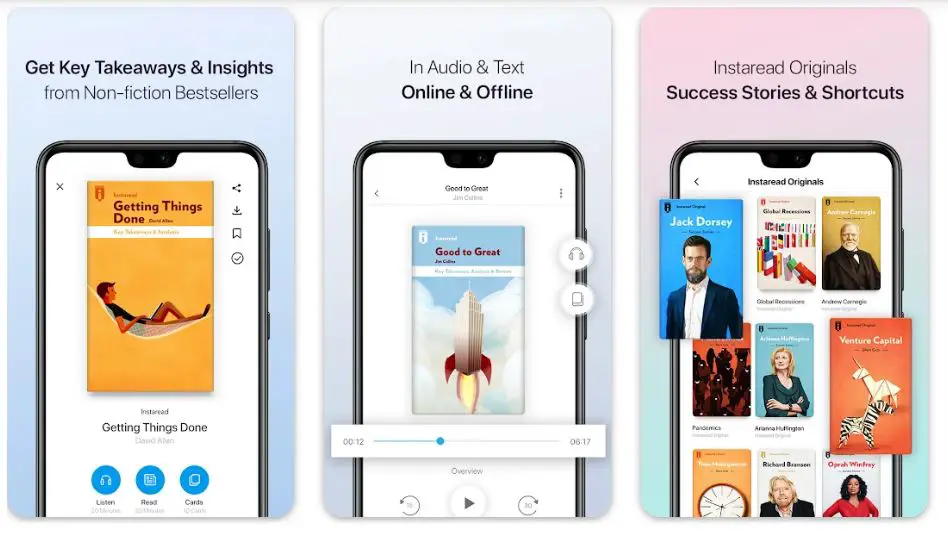
Efficiency Amplified: At the core of Instaread lies a commitment to efficiency amplified. It harnesses the power of summarization to distill the essence of books into concise yet comprehensive summaries.
Knowledge Accelerator: The app serves as a knowledge accelerator, propelling users into a realm of learning that respects their time constraints while delivering profound insights.
Thoughtful Curation: Instaread doesn’t merely summarize; it curates, ensuring that each summary embodies thoughtful curation that resonates with intellectual depth.
Multidimensional Exploration: From self-help to business, Instaread encourages multidimensional exploration across various genres, allowing users to immerse themselves in diverse subjects.
Accessible Insights: With versions available for both Android and iPhone, Instaread guarantees accessible insights, making knowledge absorption seamlessly integrated into users’ lifestyles.
Intellectual Ignition: By embracing Instaread, users ignite their intellectual curiosity. The app’s curated content serves as a spark that kindles the flame of exploration.
In essence, Instaread serves as a bridge between the information age and intellectual enlightenment. As it continues to redefine the contours of quick learning, it extends an invitation to seize knowledge in an impactful manner.
Through its efficiency amplification, thoughtful curation, and accessible insights, Instaread empowers users to gain insights and fuel a perpetual intellectual growth and exploration cycle.
Instaread is a beacon of efficient learning, offering a platform for rapid knowledge immersion. Yet, like any tool, it presents both advantages and considerations.
Here, we delve into the pros and cons of embracing Instaread as a companion on your journey to quick knowledge acquisition.
Pros:-
Efficiency Amplified: The hallmark of Instaread is its ability to amplify efficiency. Distilling books into succinct summaries empowers users to absorb key insights without the time investment required for a complete reading.
Accelerated Learning: The app accelerates learning, allowing users to explore a wide range of topics and gain valuable insights in a shorter period.
Curated Excellence: Beyond mere summarization, Instaread offers curated excellence. Each summary reflects thoughtful curation that captures the depth and significance of the original work.
Multigenre Exploration: The app promotes multigenre exploration, enabling users to delve into various subjects, from personal development to business, fostering intellectual diversity.
Adaptive Access: With versions available for both Android and iPhone, Instaread ensures adaptive access, enabling users to engage with knowledge on their preferred devices.
Cons:-
Depth Constraint: While summaries offer valuable insights, they might lack the depth and intricacies of full-text reading.
Contextual Reduction: The summarization process could reduce context, potentially leading to a skewed interpretation of the author’s original intentions.
Subjective Selection: The app’s curated content might not align with every user’s preferences, potentially limiting exposure to a broader range of works.
Dependency Risk: Relying solely on summaries might lead to a dependency on summarized content, potentially missing the value of deep dives into complete texts.
Substitution Concerns: Depending solely on summaries might encourage substituting complete reading, potentially affecting the deeper engagement with intricate ideas.
In conclusion, Instaread offers an innovative approach to knowledge consumption, catering to the modern learner’s need for efficient insights. Its efficiency amplification, curated excellence, and adaptive accessibility are commendable.
However, potential limitations such as depth constraints and the risk of substituting summaries for full texts should be acknowledged. Instaread can effectively complement traditional learning, balancing convenience and intellectual enrichment.
Download The App From Google Play Store
Download The App From Apple App Store
How to Make the Most Out of Book Summary Apps
In the dynamic landscape of information consumption, book summary apps have emerged as beacons of efficient learning, promising to distill the essence of books into concise insights.
A strategic approach is essential to navigate this sea of knowledge and extract the maximum value. Here, we delve into the strategies to make the most out of book summary apps and harness their potential for intellectual enrichment.
1. Select Your Subjects Strategically: The first step to optimizing your experience with book summary apps is strategically choosing subjects that align with your interests and goals. Focusing on topics that resonate with your curiosity ensures that your learning journey is engaging and relevant.
2. Set Clear Learning Objectives: Define your learning objectives before diving into summaries. Are you seeking broad insights or specific details? Clarifying your objectives allows you to approach each summary purposefully, enhancing the relevance of the knowledge you acquire.
3. Prioritize Quality Curation: Opt for apps that prioritize quality curation. Seek out platforms that curate summaries with intellectual depth, ensuring that the original work’s essence is preserved in the condensed version.
4. Embrace Diverse Genres: Expand your intellectual horizons by exploring various genres. Book summary apps often cover subjects from psychology to business, allowing you to cultivate a multidisciplinary understanding.
5. Supplement, Don’t Substitute: While book summary apps offer efficient insights, they should complement rather than replace traditional reading. Utilize summaries for quick insights, but consider diving into complete texts for a deeper understanding.
6. Reflect and Apply: After consuming a summary, take the time to reflect on the insights gained and consider how they apply to your personal or professional life. This practice transforms information into actionable wisdom.
7. Pair with Active Learning: Integrate summaries into your active learning routine. Engage with the content through note-taking, discussions, or applying the ideas in real-world scenarios to enhance understanding.
8. Engage with the Community: Many book summary apps offer community features like discussions or forums. Engaging with fellow learners can provide different perspectives and enrich your understanding.
9. Create a Learning Habit: Consistency is key. Establish a learning habit by dedicating a specific time each day or week to engage with summaries. This regularity fuels a continuous journey of intellectual growth.
10. Stay Curious: Foster a curious mindset as you explore various summaries. Approach each insight with an open mind, allowing your intellectual curiosity to drive your learning journey.
11. Apply the Pareto Principle: Utilize the Pareto Principle (the 80/20 rule) to identify the most impactful summaries. Focus on the ones that provide the most value for your learning objectives.
12. Note and Review: Take notes on key insights as you engage with summaries. Regularly reviewing these notes enhances retention and reinforces your understanding.
In conclusion, making the most of book summary apps involves a strategic blend of selection, engagement, and reflection. By choosing subjects wisely, setting clear objectives, and embracing diverse genres, you can leverage the condensed insights to fuel intellectual growth. Remember that summaries should complement your learning journey, not replace them entirely.
By staying curious, engaging with the community, and integrating summaries into active learning practices, you unlock the potential of these apps to transform your approach to knowledge acquisition. Through strategy and active engagement, you embark on a journey of efficient learning that transcends traditional boundaries.
Blinkist vs Short Form: Delving Deep into the Realm of Compressed Knowledge
In an age where information is ubiquitous, and everyone is striving to stay ahead, the efficacy of time-saving knowledge platforms is paramount. Two of the notable giants in this sphere are Blinkist and Short Form. These platforms epitomize the new zeitgeist of rapid learning but with subtle distinctions that cater to unique consumer propensities.
Blinkist emerged as a revolutionary luminary in compressed reading, offering a compelling promise to its users: profound insights from top-notch books in mere minutes. Its modus operandi is distilled, well-crafted synopses, known as “blinks,” offering the crux of the matter without the attendant fluff.
Contrarily, Short Form promulgates a slightly different pedagogy. While it too is entrenched in the philosophy of concise comprehension, its focus leans towards an analytical dissection of content. Where Blinkist offers swift summation, Short Form plunges into the nitty-gritty, elucidating the more arcane aspects of the book.
For voracious readers grappling with the existential quandary of time scarcity, the question looms large: Blinkist vs Short Form, which is the superior conduit for knowledge?
Let’s dissect this problem.
Content Depth and Breadth:-
The primordial factor governing this debate is content depth. Blinkist, with its encapsulated blinks, provides an aerial view. The reader soars over the landscape of the book, glimpsing the major landmarks but missing the granular details. It’s perfect for those seeking a précis, a taste of the book’s essence.
On the other hand, Short Form delves deeper, extricating the minutiae. It’s not just about knowing the story; it’s about understanding the underlying subtext, the motifs, and the intricate tapestry woven by the author.
User Interface and Experience:-
Both platforms are designed with the modern netizen in mind, yet their interfaces are divergent. Blinkist opts for a minimalist design ethos, ensuring seamless navigation. Its simplicity is its strength, making discovering and consuming content effortless.
Short Form, however, immerses its users in a more scholarly ambiance. Its design ethos leans towards comprehensive exploration, encouraging users to linger, ponder, and truly assimilate the knowledge.
Cost Implications and Value Proposition:-
The financial dimensions of Blinkist vs Short Form are multifaceted. While both platforms operate on subscription models, their value propositions vary. Blinkist appeals to those seeking an array of titles, a veritable buffet of knowledge. It’s about volume and variety.
Conversely, Short Form is the gourmet dining experience. It’s about savoring each morsel, relishing the richness of content. The cost might be steeper, but the depth of engagement it offers justifies the premium.
The debate between Blinkist vs Short Form is not a facile one. Both platforms cater to the knowledge-hungry populace, albeit in distinct ways. The ideal choice hinges on individual preferences.
If one seeks rapid insights and a broad spectrum of topics, Blinkist is the logical choice. But for those with an appetite for deeper understanding and a more comprehensive grasp of content, Short Form stands tall.
In conclusion, in the labyrinth of compressed knowledge, the route one chooses is guided by their intellectual appetence. Whether it’s the panoramic vistas of Blinkist or the meticulous detail of Short Form, the ultimate aim is enlightenment. And in this age of information overload, such platforms are not just luxuries; they are necessities.
Blinkist Vs Headway: A Deep Dive into the Battle of Book Summaries
The digital age has brought with it an insatiable thirst for information. But, paradoxically, our attention spans seem to be waning. Enter book summary apps like Blinkist and Headway, platforms designed to sate our modern-day proclivity for condensed wisdom.

As these titans clash in rapid knowledge acquisition, which emerges supreme? Let’s traverse the labyrinth of their offerings to determine the victor.
Decoding the Phenomenon
Before delving into the intricacies of Blinkist Vs Headway, it’s pivotal to understand the zeitgeist these platforms tap into. There’s a burgeoning need for curation in a world inundated with an overabundance of information.
These apps, in essence, act as cerebral sommeliers, presenting nuanced overviews of full-length books, often distilled into digestible 15-minute snippets. This symbiotic relationship between information and brevity creates an epistemological dance that is nothing short of revolutionary.
The Allure of Blinkist
Blinkist, a stalwart in this arena, has amassed many fans. Its strength lies in its voluminous library. With over 4,500 titles across diverse genres, it promises an eclectic mix for the voracious reader and the casual peruser alike.
One of Blinkist‘s pièce de résistance is its curated daily picks. Imagine, if you will, a gourmet dish served to satiate your intellectual appetite every day. The summaries, known as “blinks”, are meticulously crafted, ensuring no salient point is omitted. Furthermore, the app boasts an intuitive interface, seamless audio integration, and a plethora of languages, making it a veritable pantheon for polyglots.
Unpacking Headway
In the juxtaposition of Blinkist Vs Headway, the latter is a newer entrant, but by no means a neophyte. Headway distinguishes itself with its impeccable design and user experience. The app radiates a contemporary aura, a synthesis of minimalism and functionality.
While it may not yet rival Blinkist‘s vast library, Headway is not to be underestimated. The summaries here are insightful, and there’s a noticeable emphasis on self-help and personal development books. This focus, although niche, has found resonance with a segment of readers yearning for transformative knowledge.
A standout feature of Headway is its ‘Deep Dive’ sessions. These sessions, extending beyond mere summaries, provide a profound understanding of the core concepts of select books. It’s akin to an intensive workshop, albeit one that can be completed in a fraction of the usual time.
When navigating the maze of Blinkist Vs Headway, the choice isn’t binary. Both platforms are titanic, each with unique offerings and distinct appeal.
For the eclectic reader who values variety and sheer volume, Blinkist might hold a slight edge. Its extensive library, combined with its multilingual support, makes it a formidable contender.
Conversely, Headway shines through for those who cherish design, user experience, and a concentrated emphasis on personal development. Its ‘Deep Dive’ sessions testify to its commitment to providing an enriched reading experience.
In conclusion, the contest between Blinkist and Headway is not a zero-sum game. As with many dichotomies in life, the optimal choice is often predicated on individual preferences.
However, the transformative power of these platforms in democratizing knowledge in our hyper-connected age remains undisputed. Embrace them, and let the chronicles of condensed wisdom unfurl.
📗FAQ’s
Which is the best free book summary app?
In the quest for knowledge distillation, discerning minds often ponder the juxtaposition of Blinkist and the enigmatic allure of short-form apps. Evaluating the merit of Blinkist prompts a crucial query:
Is Blinkist worth it?
While it presents a compelling gateway to literary digests, it isn’t a free app. The Blinkist summary app delivers bite-sized synopses, but alternatives also beckon.
Is there anything better than Blinkist?
Considering alternatives to Blinkist, the art of summarizing a book unveils itself. Engaging with a book summary app can be rewarding, but determining its worth hinges on individual biases. Exploring an app’s repository becomes pivotal, like identifying the one with the most books. Enter the discourse of Lucid versus Blinkist, exploring the nuances that differentiate them.
Can Blinkist replace reading?
While Blinkist kindles the flames of curiosity, its capacity to supplant conventional reading remains a problem. Can it truly satiate the intellectual appetite akin to consuming entire tomes? The fundamental inquiry echoes: Can Blinkist replace reading?
Why do people use Blinkist?
Blinkist’s popularity endures, catering to a spectrum of readers. This popular app tantalizes with the allure of swift knowledge absorption. Still, whether authors profit from Blinkist lingers, a testament to the intricate relationship between condensation and compensation.
Amidst the discourse, clarifying the financial facet emerges crucial. Blinkist operates on a freemium model, offering a taste of its offerings gratis while enticing users toward its premium tiers. This prompts a pondering of how precisely Blinkist orchestrates its revenue streams.
How do I summarize what I read?
In the pursuit of comprehension distillation, summarizing what one reads becomes an art. Rules of summarizing come into play, encapsulating the essence in a concise yet comprehensive manner. But is indulging in book summaries ethically acceptable?
Where can I find summaries of books?
Venturing beyond apps, the quest for book summaries navigates one through various digital corridors. Websites, forums, and repositories harbor these condensed gems, providing seekers with diverse options.
Which is better, Headway or Blinkist?
Delineating the supremacy of Headway over Blinkist or vice versa requires a contextual lens. The better choice hinges on individual preferences, pitting two avenues of literary enlightenment against each other.
Conclusion
We’ve recognized the universal struggle of managing burgeoning reading lists in a time-constrained world. The desire to delve into enlightening content and the frustration of missing out has been a tangible challenge for many.
And while there’s no replacement for the depth and richness of reading a book cover-to-cover, missing out on valuable insights entirely due to time constraints is a bitter pill to swallow.
Book Summary Apps rise as a beacon of hope in this scenario. Offering concise, potent distillations of key book content, these tools are more than shortcuts—they’re lifelines to knowledge in our modern age. As you journey forward, armed with these apps, may your pursuit of wisdom be ever-vigorous yet incredibly efficient. Happy summarizing!