
























Are you in search of Leetcode Alternatives for your programming technical interview preparation?🧐 In this article, we’ll cover the top 7 Alternatives that will help you to enhance your skills and prepare for your interviews.
Without any further ado, let’s get started.
Are you a software engineer with a big technical interview coming up? Are you pursuing software engineering and need help with upgrading your coding skills? Are you someone with just an undying passion for learning coding and programming?
If you answered yes to any or all of these questions, you may look for solutions that could help you upgrade and enhance your knowledge about coding and programming.
As interesting as it seems, coding and programming are not easy at all, and learning to write the perfect codes that work and run is a skill that develops with time, hard work, effort, and practice.
However, it would be best if you started somewhere to start practicing and developing your coding skills. The question is, where?
Well, you can find multiple platforms and applications for the purpose. One of the best and most popular platforms for this purpose is Leetcode.
Let’s dig into the details about this platform, what it is, and how it helps build your coding knowledge and skills.
What is Leetcode?
Leetcode is a learning, knowledge enhancement, and skill development platform built solely for those passionate about coding and programming.
The platform is designed with extensive and exclusive courses on coding and programming to help you build your technical skills and prepare better for your upcoming technical interviews.
The platform has courses for almost every coding and programming language. You can learn a lot in these curricula, from the basics of coding to the highly advanced levels where you write complete code or program for software from scratch.
Be it any basic programming language or a high-level programming language, you can learn it all over Leetcode.
What makes this platform more robust and useful is its amazing questionnaire consisting of more than 1800 questions for practice. You can phenomenally develop your coding skills with that many attempts at writing code in different languages.
However, that doesn’t quite cover everything about Leetcode. It goes beyond just a learning and skill development solution.
In addition to helping you practice questions and build and develop your coding skills so that you may do well in your exams and interviews, Leetcode is established with a huge network of coders, developers, and engineers who come together to form an amazing community that’s always eager to help fellow community members.
As a community, this platform often organizes competitions for the members to help them develop their skills, showcase them, and have healthy competition.
Moreover, anyone can raise questions and queries about any topic or subject related to coding and programming. That begins a thread to which the community members can respond and have a fruitful discussion.
In addition to all the community activities, Leetcode is also equipped with features and functionalities like Live Interviews that can help recruiters find amazing talents, database management to help users keep track of their learnings and the courses that they have enrolled for, raising of questions and queries, and a lot more.
With all of this, Leetcode is a pretty robust education and learning platform for every aspiring software engineer, coder, developer, and even those seeking to enhance their professional knowledge and skills.
However, when it comes to education and learning, it’s never enough. There is always the scope for more. So, you may not want to stick to Leetcode.
While you use this robust platform to develop your coding skills, you may also want to explore other options, considering that there is no limitation to the choices before you.
However, what will be the best options you have in store for yourself? Well, you can not explore every single site, application, and platform on the web, but having at least some names can give you a headstart.
Let us take the opportunity to do the same for you by presenting this list of some of the best Leetcode alternatives you can try to expand your horizons further for learning, knowledge enhancement, and skill development.
Best Leetcode Alternatives – Our Pick👌👌
You can never reach a dead end regarding learning, knowledge gaining, and skill development. When you feel like you are done, there is more to learn.
As such, Leetcode cannot be your only resort and solution when it comes to learning programming and coding languages and developing your skills in the field.
There cannot be just 1800 or so questions to practice coding. Moreover, not every developer community member might necessarily be using Leetcode.
So, it shall only be wise to look for more options and platforms you can use to build, enhance, and develop your coding and programming skills.
It could be because you have exhausted all the resources and practiced every question over it several times. It could be because you want to look for more community members.
Or it could be just that you are bored with the layout, infrastructure, and the entire user interface of Leetcode. Whatever the reason, finding an alternative seems like the only solution and way out.
Moreover, more platforms mean more learning, which, in turn, means higher skills development and knowledge enhancement.
So, let’s get to know some of the best Leetcode alternatives that you can try to satisfy your needs for more knowledge and educational resources on coding and programming.
1. AlgoExpert
With learning resources and material for up to nine programming languages, AlgoExpert is one of the best Leetcode Alternatives.
It not only has practice questions for coding and programming, but this tool comes with different algorithm challenges that help you learn how different codes work with different program algorithms.
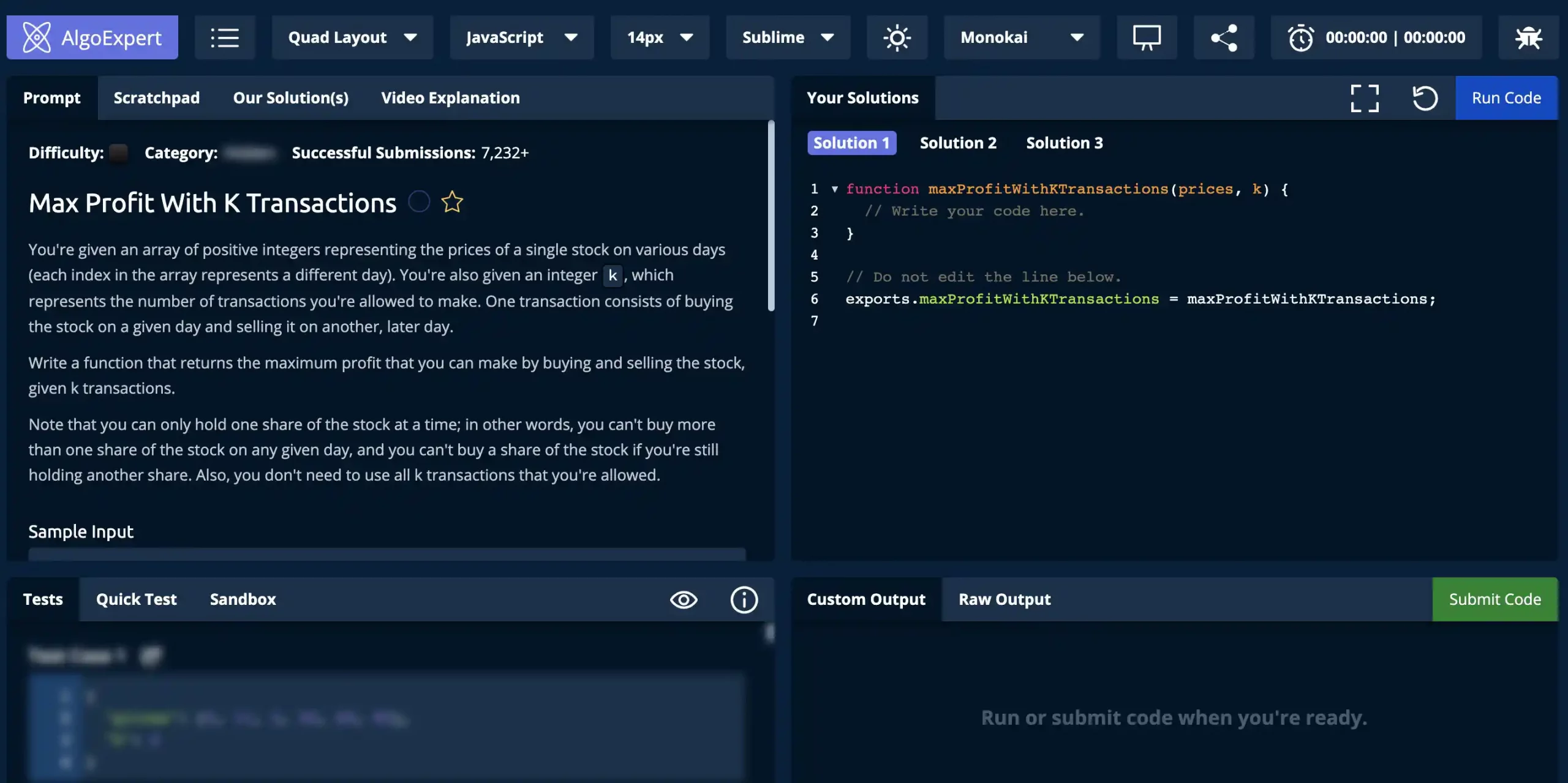
Moreover, you can choose the challenges you want to take on based on your understanding of the codes and programs. If you are a beginner, you can start with the basic challenges.
If you feel that the basic ones are too easy for your level, you can move to higher levels ranging from medium to extremely difficult.
So, there is no lack of options for raising the difficulty levels for the challenges you are taking.
In addition to taking algorithm challenges, you can learn several other topics related to coding as well. Moreover, you can get explanation videos for every question or challenge you to attempt in this application.
One of the major highlights of this tool is its four-pane window feature that you can use to work out the solutions to the challenges you take.
One of the panes can be used as a working pad, the other one as the reading area containing your question, the third one as the solution window, and the fourth one for the explanation video of the solution.
This way, you will not have to keep switching between things, you can have a better focus, and you shall better understand the concepts.
Moreover, the tool even acknowledges your effort for learning and skill development. Once you pass a challenge or test, the tool awards you a certificate. You can mention these certificates in your resume to add more value and increase your chances of selection.
With all these features and functionalities, you will love exploring and using this tool and feel it is a good change from Leetcode.
2. HackerRank
If you have a competitive spirit, you will love using HackerRank as an excellent learning platform to code. This is a gaming-based, competitive learning and education platform that covers multiple areas and topics about coding.
As such, you can learn about multiple coding and programming languages like Python, Java, SQL, etc., along with covering other disciplines and topics like modular programming, artificial intelligence, algorithms, and much more.
The competitive part comes into the picture because the questions in HackerRank are presented as challenges rather than practice questions.
Every user can participate in these challenges and compete with other participants. Each challenge comes with a question and guidance to solve the same.
The ranks are decided based on the scorecard attached to each challenge flashing the name and rank of other users and your position on the card.
The scorecard also consists of a section for debates and opinions where all the participants can discuss the task or challenge in question as they work towards finding the solution.
Another great thing about HackerRank is that it also brings up employment opportunities in addition to helping you develop your coding and programming skills in a gaming and competitive spirit.
As such, any user who completes business competition challenges in the application can apply for a job at HackerRank.
With all these features and functionalities, you may want to try HackerRank to build your skills as a developer while also creating some opportunities for earning money as you enjoy this platform’s competitive gaming spirit and setup.
3. Coderbyte – Leetcode alternatives for SQL
If you have a big technical interview, Coderbyte is probably the application that will come as a boon for your preparation.
This application is not just a learning and education platform. Instead, it is complete software for evaluating anyone’s coding skills and talents.
As such, many companies and organizations use Coderbyte to create their questions for the technical interview rounds. So, using it for preparation may come as a plus.
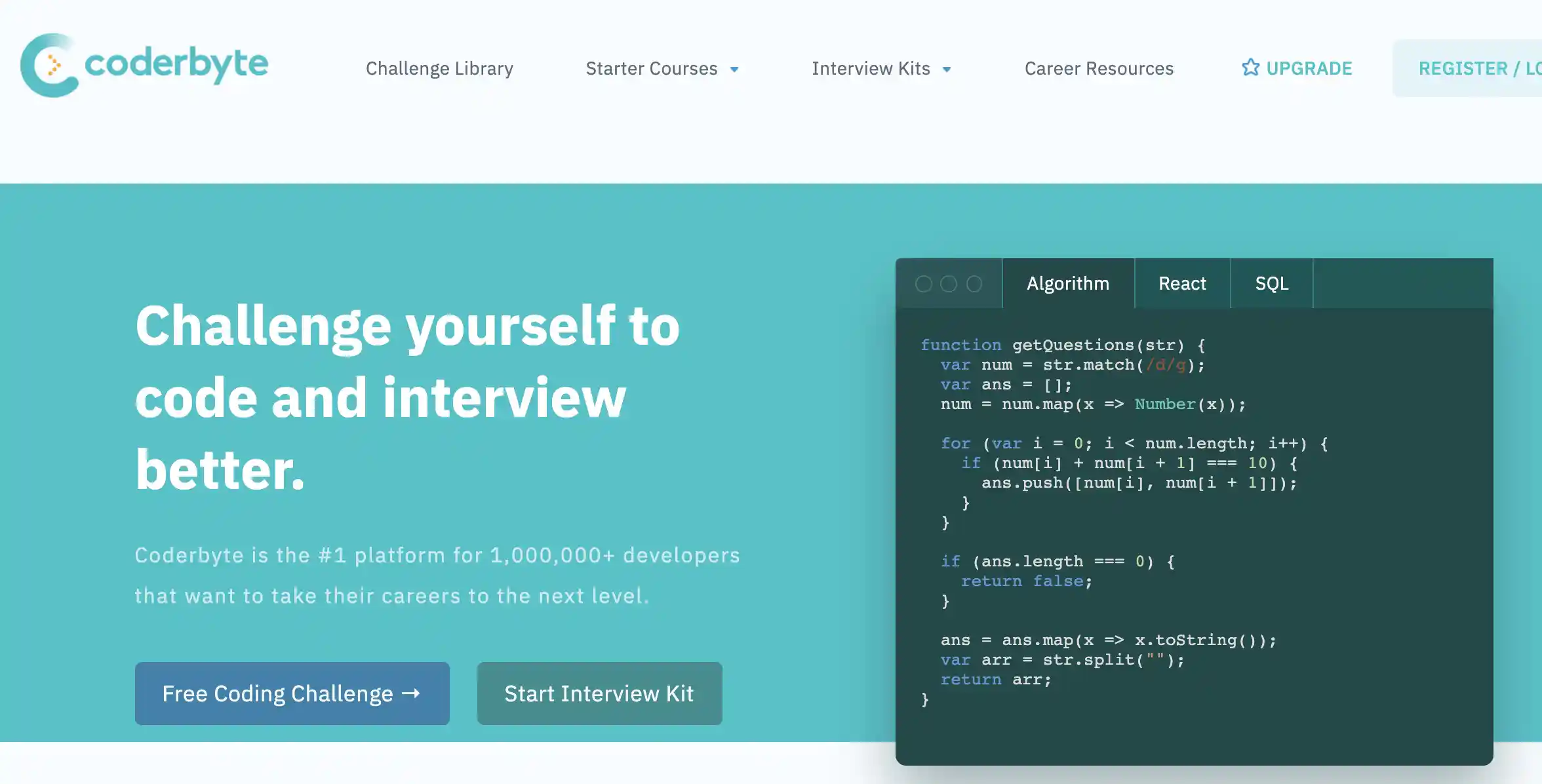
Moving on to its features and functionalities, the application is pretty robust and has excellent capabilities to improve and enhance anyone’s knowledge and skills in coding and programming.
The tool is equipped with practice questions and tests and comes with new daily challenges and prompts for you to try and solve. As such, this platform has no limitations to resources and content.
Moreover, this tool is not limited to questions and challenges for programming and coding. Still, it expands the horizons and helps you explore and learn topics like algorithms, artificial intelligence, reasoning, logic, etc.. So, this platform seeks your overall development as a coder, developer, and engineer.
In addition to all these challenges, the application is equipped with more features and functionalities, such as an uninterrupted coding environment, a solutions manual, and regular progress reports.
With all these features and functionalities, it’s easier to focus on your coding questions and tests for practice while also knowing your progress with time. Also, if you get stuck with the question, you can get help from the manuals.
With all these features and functionalities, this is the perfect platform to prepare you for examinations and interviews.
In addition to helping you prepare for an interview as a candidate, Coderbyte is also known for helping companies with their recruitment processes.

While it has all the features and functionalities to help develop your coding and programming skills, it is also equipped with systems to test your skills.
As such, recruiters can use Corderbyte to create customized tests and assess their candidates.
Additionally, they can set up user accounts to monitor the activity logs, see how the candidates are working along with the time they are taking for task completion, and judge them on all other parameters and criteria for selection.
With all of this, this platform comes as the most comprehensive and feature-rich solution for developing, enhancing, and assessing coding and programming skills and goes much beyond being just as great.
4. Edabit
If you are someone who wants to begin at the basics and eventually make your way to the advanced levels of coding and programming, then Edabit is yet another Leetcode alternatives that you may want to try.
This tool is built with education, learning, growth, and entertainment in mind. With the belief that learning must be fun, Edabit is built like a gaming platform where you eventually pass through the levels of coding.
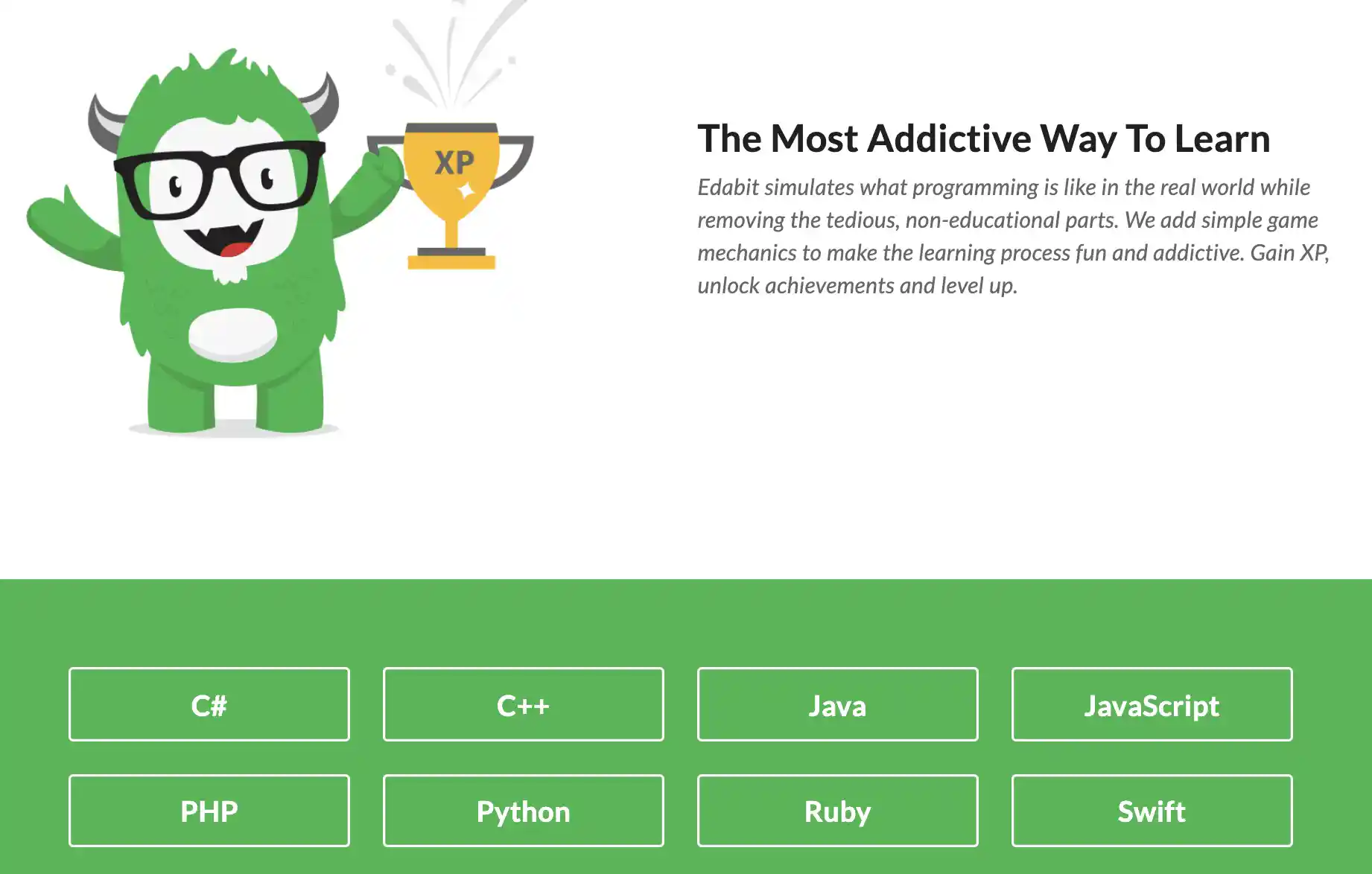
The application is great for hands-on experience with major coding and programming languages such as Java, Python, Swift, etc.; you learn these languages by reading and doing the work yourself.
As such, every level in this application is a task wherein you need to write codes based on the instructions. As you can work out the code and finish the task, you move to the next task (level) in the application.
With that, you are always filled with a competitive spirit, and learning becomes entertaining.
With all these features and functionalities, Edabit is a great alternative to Leetcode. While it’s an educational and learning platform, it incorporates a fun element with its game-like setting. That shall be a good chance you might love.
With that, Edabit is essentially a platform that you must try if you are zealous and passionate about coding and programming and would like to learn it better by just doing it rather than just reading about it over and over again while not being able to explore and understand how it works in the real and practical world.
5. Checkio – Leetcode alternatives For coding games and programming challenges
Another great coding platform acting as one of the best Leetcode Alternatives, a free and open-source platform for learning, education, and skill development in coding and programming, is Checkio. This tool is perfect for those on their beginner levels of coding.
The tool focuses on helping you learn coding and programming in two of the most popular coding languages: Python and Transcript.
The application contains multiple questions, challenges, and tasks for the users to complete to build, develop, and enhance their coding skills and knowledge.
Each task comes with specific instructions that the users need to follow. Moreover, the tasks and challenges come with time constraints.

So, while developing your skills and enhancing your knowledge, you can also work on your coding and programming speed and significantly improve the same so that you write codes at a much faster pace as time passes.
With that, you blend skills with the speed that makes you the kind of developer and coder everyone wishes to become.
In addition to helping you learn two of the best coding and programming languages in a smooth, fun, and entertaining way, this application also keeps things comfortable and convenient for you by supporting multilingual capabilities.
At present, the application supports Spanish and English. There may be more languages coming in the future.
Another great feature and functionality of this application is its ability to open up employment opportunities. However, the application does not create opportunities by itself.
Instead, it provides a medium for its users to create jobs per their requirements and preferences and distribute them as they see fit and convenient.
With all such features and functionalities, Checkio is a very robust and comprehensive education and learning tool. It can help you become your own master at coding and programming, and that’s what makes it worth a mention.
6. CodeChef – Leetcode alternatives For Competitive Programming
With excellent features and functionalities that offer learning and education in the form of challenges, competitions, lessons, courses, discussions, etc.,
CodeChef is a comprehensive alternative to Leetcode, designed for all developers, coders, and engineers, be they beginners, intermediates, or advanced-level professionals and experts.

One of this application’s major highlights is how it unfolds its different learning categories, like a gaming level.
You begin with the lessons and tests in the application, eventually move to the daily tests and challenges, and once you are well aware of the different codes and programs, you can move on to the competition.
Moreover, you can even engage in discussions and debates with the other users and even the CodeChef crew as you move further up the levels in the application.
With that setup, this application builds you as a coder, developer, and engineer, constantly enhancing your knowledge and skills and walking you through all the coding and programming levels, from the very basic to the highly advanced.
Moreover, the application has no limitations to learning in terms of programming languages and topics either. This tool provides lessons, courses, challenges, and competitions in over 40 programming languages. With that, the scope for learning is endless on this platform.
Additionally, as you participate in the challenges, you can submit your tasks in over 55 coding and programming languages.
Also, the features such as discussions and debates with other users on the application lead to the formation of a brilliant community of developers, coders, and programmers.
With all these things, learning and skill development on this application is highly fun and entertaining. Moreover, this application is entirely free to use. So you learn a lot, build an earning potential for yourself, and all that without spending a penny.
Considering all these factors, it wouldn’t be wrong to mention that CodeChef is perfect and, in fact, even better than most tools, something that shall be worth all your time and effort.
7. Exercism – Leetcode alternative free
Suppose you are a beginner, not a fan of competition and challenges, and want a dedicated learning environment where you can learn coding and programming from the basics to advanced levels. In that case, Exercism is the last one on our list of the best Leetcode alternatives.
With a much different setup and user interface compared to other platforms discussed in this article, Exercism can be said to be the unique Leetcode alternative in the marketplace.
This dedicated learning and education platform promotes single-user learning rather than pitting users as competitors against each other.
With that said, this platform is for extremely serious users looking for guidance and mentorship as they develop and enhance their coding and programming skills and knowledge base.
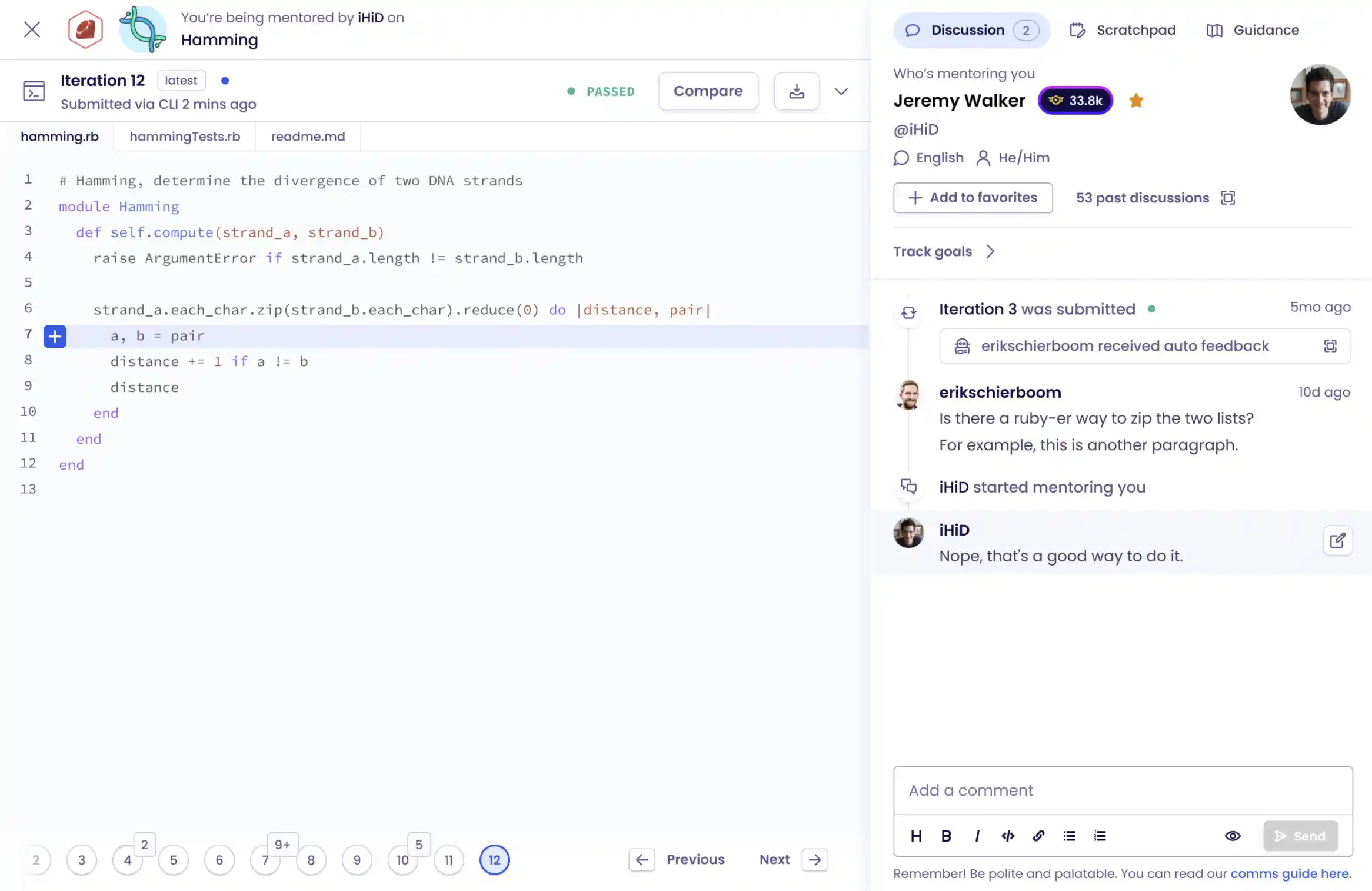
This platform offers different learning activities in up to 52 different programming languages. You can pick up an activity as per your level in coding and programming, work on the code, and submit the same to your mentor for review.
Based on the excellence and accuracy of your code, your mentor on the application shall grade you, and you shall move on to the next levels and tasks.
In addition to working on the tasks and activities in the application, you can even submit your self-written codes in the application for review by the experts on the platform. With the reviews from the experts, you can constantly work on improving your codes and making them better.
Besides having a dedicated learning experience with hands-on training and knowledge transfer from an expert professional, you can also get in touch with the developer community on the platform.
You can raise your questions and queries, and the entire community will be happy to help you.
With all these features and functionalities, Exercism is great for those who look to build their coding and development skills but are shy to work in a crowded environment or need a dedicated guide with them every step of the way.
Considering the dedicated learning it offers, this can be best for those preparing for their examinations or big interviews but need confidence, guidance, and support to add to their skills and, more importantly, confidence levels.
The best thing about this application is that you get everything in it for free. So you have access to almost 4000 activities in 52 different programming languages and a dedicated personal mentor to guide you with the activities and review your codes, all free of cost.
What more could you ask for in an education and learning platform? Probably nothing more!
With that said, it wouldn’t be wrong to mention that Exercism is one of the most functional, feature-rich, and unique tools worth your time, and you need to create value for yourself as a coder, developer, and engineer.
📚FAQ
Which is better AlgoExpert or LeetCode?
When determining which platform is best for you, keep the following things in mind:-
With a focus on algorithms and data structures, AlgoExpert is specifically designed to assist people in getting ready for technical interviews. A coaching service is one of the many resources it offers, along with practice problems with thorough solutions and videos.
A more all-encompassing portal, LeetCode, offers information on computer science subjects, such as databases, machine learning, and algorithms. Compared to AlgoExpert, it has a bigger problem set and more resources, including video courses, publications, and a job search tool.
Your demands and goals will ultimately determine the best platform for you. AlgoExpert can be a good choice if you want to concentrate solely on being ready for technical interviews.
LeetCode might be a better option if you’re looking for materials and subjects in computer science that cover a wider variety.
Is codewars harder than LeetCode?
Codewars is a platform for gamified coding that provides challenges in several programming languages. The difficulties of the challenges are ranked in “kata,” which are groups of problems.
The community is often highly supportive and helpful, and the challenges on Codewars tend to be more focused on honing coding abilities and problem-solving skills.
LeetCode is a website that provides interactive lessons, practice problems, and coding challenges. The tasks on LeetCode are more focused on helping people get ready for technical interviews, and they frequently more closely match the kinds of questions that are posed in such interviews.
People generally believe that the challenges on LeetCode are more difficult than those on Codewars and can be quite demanding.
As a result, it is challenging to conclude if Codewars or LeetCode is “harder” because the challenges on each platform are designed to achieve distinct objectives and range in difficulty.
Which is tougher, HackerRank or LeetCode?
Some obstacles on one platform could be harder to overcome than others on the other. It is also important to remember that certain tasks may be harder or easier for different people, so what one person finds difficult might not be so for another.
HackerRank and LeetCode are both well-liked platforms for honing and developing coding abilities, and both offer various challenges at various levels of difficulty.
Is Geeksforgeeks better than LeetCode?
Some people might favor GeeksforGeeks over LeetCode because LeetCode offers a larger variety of practice problems and allows users to track their progress and compete with other users.
In contrast, others might favor LeetCode because it offers a comprehensive library of resources and tutorials on various computer science topics.
Ultimately, it might be beneficial to test out both platforms to discover which works best for you.
Is AlgoExpert enough for coding interview?
AlgoExpert is a tool that offers examples of difficulties and explications for computer science ideas that are frequently examined in coding interviews. It can be a useful tool for getting ready for coding interviews.
Still, it’s equally crucial to have a solid grasp of computer science basics and the ability to use what you know to solve problems quickly.
In coding interviews, additional considerations may be crucial, such as your capacity to articulate your ideas and produce clear, effective code.
It’s a good idea to practice with various tools, such as online platforms like AlgoExpert, to be well-prepared for code interviews.
You can also look for opportunities to acquire feedback on your coding abilities from seasoned programmers.
Is LeetCode a Chinese company?
It is a U.S.-based business that offers online resources for practicing and preparing technical interviews, including coding interviews.
Is 300 LeetCode questions enough?
A great method to hone your coding skills and get ready for a coding interview is to complete 300 LeetCode questions.
Still, it’s also crucial to have a solid grasp of computer science basics and the ability to use that understanding to solve issues quickly.
Is it worth paying for LeetCode?
If you’re getting ready for a technical interview and seeking more practice challenges and tools to help you hone your coding skills, LeetCode might be something to consider.
However, it’s crucial to remember that there are also a lot of other free tools available for getting ready for technical interviews, such as online tutorials, sample questions, and open-source code repositories.
To find the greatest fit for your goals and budget, it could be worthwhile to consider a combination of paid and free resources.
Which is the toughest coding platform?
Various coding platforms are available, and each has different advantages and difficulties.
LeetCode, HackerRank, and Codeforces are well-known websites where programmers can practice their skills and be ready for technical interviews.
These platforms provide users with a selection of practice issues and tasks that can help them hone their coding abilities and prepare for technical interviews.
Your level of skill and familiarity with the theories and methods being examined will ultimately determine how challenging a certain coding platform is for you.
Is HackerRank 30 days of code good?
You can enhance your coding abilities and gain more familiarity with programming principles by participating in HackerRank’s 30 Days of Code challenge.
The challenge asks you to finish one code task every day for 30 days, which can improve your problem-solving abilities and increase your familiarity with various programming ideas.
Is Grokking coding interview good?
It might be something to think about if you’re searching for a thorough course to help you be ready for technical interviews.
Can beginners use AlgoExpert?
Yes, AlgoExpert is made to be user-friendly for those new to programming and computer science.
The portal serves as a resource for users to hone their coding abilities and be ready for technical interviews by offering practice challenges and solutions.
In addition to other resources and learning materials, AlgoExpert provides explanations and examples for each issue.
It is appropriate for novices who want to develop their coding skills and get more self-assurance in their talents.
However, as the platform assumes a certain level of familiarity with ideas like variables, loops, and data structures, it can be advantageous to have some fundamental programming knowledge before utilizing AlgoExpert.
Why are coding interviews getting so hard?
For several reasons, coding interviews can appear difficult. One reason is that handling complex problems under time constraints are something they frequently entail, which can be scary.
In addition, coding interviews frequently assess a broad range of abilities and expertise, including problem-solving, data structures, algorithms, and programming languages; as a result, it can be challenging to prepare for every potential topic that might be covered.
The fact that coding interviews frequently require tackling new challenges adds to their difficulty. This means that you might not have encountered the specific issue previously and will have to use your programming and problem-solving talents to come up with a solution.
This may be very difficult for you if you are not accustomed to addressing new difficulties or lack confidence in your coding skills.
Finally, coding interviews can be difficult because they are frequently conducted in a high-stress atmosphere. You might be anxious about the interview and the repercussions of performing poorly, making it challenging to concentrate and give your best effort.
Overall, numerous aspects can make coding interviews challenging; therefore, it’s critical to be ready and hone your coding skills to be successful in these types of interviews.
Do interviewers use LeetCode?
Many software engineers utilize LeetCode, including those getting ready for technical interviews. There is a chance that some interviewers will utilize LeetCode to identify sample issues or assess applicants in person.
How do you get 5 stars on LeetCode?
Since the difficulty of a challenge is arbitrary and might differ from person to person, there is no set formula for receiving a five-star rating on LeetCode.
While some people might find a problem exceedingly challenging, others might find it much simpler.
There are a few ways you can attempt to increase your odds of completing puzzles on LeetCode with five stars:-
Regular practice will help you become more adept at detecting and resolving challenging issues. The more you practice coding and problem-solving, the better you will get at it.
Learn and go over important ideas: Learn the fundamental ideas and methods that will be used to solve challenging challenges on LeetCode, such as data structures, algorithms, and problem-solving methodologies.
Ask for help and direction if you need it: If you are experiencing difficulty with a problem, don’t hesitate to ask for help or direction. You can ask questions and seek assistance from other users in the community forum for LeetCode.
Solving complex tasks cannot be easy, but maintaining motivation and concentration is crucial. Make plans for the future and strive to advance each day.
In general, frequently practicing, learning and reviewing important ideas, asking for help and advice when necessary, and remaining motivated and focused are all essential to accomplishing five-star challenges on LeetCode.
Your coding abilities can be strengthened with commitment and effort, raising your likelihood of successfully resolving challenging issues on the platform.
Do front end Devs need LeetCode?
Since LeetCode is geared toward more general programming concepts and problem-solving techniques, front-end developers may not always need to use it in their day-to-day work.
Algorithms, data structures, and problem-solving abilities are a few LeetCode features that might be useful for front-end developers to practice and hone.
Additionally, LeetCode may be a helpful tool for preparing for technical interviews or coding challenges that some firms employ to screen candidates for front-end developer positions.
Final Words
Access to the right resources and materials when trying to develop your skills is extremely important.
Be it any field of education, a platform for learning and skill development is a must in today’s time, and when it comes to coding and programming, you need to be more careful and alert in searching and finding your options.
Leetcode is one of the best platforms to help you with all your learning and skill development needs as regards coding and programming.
However, the thing with education is that it has no bounds whatsoever, and you can always keep exploring new and better options.
All these options mentioned in this article are some of the best Leetcode alternatives. They shall guide you well, and you will enjoy using them.
We hope you found the article helpful and are now all set to explore these wonderful options for enhancing your coding skills and knowledge.