
























Are you struggling with poor communication channels in outdoor adventures, industrial sites, or emergency scenarios?
Do your communication devices lack the robustness and range to keep everyone in touch?
When conventional means of communication break down or are inconvenient, it can hinder productivity and compromise safety. Imagine you’re deep in the woods on a thrilling camping trip, and your buddy has ventured off to gather firewood.
The serene silence is interrupted by a startling rustle in the undergrowth – a wild animal perhaps? You instinctively reach for your mobile, only to realize that you’ve lost signal, miles away from the nearest cell tower.
Or maybe you’re a site manager at a sprawling construction project, but your team is constantly grappling with dead zones in communication that lead to costly mistakes or, worse, accidents.
Long Range Walkie Talkies are the solution to your communication woes. These powerful devices cut through cellular networks and Wi-Fi constraints, providing reliable, clear communication over vast distances. They’re built to endure rough environments and weather conditions, ensuring that you stay connected when it matters most.
Whether you’re an outdoor enthusiast, a construction supervisor, or a disaster response professional, long range walkie talkies could transform how you connect with your team.
Read on to explore why these devices are crucial for effective, unhindered communication, regardless of where you are.
Understanding Walkie-Talkies and Their Technology
Walkie-talkies, handheld or two-way radios, have become integral to modern communication systems. They provide reliable and convenient wireless communication in various industries, including emergency services, outdoor adventures, construction, and event management.
Understanding walkie-talkies and their technology can help users make informed decisions when choosing the right device for their needs.
Walkie-talkies operate on the principle of two-way radio communication. They consist of a transmitter and receiver, allowing users to transmit and receive voice signals. These devices utilize radio frequencies to establish communication between two or more units within a specific range.
The technology behind walkie-talkies is based on analog or digital systems. Analog walkie-talkies use continuous radio waves to transmit and receive signals, while digital walkie-talkies convert voice signals into binary code for transmission. Digital technology offers enhanced audio quality, longer battery life, and improved resistance to interference.
Key components of walkie-talkies include the antenna, which sends and receives radio waves, and the transceiver, which combines the transmitter and receiver functions in a single unit.
Walkie-talkies may also feature channels and privacy codes. Channels allow users to select different frequencies for communication, while privacy codes provide added security by filtering out unwanted signals.
The range of a walkie-talkie refers to the maximum distance over which it can transmit and receive signals effectively. The range can vary based on terrain, obstructions, and the device’s power output. It is important to consider these factors when determining the suitable range for specific applications.
Walkie-talkies may offer additional features such as weather alerts, VOX (Voice-Activated Transmission), LCD screens, built-in flashlights, and battery-saving modes. These features enhance functionality and usability in various situations.
In conclusion, understanding walkie-talkies and their technology is essential for choosing the right device for your communication needs. Knowing the key components, technology types, and range considerations will enable you to decide whether it’s for professional or recreational purposes. Walkie-talkies continue to evolve, providing efficient and reliable communication solutions for various industries and activities.
The Benefits of Long-Range Walkie Talkies
Long-range walkie-talkies benefit individuals and organizations seeking efficient and reliable communication solutions. These advanced devices provide extended coverage and instant connectivity, making them indispensable in various industries and scenarios.
One of the key advantages of long-range walkie-talkies is their expansive coverage range. With the ability to transmit and receive signals over long distances, these devices enable seamless communication even in remote or challenging environments.
Whether coordinating activities on a large construction site or keeping a team connected during outdoor adventures, long-range walkie-talkies ensure reliable communication when it matters most. Furthermore, the instant communication feature of long-range walkie-talkies allows for quick and efficient information exchange.
With a simple push-to-talk functionality, users can instantly connect with team members without dialing numbers or waiting for connections. This real-time communication promotes swift decision-making, enhances collaboration, and facilitates seamless coordination, ultimately improving productivity and efficiency.
Another significant benefit of long-range walkie-talkies is their versatility in enhancing safety and security. These devices enable workers in hazardous environments to constantly contact their teams, providing immediate communication in case of emergencies or accidents. Many models offer features such as emergency alerts, weather updates, and built-in GPS, further bolstering safety protocols.
In summary, the benefits of long-range walkie-talkies are substantial. From extended coverage and instant communication to improved safety and security, these devices empower individuals and organizations to stay connected and communicate effectively, even across long distances. Long-range walkie-talkies enhance productivity, collaboration, and operational efficiency in various professional and recreational settings.
Top Long Range Walkie Talkies in the Market
1. Motorola T600 H2O
When it comes to super long range walkie talkies, the Motorola T600 H2O stands out as one of the top choices available in the market today. Packed with advanced features and exceptional performance, this device offers unparalleled communication capabilities.
The Motorola T600 H2O boasts an impressive communication range, allowing users to stay connected over long distances.
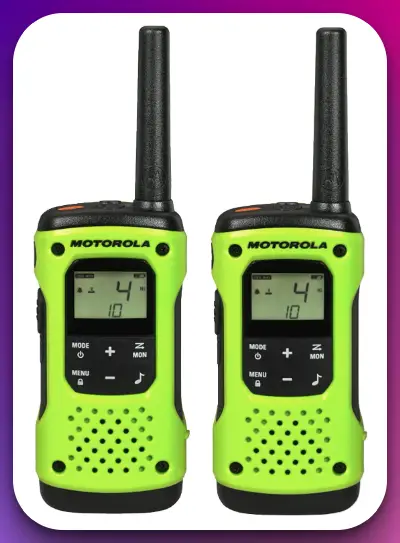
Whether exploring the great outdoors or coordinating operations in a large construction site, this walkie-talkie ensures reliable and clear communication even in challenging environments.
One of the standout features of the Motorola T600 H2O is its durability. With an IP67 rating for water and dust resistance, this walkie-talkie can withstand tough conditions, making it an ideal choice for outdoor enthusiasts and professionals working in demanding environments.
Another noteworthy feature is the built-in flashlight, which provides visibility in low-light situations. Additionally, the device offers NOAA weather alerts to keep you informed about changing weather conditions, ensuring your safety and preparedness during outdoor adventures.
The Motorola T600 H2O also excels in terms of convenience. It has a dual power option—you can either use rechargeable batteries or replace them with standard AA batteries, providing flexibility and peace of mind, especially during extended trips or emergencies.
In conclusion, the Motorola T600 H2O is undoubtedly one of the top long-range walkie talkies in the market. With its impressive communication range, durability, advanced features such as the built-in flashlight and NOAA weather alerts, and the convenience of dual power options, this device offers outstanding performance for various applications.
Whether you’re an outdoor enthusiast, a professional in the field, or simply seeking reliable communication, the Motorola T600 H2O is a top-notch choice.
Pros:-
- Impressive communication range for reliable connectivity over long distances.
- Durable design with an IP67 rating for water and dust resistance.
- Built-in flashlight enhances visibility in low-light conditions.
- NOAA weather alerts keep you informed about changing weather conditions.
- Dual power options offer flexibility with rechargeable or standard AA batteries.
- Clear and crisp audio transmission for effective communication.
- Intuitive interface and easy-to-use controls.
- Multiple channels for versatile communication options.
- Hands-free operation with VOX (Voice-Activated Transmission) capability.
- Its lightweight and portable design makes it easy to carry during outdoor activities.
Cons:-
- The range may be affected by environmental factors and obstructions.
- The device may be relatively expensive compared to other models in the market.
- The battery life may vary depending on usage and power settings.
- Some users may find the buttons and controls small or difficult to operate with gloves on.
Overall, the Motorola T600 H2O offers a range of valuable features and benefits, including reliable communication, durability, convenience, and advanced capabilities. However, it’s important to consider individual preferences, budget, and specific use cases when evaluating whether this walkie talkie meets your requirements.
2. Midland GXT1000VP4
When it comes to long range walkie talkies, the Midland GXT1000VP4 stands out as a top contender in the market. Designed to deliver exceptional performance and reliability, this device offers a range of features that make it an ideal choice for various applications.
The Midland GXT1000VP4 boasts an impressive communication range, allowing users to stay connected over long distances.
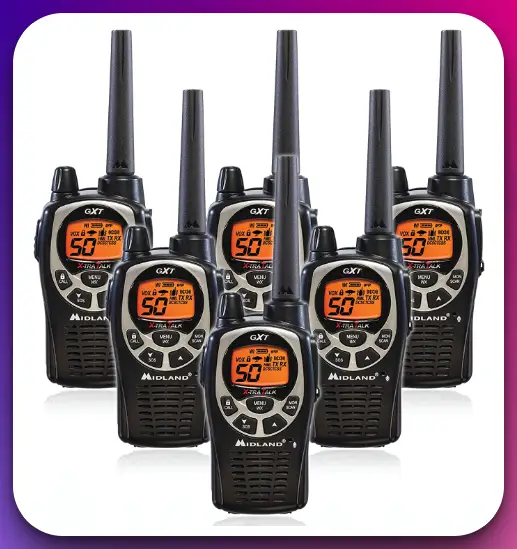
Whether on a hiking expedition, coordinating events, or working on a construction site, this walkie-talkie ensures reliable and clear communication when needed.
One of the standout features of the Midland GXT1000VP4 is its versatility. It offers 50 channels, including NOAA weather channels, ensuring you have access to real-time weather information. This feature is particularly valuable for outdoor enthusiasts who must stay updated on changing weather conditions.
Additionally, the Midland GXT1000VP4 comes equipped with advanced technology such as eVOX (Easy Voice and Sound Activation), which allows for hands-free operation. This feature enables users to communicate effortlessly without pressing any buttons.
Furthermore, the device features a vibrating alert function, ensuring you never miss important communication, even in noisy environments. It also has a built-in SOS siren for emergencies, providing an added layer of safety and security.
In conclusion, the Midland GXT1000VP4 is a long-range walkie-talkie with impressive features and performance. With its extended communication range, versatile channel options, advanced technology like eVOX, and added safety features, this device is well-suited for outdoor adventures, event management, and professional use. The Midland GXT1000VP4 is a reliable companion that ensures effective and seamless communication.
Pros:-
- Impressive communication range for reliable connectivity over long distances.
- Versatile with 50 channels, including NOAA weather channels for real-time weather updates.
- Advanced eVOX technology enables hands-free operation for convenient communication.
- The vibrating alert feature ensures important messages are not missed, even in noisy environments.
- Built-in SOS siren provides an added layer of safety in emergencies.
- Durable and rugged design for enhanced durability and longevity.
- Long battery life ensures extended usage without frequent recharging.
- The clear and crisp audio quality for effective communication.
- Additional features like privacy codes, group calls, and direct call options add flexibility and convenience.
- Compact and portable design for easy carrying during outdoor activities.
Cons:-
- The range may be affected by terrain and obstructions.
- The device may be relatively larger and bulkier compared to some other models.
- Some users may find the interface and control slightly complex initially.
- The provided rechargeable battery pack may have a limited lifespan.
- The included belt clips or accessories may not be as durable as desired.
Overall, the Midland GXT1000VP4 offers a range of valuable features and benefits, including long-range communication, versatile channel options, advanced technology, and durability. However, it’s important to consider individual preferences, specific use cases, and potential drawbacks when deciding if this walkie talkie suits your requirements.
3. Retevis RT22
The Retevis RT22 is an exceptional Walkie talkie with VOX functionality that offers a range of features and capabilities, making it a popular choice among users. With its advanced technology and compact design, this walkie-talkie provides reliable long-distance communication.
The Retevis RT22 is known for its impressive communication range, allowing users to stay connected even in remote locations. This makes it a valuable tool for outdoor enthusiasts, event organizers, and professionals who require long-range communication capabilities.
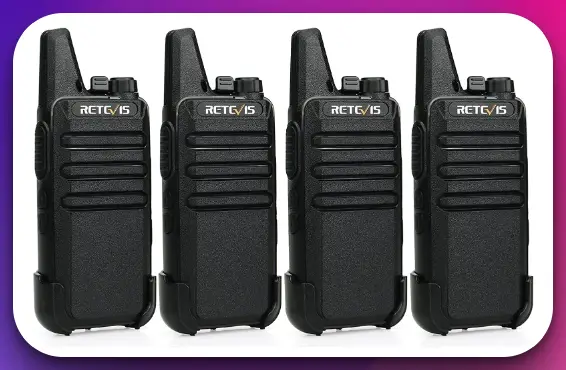
Despite its compact size, the Retevis RT22 is packed with features. It offers a 16-channel capacity for versatile communication options, allowing users to select the most suitable channel for their needs.
The VOX (Voice-Activated Transmission) feature also enables hands-free operation, making it convenient for users when manual operation is impractical.
Another notable feature of the Retevis RT22 is its long battery life. With a 1100mAh battery capacity, this walkie-talkie ensures extended usage without frequent recharging, providing reliable communication during extended trips or operations.
In terms of design, the Retevis RT22 is compact and lightweight, making it easy to carry and use. It features a sturdy build that can withstand the demands of outdoor activities or professional use.
In conclusion, the Retevis RT22 is a highly capable long-range walkie-talkie. Its impressive communication range, channel capacity, hands-free operation, long battery life, and compact design offer a reliable communication solution for various applications.
Whether exploring the great outdoors or coordinating operations, the Retevis RT22 is a dependable choice that ensures seamless and effective communication.
Pros:-
- Impressive communication range for reliable connectivity over long distances.
- Compact and lightweight design for easy portability and use.
- 16-channel capacity provides versatile communication options.
- VOX (Voice-Activated Transmission) feature enables convenient hands-free operation.
- Long battery life (1100mAh capacity) ensures extended usage without frequent recharging.
- Sturdy build and durable construction for reliable performance in demanding environments.
- The clear audio quality for effective communication.
- Cost-effective option compared to some other long range walkie talkies.
- Simple and intuitive controls for ease of use.
- Suitable for a wide range of applications, including outdoor adventures and professional use.
Cons:-
- The range may be affected by environmental factors and obstructions.
- Limited advanced features compared to some higher-end models.
- The included earpieces may not be of the highest quality.
- Some users may find the buttons and controls small or less user-friendly for larger hands.
The Retevis RT22 offers impressive features and benefits, including long-range communication, compact design, versatile channel options, and hands-free operation. While it may have some limitations compared to higher-end models, it provides a cost-effective and reliable solution for various communication needs.
4. Cobra ACXT645
The Cobra ACXT645 walkie-talkie is a top choice for reliable long-range communication during outdoor adventures. This device offers exceptional performance and durability and is packed with features designed specifically for outdoor enthusiasts.
The Cobra ACXT645 boasts an impressive communication range, allowing adventurers to stay connected even in remote locations. With its advanced UHF technology, this walkie-talkie ensures clear and uninterrupted communication, making it ideal for hiking, camping, and other outdoor activities.
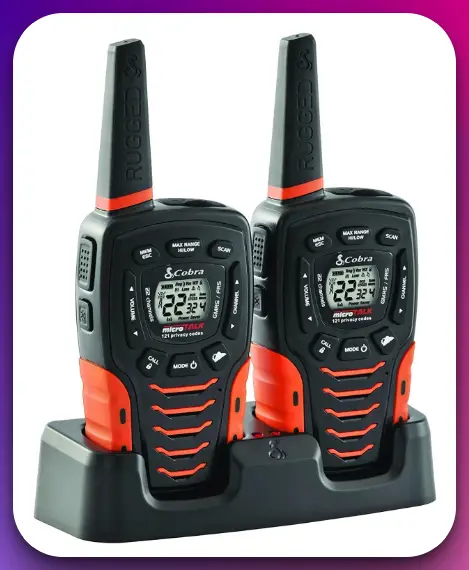
One of the standout features of the Cobra ACXT645 is its rugged and waterproof design. With an IPX4 rating, it can withstand splashes, rain, and dust, ensuring reliable operation in challenging outdoor environments.
Additionally, this walkie-talkie offers convenient features such as NOAA weather alerts, which keep users informed about changing weather conditions and potential hazards. It also includes a built-in LED flashlight for visibility during nighttime adventures or emergencies.
The Cobra ACXT645 is equipped with VOX (Voice-Activated Transmission) technology, enabling hands-free operation. This feature allows users to communicate effortlessly without pressing any buttons, enhancing convenience and safety during outdoor activities.
In conclusion, the Cobra ACXT645 is a long-range walkie-talkie designed for outdoor adventures. With its impressive communication range, durable and waterproof construction, advanced features like NOAA weather alerts, and VOX technology, this walkie-talkie ensures reliable and effective communication in the great outdoors.
Whether exploring remote trails or embarking on thrilling adventures, the Cobra ACXT645 is a reliable companion that enhances safety and connectivity.
Pros:-
- Impressive communication range for reliable connectivity in remote outdoor locations.
- Advanced UHF technology ensures clear and uninterrupted communication.
- Rugged and waterproof design with an IPX4 rating for durability in challenging environments.
- NOAA weather alerts keep users informed about changing weather conditions and potential hazards.
- Built-in LED flashlight provides added visibility during nighttime adventures or emergencies.
- VOX (Voice-Activated Transmission) technology enables convenient hands-free operation.
- Compact and portable design for easy carrying during outdoor activities.
- Long battery life ensures extended usage without frequent recharging.
- Multiple channels and privacy codes for versatile communication options.
- Cost-effective option for outdoor enthusiasts seeking reliable long-range communication.
Cons:-
- The range may be affected by terrain, obstructions, and weather conditions.
- Some users may find the audio quality slightly lacking in certain environments.
- The belt clip or accessories provided may not be as durable as desired.
- The user interface may be slightly complex for beginners.
Overall, the Cobra ACXT645 offers a range of valuable features and benefits for outdoor adventures, including long-range communication, durability, weather alerts, hands-free operation, and portability. While it may have some limitations, it provides a cost-effective and reliable solution for staying connected during outdoor escapades.
5. Baofeng BF-F8HP
Regarding camping and outdoor adventures, having a reliable long-range walkie-talkie is essential, and the Baofeng BF-F8HP is a standout choice. This powerful device offers exceptional features and performance, making it an ideal companion for camping enthusiasts.
The Baofeng BF-F8HP boasts an impressive communication range, allowing campers to stay connected even in remote locations. With its 8-watt power output, this walkie-talkie provides enhanced signal strength and coverage, ensuring reliable communication in rugged terrains and dense forests.
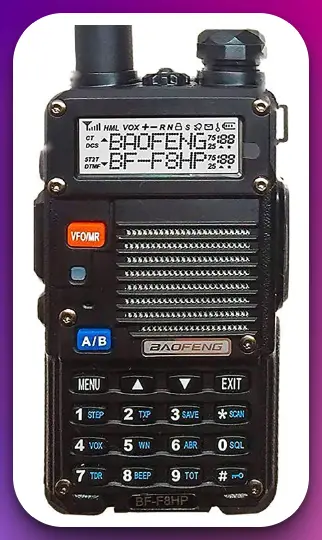
One of the standout features of the Baofeng BF-F8HP is its versatility. It offers 128 programmable channels for customizable communication options, allowing campers to select the most suitable channels for their needs.
Additionally, this walkie-talkie comes equipped with a dual-band frequency capability, enabling users to switch between VHF and UHF bands for optimal performance in different environments. It also features a built-in flashlight that can be handy during nighttime camping activities or emergencies.
The Baofeng BF-F8HP is designed for durability and ease of use. It has a solid build that can withstand outdoor elements, and its ergonomic design ensures comfortable handling during extended camping trips.
In conclusion, the Baofeng BF-F8HP is an excellent long-range walkie-talkie for camping adventures. With its impressive communication range, high power output, versatile channel options, dual-band frequency capability, and durability, this walkie-talkie provides reliable and effective communication in the great outdoors.
Whether exploring nature trails or setting up campsites, the Baofeng BF-F8HP is a reliable companion that enhances safety and connectivity during your camping experience.
Pros:-
- Impressive communication range for reliable connectivity in remote camping locations.
- High power output (8 watts) provides enhanced signal strength and coverage.
- Dual-band frequency capability (VHF and UHF) for optimal performance in different environments.
- 128 programmable channels offer versatile communication options and customization.
- Durable build to withstand outdoor elements and rugged conditions.
- Ergonomic design for comfortable handling during extended camping trips.
- Built-in flashlight for added convenience during nighttime activities or emergencies.
- Cost-effective option compared to some other long-range walkie talkies.
- Compatible with various accessories, allowing for further customization and functionality.
- Provides reliable communication, enhancing safety and coordination during camping adventures.
Cons:-
- The user interface and programming may be slightly complex for beginners.
- The device may require time and effort to understand and utilize its features fully.
- The larger size and weight of the walkie-talkie may be less suitable for minimalist camping or backpacking.
- Some users may find the battery life relatively shorter, especially when using higher power output.
The Baofeng BF-F8HP offers various valuable features and benefits for camping enthusiasts, including long-range communication, power output, dual-band frequency capability, durability, and versatility.
While it may have a learning curve for some users and considerations regarding size and battery life, it remains a reliable and cost-effective for enhancing communication during camping adventures.
6. Uniden SX507-2CKHS
The Uniden SX507-2CKHS stands out as an exceptional choice for long-range walkie talkies. This advanced device offers many features and capabilities, making it ideal for various applications requiring reliable long-distance communication.
The Uniden SX507-2CKHS provides an impressive communication range, allowing users to stay connected even in remote locations. With its 22 channels and 142 privacy codes, this walkie-talkie offers versatile communication options, ensuring clear and secure transmissions.
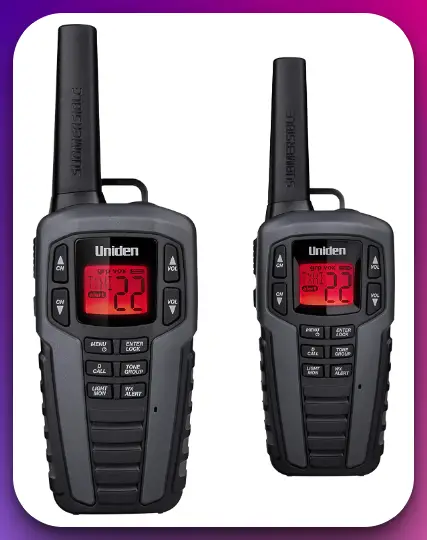
One of the standout features of the Uniden SX507-2CKHS is its NOAA weather alert functionality. This feature keeps users informed about changing weather conditions, enabling them to make informed decisions and stay safe during outdoor adventures.
The walkie talkies also feature a built-in flashlight that provides added convenience during low-light situations. Moreover, the eVOX (Voice-Activated Transmission) feature allows for hands-free operation, enhancing usability in various scenarios.
The Uniden SX507-2CKHS is designed to be rugged and durable, with an IPX7 waterproof rating. This ensures that the walkie-talkies can withstand water submersion up to one meter for 30 minutes, making them suitable for outdoor activities even in wet conditions.
In conclusion, the Uniden SX507-2CKHS offers a range of features and capabilities that make it a top choice for long-range communication. With their impressive range, versatile channels and privacy codes, NOAA weather alerts, built-in flashlights, and rugged design, these walkie-talkies excel in various outdoor settings.
Whether hiking, camping, or engaging in other outdoor activities, the Uniden SX507-2CKHS provides reliable communication and essential features to enhance your experience.
Pros:-
- Impressive communication range for reliable connectivity over long distances.
- 22 channels and 142 privacy codes offer versatile communication options and secure transmissions.
- NOAA weather alert feature keeps users informed about changing weather conditions.
- Built-in flashlight provides convenience during low-light situations.
- eVOX (Voice-Activated Transmission) feature enables hands-free operation.
- Rugged and durable design with an IPX7 waterproof rating for outdoor use.
- Long battery life ensures extended usage without frequent recharging.
- Clear and crisp audio quality for effective communication.
- Compact and portable design for easy carrying during outdoor activities.
- Cost-effective option compared to some other long-range walkie talkies.
Cons:-
- The range may be affected by terrain, obstructions, and weather conditions.
- Some users may find the user interface and controls slightly complex initially.
- The belt clip or accessories provided may not be as durable as desired.
- The walkie talkies may be bulkier compared to some other models.
Overall, the Uniden SX507-2CKHS offers a range of valuable features and benefits for long-range communication. While it may have some limitations, it provides a reliable and cost-effective solution for outdoor enthusiasts seeking clear and secure communication in various environments.
7. BaoFeng UV-5R: A Versatile Two-Way Communication Solution
The BaoFeng UV-5R is a versatile two-way radio that has gained popularity for its wide range of features and affordable price point. This compact and lightweight device offers reliable communication for various applications, making it a favorite among radio enthusiasts and professionals.
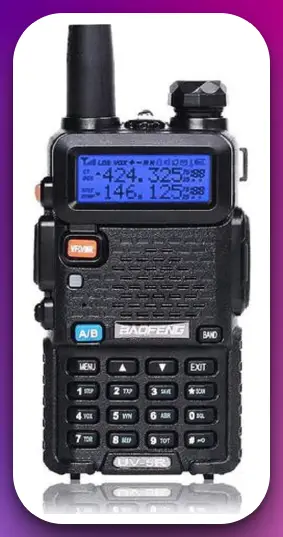
One of the standout features of the BaoFeng UV-5R is its dual-band capability, operating on both VHF (Very High Frequency) and UHF (Ultra High Frequency) bands. This allows users to access a broader range of frequencies, enhancing communication options in different environments.
The BaoFeng UV-5R offers an impressive 128 programmable channels, enabling users to customize their communication experience and access the most suitable channels for their needs. Additionally, the device includes CTCSS/DCS encoding and decoding, ensuring secure and interference-free transmissions.
Another notable feature is the built-in FM radio function, which allows users to listen to their favorite radio stations without two-way communication. This adds an extra level of entertainment and convenience.
The device is designed with a user-friendly interface, featuring a backlit display and keypad for easy operation, even in low-light conditions. The BaoFeng UV-5R also has a long battery life, allowing for extended usage without frequent recharging.
In summary, the BaoFeng UV-5R is a versatile and affordable two-way radio. With its dual-band capability, programmable channels, CTCSS/DCS encoding, FM radio function, and user-friendly design, this radio offers reliable communication and entertainment options.
Whether you’re a radio enthusiast, outdoor enthusiast, or professional user, the BaoFeng UV-5R is a valuable tool that provides efficient and effective communication in various settings.
Pros:-
- Dual-band capability (VHF and UHF) for accessing a wide range of frequencies.
- 128 programmable channels for customizable communication options.
- CTCSS/DCS encoding and decoding for secure and interference-free transmissions.
- Built-in FM radio function for added entertainment and convenience.
- User-friendly interface with a backlit display and keypad for easy operation.
- Compact and lightweight design for portability.
- Affordable price point compared to many other two-way radios.
- Long battery life for extended usage without frequent recharging.
- Compatible with a variety of accessories for enhanced functionality.
- Popular and widely supported in the amateur radio community.
Cons:-
- The learning curve for programming and operating the radio.
- The user manual may be challenging to understand for beginners.
- The build quality may not be as durable as higher-end models.
- Limited range compared to some high-powered radios.
- The audio quality may be less clear and crisp in certain environments.
Overall, the BaoFeng UV-5R offers a range of features and benefits at an affordable price.
While it may have some limitations, it remains a popular choice for amateur radio enthusiasts, outdoor enthusiasts, and individuals seeking entry-level two-way radio.
8. Motorola T460: A Reliable Outdoor Communication Solution
The Motorola T460 is a top-tier two-way radio with many features and capabilities, making it an excellent choice for outdoor enthusiasts and professionals. With its rugged construction and advanced functionalities, this radio ensures reliable communication in challenging environments.
One of the standout features of the Motorola T460 is its impressive communication range. With a maximum range of up to 35 miles in optimal conditions, this radio allows users to stay connected over long distances, making it ideal for outdoor activities such as hiking, camping, and skiing.
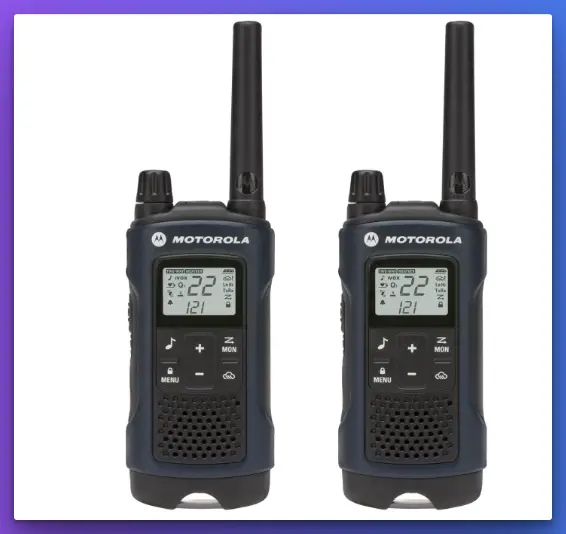
The Motorola T460 is designed to withstand the rigors of outdoor adventures. Its IP54 rating ensures protection against dust and water splashes, providing peace of mind in unpredictable weather conditions.
The radio also offers 22 channels and 121 privacy codes, allowing for flexible and secure communication. The Quiet Talk (QT) functionality ensures interference-free conversations, while the VibraCall feature provides silent notifications, making it useful in noisy environments.
Furthermore, the Motorola T460 has an emergency alert button that instantly alerts others of potential dangers, enhancing safety during outdoor activities. With a built-in LED flashlight, this radio is a practical tool in low-light situations.
The Dual Power option, which supports rechargeable and standard AA batteries, ensures uninterrupted communication even in remote areas with limited charging options. The Motorola T460 is a reliable, feature-packed two-way radio suitable for outdoor enthusiasts and professionals.
Its impressive communication range, rugged design, advanced functionalities, and convenient features make it an excellent companion for outdoor adventures, providing reliable and effective communication when it matters most.
Pros:-
- An impressive communication range of up to 35 miles provides extended coverage in outdoor environments.
- Rugged construction with an IP54 rating protects against dust and water splashes.
- 22 channels and 121 privacy codes for flexible and secure communication.
- Quiet Talk (QT) functionality ensures interference-free conversations.
- VibraCall feature provides silent notifications in noisy environments.
- Emergency alert button for instant alerts during potential dangers or emergencies.
- Built-in LED flashlight for convenient illumination in low-light situations.
- Dual Power option with support for both rechargeable batteries and standard AA batteries.
- User-friendly interface with easy-to-use controls.
- Compact and portable design for convenient carry during outdoor activities.
Cons:-
- The communication range may be affected by terrain, obstructions, and weather conditions.
- The radio’s advanced functionalities may have a learning curve for beginners.
- The included rechargeable battery pack may have a limited lifespan.
- Some users may find the audio quality slightly lacking in certain environments.
- The belt clip or accessories provided may not be as durable as desired.
Overall, the Motorola T460 offers a range of valuable features and benefits, including an impressive communication range, rugged construction, advanced functionalities, and convenience. While it may have some limitations, it remains a reliable choice for outdoor enthusiasts and professionals seeking effective and durable communication in various outdoor environments.
How To Maximize the Efficiency of Your Long-Range Walkie Talkie
Long-range walkie-talkies are valuable tools that offer reliable communication over extended distances. Whether using them for outdoor adventures, professional applications, or emergencies, maximizing their efficiency is crucial for clear and effective communication.
We have compiled a comprehensive guide with essential tips and techniques to help you get the most out of your long-range walkie-talkie.
1. Choose the Right Channel
Choosing the appropriate channel is essential for efficient communication. Look for unoccupied channels and avoid those with interference. By selecting a clear channel, you can minimize the chances of signal degradation and enhance overall communication quality.
2. Check Battery Levels
Always check the battery levels before embarking on any communication activity. Make it a habit to ensure that your walkie-talkie has sufficient power to last throughout your intended usage. Consider carrying spare batteries or a portable charger for extended trips, ensuring uninterrupted communication.
3. Optimize Antenna Positioning
Proper antenna positioning plays a significant role in maximizing the range and performance of your walkie-talkie. Orient the antenna vertically for optimal signal transmission and reception. Avoid obstructing the antenna with your hand or other objects, as it can impede signal strength and hinder communication effectiveness.
4. Utilize Headsets or Earpieces
Use headsets or earpieces to improve privacy, reduce background noise, and enhance communication clarity. These accessories allow for clearer audio reception and transmission, especially in noisy environments or situations that require discretion.
5. Practice Proper Etiquette
Adhering to walkie-talkie etiquette is crucial for efficient communication. Utilize clear and concise messages, avoiding unnecessary chatter or prolonged pauses. Allowing others to communicate effectively ensures a smoother and more efficient flow of information.
6. Understand Signal Range
Familiarize yourself with the signal range of your long-range walkie-talkie. Remember that the effective range may vary depending on environmental factors such as terrain, buildings, and weather conditions. Understanding these limitations will help you plan and adjust your communication expectations accordingly.
7. Avoid Obstructions
Maintain a clear line of sight between walkie-talkies whenever possible. Obstructions such as buildings, trees, or hilly terrains can limit the range and effectiveness of your communication.
When obstructed, consider elevating your position or finding a location with fewer barriers to improve signal transmission.
8. Adjust Squelch Settings
The squelch function on your walkie-talkie helps filter out weak or irrelevant signals. Adjusting the squelch level appropriately will eliminate background noise and improve overall audio quality. Experiment with different settings to find the optimal balance between reducing interference and maintaining clear communication.
9. Perform Regular Maintenance
Regular maintenance is key to maximizing the efficiency of your long-range walkie-talkie. Clean your device regularly, paying attention to the antenna and battery contacts. Check for any signs of damage or wear and promptly address any issues. Follow the manufacturer’s maintenance and storage guidelines to ensure your device’s longevity and optimal performance.
10. Familiarize Yourself with Features
Take the time to familiarize yourself with your long-range walkie-talkie’s features and functionalities. Accessing advanced options such as weather alerts, privacy codes, group call settings, and power-saving modes will enhance your communication experience. Experiment with these features to determine their applicability to your specific needs.
11. Stay Updated
Stay informed about any firmware updates or software enhancements provided by the manufacturer. Regularly check the manufacturer’s website or subscribe to notifications to ensure you have the latest updates installed on your device. These updates may introduce performance improvements, bug fixes, or new features that can further enhance the efficiency of your long-range walkie-talkie.
12. Conduct Range Tests
Periodically conduct range tests to assess the performance of your long-range walkie-talkie in different environments. By testing the signal strength and clarity at varying distances, you can gain insights into the limitations and capabilities of your device. This information will help you make informed decisions about communication strategies in different scenarios.
13. Consider External Antennas
Consider using external antennas when you require even greater range and signal strength. These antennas can be mounted on vehicles or stationary objects to extend the reach of your walkie-talkie.
However, it is essential to ensure compatibility with your specific device and comply with local regulations regarding antenna use. By implementing these tips and techniques, you can maximize the efficiency and performance of your long-range walkie-talkie.
Effective communication is crucial for safety, coordination, and seamless information exchange. Whether embarking on an outdoor adventure, coordinating a team, or preparing for emergencies, a well-utilized walkie-talkie can significantly enhance your communication capabilities.
Legal and Regulatory Considerations in Long Range Walkie Talkies
Long range walkie talkies are powerful communication devices that offer reliable connectivity over extended distances. However, being aware of the legal and regulatory considerations surrounding their use is crucial.
Understanding and adhering to these considerations ensures your long-range walkie-talkie’s responsible and compliant operation.
1. Licensing Requirements
In many countries, operating long-range walkie talkies may require a specific license or authorization. Regulatory bodies typically issue these licenses to ensure proper usage and prevent interference with other communication systems. Researching and complying with your jurisdiction’s licensing requirements before operating long-range walkie-talkies is essential.
2. Frequency Allocation
Long range walkie talkies operate on specific frequency bands. Regulatory authorities allocate these bands to various services and users. It’s important to ensure that your long-range walkie-talkie operates within the authorized frequency range and does not interfere with other licensed users in that band.
3. Power Limitations
Regulations may impose power limitations on long-range walkie talkies to prevent excessive interference and maintain spectrum efficiency. Understanding and adhering to the power limits set by regulatory authorities is essential. Operating a long-range walkie-talkie with higher power than allowed can result in penalties and legal consequences.
4. Privacy and Encryption
In some jurisdictions, encryption or privacy features in long-range walkie talkies may be subject to specific regulations. While privacy features are beneficial for secure communication, it’s important to ensure compliance with local laws regarding encryption. Be aware of any restrictions or guidelines for using encryption in your region.
5. Emergency Communications
Long-range walkie talkies can be valuable tools in emergencies. However, it’s important to be aware of any regulations or protocols related to emergency communications. Certain frequencies or channels may sometimes be designated for emergency use only. Familiarize yourself with these regulations to ensure proper and responsible use during emergencies.
6. Radio Etiquette
While not a legal requirement, radio etiquette is essential for efficient and courteous communication. Following proper procedures, using clear and concise messages, and respecting other users on the same frequency contribute to a harmonious radio environment.
7. Interference
Long-range walkie talkies should not cause interference with other licensed services or communication systems. Be mindful of nearby radio services and take steps to minimize any potential interference. Adjusting frequencies, using interference-reducing techniques, and avoiding operating near sensitive equipment or facilities can help prevent disruptions.
In summary, awareness of the legal and regulatory considerations in using long-range walkie-talkies is vital for responsible operation. Familiarize yourself with your jurisdiction’s licensing requirements, frequency allocation, power limitations, privacy regulations, and emergency communication protocols.
Adhering to these considerations ensures compliant and responsible use of long-range walkie-talkies, contributing to a safe and efficient communication environment.
The Future of Long-Range Walkie Talkies
Long-range walkie talkies have come a long way since their inception, and they continue to evolve with technological advancements.
As we look to the future, several exciting developments hold promise for the evolution of long-range walkie talkies.
1. Enhanced Range and Coverage
The future of long range walkie talkies lies in further expanding their communication range and coverage. Advancements in antenna technology, signal processing, and power efficiency are expected to result in even greater range capabilities, allowing users to stay connected over long distances and in challenging environments.
2. Improved Battery Technology
Battery life has always been a consideration for walkie-talkie users. However, advancements in battery technology, such as using more efficient and longer-lasting batteries, will alleviate concerns about power consumption. Future long-range walkie talkies may offer extended battery life, reducing the need for frequent recharging or battery replacements.
3. Integration with Other Technologies
Long-range walkie-talkies will likely integrate with other emerging technologies like GPS and Bluetooth. This integration would enable real-time location tracking, automatic pairing with compatible devices, and seamless integration with mobile phones or other communication systems.
4. Advanced Communication Features
The future of long-range walkie talkies will incorporate advanced communication features to enhance user experience. This may include voice recognition, text messaging capabilities, group calling, and improved audio quality. These features will enable more efficient and versatile communication options for users.
5. Smaller and More Compact Designs
Advancements in miniaturization and manufacturing techniques will lead to smaller and more compact long-range walkie talkies. These sleek and lightweight designs will offer improved portability and comfort, making them ideal for various outdoor activities and professional use.
6. Integration with IoT and Cloud Connectivity
Long-range walkie talkies may leverage the power of the Internet of Things (IoT) and cloud connectivity. This integration could enable remote management, firmware updates, and device data exchange. Walkie talkies could become part of a larger communication ecosystem, seamlessly connecting with other devices and services.
7. Enhanced Durability and Weather Resistance
The future holds advancements in ruggedness and weather resistance for long-range walkie talkies. With improved materials and construction techniques, these devices will be more durable and able to withstand harsh conditions, including water resistance and dust protection.
In conclusion, the future of long-range walkie talkies is exciting and promising. With advancements in range capabilities, battery technology, integration with other technologies, advanced communication features, compact designs, IoT connectivity, and enhanced durability, long-range walkie talkies will continue to be valuable tools for communication in various industries and outdoor activities.
As technology advances, the possibilities for long-range walkie talkies are limitless, providing users with reliable and efficient communication solutions.
International and Mountain Use of Long Range Walkie Talkies
Long range walkie talkies are invaluable tools for communication, particularly in international and mountainous environments where conventional communication methods may be limited.
Their portability, range, and reliability make them ideal for ensuring effective communication and enhancing safety in these challenging settings.
International Use:-
Long range walkie talkies provide reliable communication when venturing into international territories. They allow travelers, explorers, and professionals to stay connected and coordinate activities across regions and time zones.
Long-range walkie talkies with multi-channel capabilities and international frequency bands ensure compatibility and compliance with local regulations, enabling seamless communication during international expeditions.
Mountain Use:-
Long-range walkie talkies become essential communication devices in mountainous regions, where cellular coverage may be limited or nonexistent.
Their extended range capabilities enable hikers, climbers, and mountaineers to maintain contact over vast distances, ensuring coordination and safety in challenging terrain. The rugged construction of these devices withstands the rigors of mountain environments, including extreme temperatures, moisture, and impact.
Emergency Situations:-
Long-range walkie talkies are crucial in emergencies in international and mountainous areas. They facilitate rapid communication and coordination between response teams during natural disasters, search and rescue operations, or medical emergencies.
The ability to transmit distress signals, share vital information, and provide real-time updates enhances emergency response efforts, potentially saving lives.
Language and Cultural Barriers:-
Long-range walkie-talkies help overcome language and cultural barriers in international settings. With clear and concise communication, they enable effective coordination among individuals who may speak different languages. Long range walkie talkies equipped with translation features or the ability to communicate using universal distress signals further aid in bridging communication gaps.
Interoperability:-
Interoperability is crucial in international and mountain environments where multiple groups or agencies may operate. Long-range walkie talkies that offer compatibility with different communication systems, such as public safety networks or other radio devices, enhance coordination and information sharing between various teams, ensuring seamless interoperability.
Backup Communication:-
Long-range walkie talkies serve as reliable backup communication systems in areas where conventional methods may fail.
In remote mountain regions or during international travel, where cellular networks or internet connectivity may be unreliable or unavailable, long-range walkie talkies provide a lifeline for communication, maintaining contact with fellow adventurers, support teams, or emergency services.
In summary, long range walkie talkies are essential international and mountain-use tools.
Their extended range, durability, and versatility make them invaluable for effective communication, emergencies, overcoming language barriers, facilitating interoperability, and providing backup communication. Whether exploring remote mountain peaks or traversing international borders, long range walkie talkies are reliable means of staying connected and ensuring safety in challenging environments.
📗FAQ’s
What is the longest range of a walkie-talkie?
The range of a walkie-talkie can vary depending on several factors, including the terrain, obstructions, and the specific model of the walkie-talkie. While some walkie-talkies range a few miles, others are designed for long-range communication and can reach distances of up to 50 miles or more in ideal conditions.
What is the best long-range walkie-talkie in the world?
Several manufacturers produce long-range walkie-talkies, each with its features and capabilities.
Some top contenders for the best long-range walkie-talkie in the world include Motorola, Kenwood, and Midland models. These brands offer durable devices with extended range capabilities, advanced communication features, and excellent audio quality.
How far can long-range radios go?
Long-range radios are specifically designed to provide communication over extended distances. Depending on the model and environmental conditions, long-range radios can reach several miles to over 50 miles.
What is the farthest reaching two-way radio?
The farthest reaching two-way radio depends on the specific model and the conditions in which it is used. Some long-range two-way radios can achieve distances of up to 50 miles or more in open, unobstructed areas with favorable terrain.
How far can a real walkie talkie reach?
The range of a walkie-talkie can vary significantly depending on various factors, including the power output, antenna quality, environmental conditions, and obstructions.
Real walkie-talkies can communicate from a few hundred feet to several miles.
How far can military-grade walkie-talkies reach?
Military-grade walkie-talkies, also known as tactical radios, are designed to meet stringent requirements for reliability and range. Depending on the specific model, terrain, and other operational factors, these devices can achieve several miles to tens of communication ranges.
Do walkie-talkies have unlimited range?
No, walkie-talkies do not have unlimited range. The range of a walkie-talkie is limited by factors such as power output, frequency, antenna design, terrain, and obstructions.
While some long-range walkie-talkies offer extended communication capabilities, their range has practical limitations.
Which company is best for walkie-talkies?
Several companies are known for producing high-quality walkie-talkies. Some of the top brands in the industry include Motorola, Kenwood, Midland, Icom, and Baofeng.
These companies offer various models with varying features, durability, and performance, catering to different user requirements.
How do I extend the range of my walkie-talkie?
To extend the range of your walkie-talkie, you can consider the following steps:
- Use higher power settings if available on your device.
- Ensure the antennas are fully extended and positioned vertically.
- Opt for models with better antenna designs and higher gain.
- Choose walkie-talkies that operate on UHF frequencies, as they generally provide a better range in urban and indoor environments.
- Minimize obstructions and maintain a clear line of sight between devices.
- Avoid densely populated areas or places with high interference levels.
- Consider using external antennas or signal boosters for enhanced range, if compatible with your walkie-talkie model.
Can walkie-talkies be traced?
Walkie-talkies operate on specific frequencies that can be monitored but do not have built-in tracking capabilities.
However, it’s important to note that unauthorized use of walkie-talkies on certain frequencies or interference with licensed communication can be detected and traced by regulatory authorities or relevant agencies.
Which is better, UHF or VHF walkie-talkie?
The choice between UHF (Ultra High Frequency) and VHF (Very High Frequency) walkie-talkies depends on the specific application and operating environment.
Generally, UHF walkie-talkies offer better range and penetration through obstacles like buildings, making them suitable for urban and indoor use.
On the other hand, VHF walkie-talkies are better at transmitting over long distances in open areas, making them suitable for outdoor and rural environments.
How far do military radios go?
The range of military radios can vary depending on the specific model and operational conditions. Military radios are designed to provide reliable communication over extended distances, typically from several miles to tens of miles.
What radio can reach 1000 miles?
Reaching 1000 miles with a radio requires specialized equipment and conditions such as satellite communication or HF (High-Frequency) radio systems.
These systems are typically used in military, aviation, or maritime applications and are not commonly found in consumer-grade walkie-talkies.
Can walkie-talkies work anywhere in the world?
Walkie-talkies operate on specific frequencies and may be subject to regulatory restrictions and licensing requirements depending on the country or region.
It’s important to check and comply with local regulations and frequency allocations before using walkie-talkies in different parts of the world.
Does VHF or UHF have a longer range?
VHF frequencies generally have a longer range than UHF frequencies when used in open areas with minimal obstructions. VHF signals have lower attenuation and can propagate over greater distances than UHF signals.
Do walkie-talkies work without satellites?
Walkie-talkies operate on radio frequencies and do not rely on satellite communication. They establish direct communication between two or more devices within their operating range.
However, specialized satellite-based communication systems combine walkie-talkie functionality with satellite connectivity for long-range communication in remote areas.
How far can Apple Watch walkie-talkie reach?
The Apple Watch walkie-talkie feature utilizes Wi-Fi or cellular data to establish communication between Apple Watch users. The range of this feature is dependent on the Wi-Fi or cellular network coverage and is not limited to a specific distance when connected over the internet.
What is the difference between a walkie-talkie and a two-way radio?
“walkie-talkie” and “two-way radio” are often used interchangeably for portable handheld communication devices. Both devices allow for two-way communication.
However, “walkie-talkie” is a more casual term typically used for consumer-grade devices, whereas “two-way radio” is a broader term encompassing a wide range of professional and commercial radio equipment.
Why do the military use walkie-talkies?
The military uses walkie-talkies, or tactical radios, for reliable and secure communication in various operational scenarios.
Walkie-talkies provide soldiers with a means to coordinate and relay information on the battlefield or in other challenging environments where traditional communication systems may be unreliable or compromised.
What is the best walkie talkie for Burning Man?
Burning Man is a unique event where communication in a large, crowded, dynamic environment is essential.
The best walkie-talkie for Burning Man should have a long-range, durable construction, good battery life, and resistance to dust and harsh conditions. Popular options include models from Motorola, Midland, and Baofeng, with features suitable for the specific challenges of the event.
How long is the lifespan of a walkie-talkie?
The lifespan of a walkie-talkie depends on various factors such as usage, quality of components, and maintenance.
With proper care and regular maintenance, walkie-talkies can last for several years. However, it’s important to remember that batteries and other consumable parts may need replacement over time.
Can 2 sets of walkie-talkies work together?
Yes, two sets of walkie-talkies can work together if they operate on the same frequency or within compatible frequency ranges. It’s important to ensure all devices are set to the same channel and have compatible features and capabilities for seamless communication.
What is the range of 400-470 MHz in km?
The range of 400-470 MHz frequencies in kilometers can vary depending on several factors, such as power output, antenna quality, terrain, and obstructions.
Generally, these frequencies can provide reliable communication over distances ranging from a few kilometers up to tens of kilometers.
What is the difference between 1-watt and 2-watt walkie-talkies?
The difference between 1-watt and 2-watt walkie-talkies lies in their power output. A 2-watt walkie-talkie generally provides a stronger signal and potentially longer communication range than a 1-watt device.
However, other factors such as antenna design, frequency, and environmental conditions, can still influence the actual range.
Is a walkie-talkie better than a phone?
Walkie-talkies and phones serve different communication purposes. Walkie-talkies excel in providing instant and reliable push-to-talk communication over shorter distances, especially in areas with limited or no cellular coverage.
On the other hand, phones offer broader communication capabilities such as voice calls, messaging, and internet access but require cellular network coverage.
What to look for when buying a walkie-talkie?
When buying a walkie-talkie, consider the intended use, range requirements, durability, battery life, ease of use, available features (e.g., weather alerts, group communication), and compatibility with other devices.
Additionally, check for necessary licenses or regulatory compliance depending on your location and frequency of usage.
Are walkie-talkies better than cell phones?
Walkie-talkies and cell phones have distinct advantages and disadvantages. Walkie-talkies provide instantaneous and reliable communication, especially in areas with limited or no cellular coverage. They are also typically more durable and have longer battery life.
On the other hand, cell phones offer broader communication capabilities, internet access, and a wide range of applications but rely on cellular network coverage.
How can I make my cheap walkie-talkie better?
To enhance the performance of a cheap walkie-talkie, consider the following:-
- Use high-quality rechargeable batteries for improved battery life.
- Optimize the antenna by ensuring it is fully extended and positioned correctly.
- Choose an open frequency channel with minimal interference.
- Minimize obstructions and ensure a clear line of sight between devices.
- Consider using an external antenna or signal booster if compatible.
- Keep the walkie-talkie clean and free from debris that may affect performance.
Do walkie-talkies use repeaters?
Some walkie-talkies can utilize repeaters, which are devices that receive and retransmit signals to extend the range of communication.
Repeaters are particularly useful when long-range communication is required, such as in large buildings, remote locations, or hilly terrains.
What is the signal strength for a walkie-talkie?
The signal strength of a walkie-talkie can vary depending on the specific model and environmental conditions.
Signal strength is typically measured in decibels (dB) or signal-to-noise ratio (SNR) and indicates the power and clarity of the transmitted signal. Higher signal strength values indicate better reception and communication quality.
Can people hack walkie-talkies?
Walkie-talkies that operate on analog frequencies can be vulnerable to eavesdropping or interception. However, modern digital walkie-talkies that utilize encryption and other security measures provide more protection against unauthorized access or hacking.
Can anyone hear you on a walkie-talkie?
By default, anyone tuned to the same frequency and within range can hear transmissions on a walkie-talkie.
However, some models offer privacy features such as privacy codes or subchannels that allow users to communicate privately within a specific group, reducing the likelihood of others hearing their conversations.
Can a walkie-talkie hear you?
A walkie-talkie can receive and transmit audio signals, allowing users to hear and be heard by others tuned to the same frequency. The ability to hear and communicate with other walkie-talkie users is a fundamental feature of these devices.
How far can a 50-watt radio transmit?
The transmission range of a 50-watt radio depends on various factors, including frequency, antenna quality, terrain, and environmental conditions.
Generally, a 50-watt radio can provide reliable communication over distances ranging from a few miles to tens of miles, especially in open areas with minimal obstructions.
How far will 25 watts transmit?
The transmission range of a 25-watt radio is influenced by factors such as frequency, antenna quality, terrain, and obstructions. In ideal conditions, a 25-watt radio can communicate from a few miles to approximately 20 miles or more.
Can VHF penetrate walls?
Operating at lower frequencies, VHF signals have longer wavelengths than UHF signals. As a result, VHF signals can penetrate obstacles and walls more effectively, making them suitable for communication in buildings or dense vegetation.
What is the best frequency for long-range communication?
The best frequency for long-range communication depends on various factors, including the terrain, obstructions, and specific radio equipment.
Lower frequencies, such as VHF (Very High Frequency) and HF (High Frequency), provide a better range in open areas. In contrast, UHF (Ultra High Frequency) frequencies are more suitable for urban and indoor environments.
How far can an 8-watt radio transmit?
The transmission range of an 8-watt radio can vary depending on the specific model, frequency, antenna quality, terrain, and environmental conditions.
An 8-watt radio can provide reliable communication from several miles to approximately 10-15 miles in optimal conditions.
How far can VHF transmit?
The transmission range of VHF (Very High Frequency) radios can vary depending on factors such as power output, antenna quality, terrain, and obstructions.
VHF radios can provide reliable communication over several to tens of miles in open areas with favorable conditions.
What is the longest-range walkie-talkie without a license?
Consumer-grade walkie-talkies that operate on the Family Radio Service (FRS) or General Mobile Radio Service (GMRS) frequencies typically have a maximum power output of 2 watts. Without obtaining a GMRS license, the maximum range for these walkie-talkies is limited to a few miles, depending on the specific conditions.
What is the longest range radio wave?
Radio waves can have varying wavelengths, and the longest radio waves belong to the Extremely Low Frequency (ELF) range. These waves have wavelengths ranging from thousands to tens of thousands of kilometers, making them suitable for long-range and submarine communication systems.
How far can a 100-watt radio transmit?
The transmission range of a 100-watt radio can vary depending on factors such as frequency, antenna quality, terrain, and environmental conditions. In ideal conditions, a 100-watt radio can provide reliable communication over distances of up to 50 miles or more.
Can you fly with walkie-talkies?
Yes, you can generally fly with walkie-talkies in carry-on and checked luggage.
However, it’s recommended to check with your destination’s specific airline and transport regulations to ensure compliance with any restrictions or guidelines regarding electronic devices.
Can walkie-talkies work without the internet?
Yes, walkie-talkies can work without the need for an internet connection. Walkie-talkies utilize radio frequencies for direct communication between devices, allowing for communication in areas where cellular coverage or internet access may be limited or unavailable.
Who still uses walkie-talkies?
Walkie-talkies are used by a wide range of individuals and industries, including:
- Military and defense organizations
- Law enforcement and security personnel
- Construction and manufacturing industries
- Event organizers and staff
- Outdoor enthusiasts such as hikers, campers, and hunters
- Warehouse and logistics teams
- Hospitality and restaurant staff
- Emergency services and first responders
Can UHF penetrate walls?
UHF (Ultra High Frequency) signals have shorter wavelengths than VHF signals.
While UHF signals may have some difficulty penetrating certain types of walls or obstacles, they can generally provide better coverage and signal penetration in urban environments compared to higher frequency bands.
What is the longest distance for UHF?
The maximum distance for UHF communication depends on several factors, including the power output, antenna quality, terrain, and environmental conditions.
UHF radios can provide reliable communication from a few miles to tens of miles, especially in open areas with minimal obstructions.
What is the maximum range of UHF?
The maximum range of UHF communication depends on various factors, including power output, antenna quality, terrain, and environmental conditions.
UHF radios can provide reliable communication over several to tens of miles in optimal conditions.
Conclusion
As we’ve explored, Long Range Walkie Talkies are much more than a simple tool for communication.
They are a reliable lifeline in wilderness adventures, a backbone for coordination in construction sites, and a crucial means of connection during disaster relief operations.
Their robust build, broad coverage, and undeniable reliability underscore their immense value in diverse scenarios where typical communication devices fall short.
While technology advances and digital communication options multiply, long-range walkie-talkies’ simplicity, reliability, and resilience remain steadfast.
They remind us that sometimes, the most effective solutions have stood the test of time, even in the face of rapidly evolving technology landscapes.
So, whether you’re preparing for your next outdoor adventure, seeking to improve productivity on your worksite, or enhancing your emergency preparedness, don’t overlook the power of long range walkie talkies.
They might be the communication lifeline you never knew you needed. Harness the power of these devices and take your communication to the next level—whatever your mission might be.
References for further reading
Radio Frequency Interference Best Practices Guidebook
About the Author
Syed Balal Rumy is a seasoned telecommunications specialist with over two decades of hands-on experience in radio communication technology.
Beginning his career as a field engineer with Motorola, Syed quickly distinguished himself with his deep technical knowledge and ability to simplify complex concepts for everyday users.
Following his stint in the field, Syed moved into a product development role, where he led the design of several popular long-range walkie-talkies widely used in outdoor recreation and emergency services industries.
With a Master’s degree in Telecommunications from the University of Illinois, Syed has always been on the leading edge of radio communication technology. His passion led him to start his blog, ‘Walkie Talkie Wizardry’, where he shares expert insights and tips.
Syed extensive experience in the walkie-talkie industry, his technical background, and his love for outdoor adventure make him a trusted voice in the world of long-range walkie-talkies.
Whether you’re a professional relying on radio communication or a hobbyist interested in tech, Syed’s expert advice will guide you.