






















In today’s interconnected world, where data breaches and malware attacks have become increasingly common, safeguarding our personal and professional information has never been more critical.
One area often overlooked is the humble USB drive—a seemingly innocuous device that can unwittingly unleash digital havoc.
The rise of USB-related malware has highlighted the urgent need for reliable and efficient USB virus scanners to protect our data from lurking threats.
Welcome to an informative journey where we explore the world of USB virus scanners, the silent heroes shielding your valuable files and confidential information from malicious intent.
Whether you’re a tech enthusiast, a business professional, or an everyday user, understanding the risks associated with USB devices and taking proactive measures to counter them is crucial in today’s digital landscape.
In this article, we’ll delve into the ins and outs of USB virus scanners, uncovering how they work, their importance in safeguarding your data, and the key features to consider when choosing the right scanner for your needs.
By the end, you’ll have a comprehensive understanding of USB virus scanners and be equipped with the knowledge to make an informed decision, ensuring your digital security remains intact.
So, if you’re ready to fortify your defenses against the ever-present threats lurking within USB drives, let’s embark on this enlightening exploration of USB virus scanners and discover the peace of mind they can bring to your digital life.
Best USB Virus Scanners To Stay One Step Ahead
1. Bitdefender USB Immunizer
This antivirus instrument immunizes both SD cards exactly when the USB storage drives are inserted against the ‘undesirable crapware’. The instrument forestalls malware to run its autorun.inf record on your PC.
The Bitdefender (Download Here) is one of the leading antivirus software companies in the world now has Bitdefender programs that prevent malicious software from entering through the autorun feature which has been sprouting to become a huge problem for many PC users.
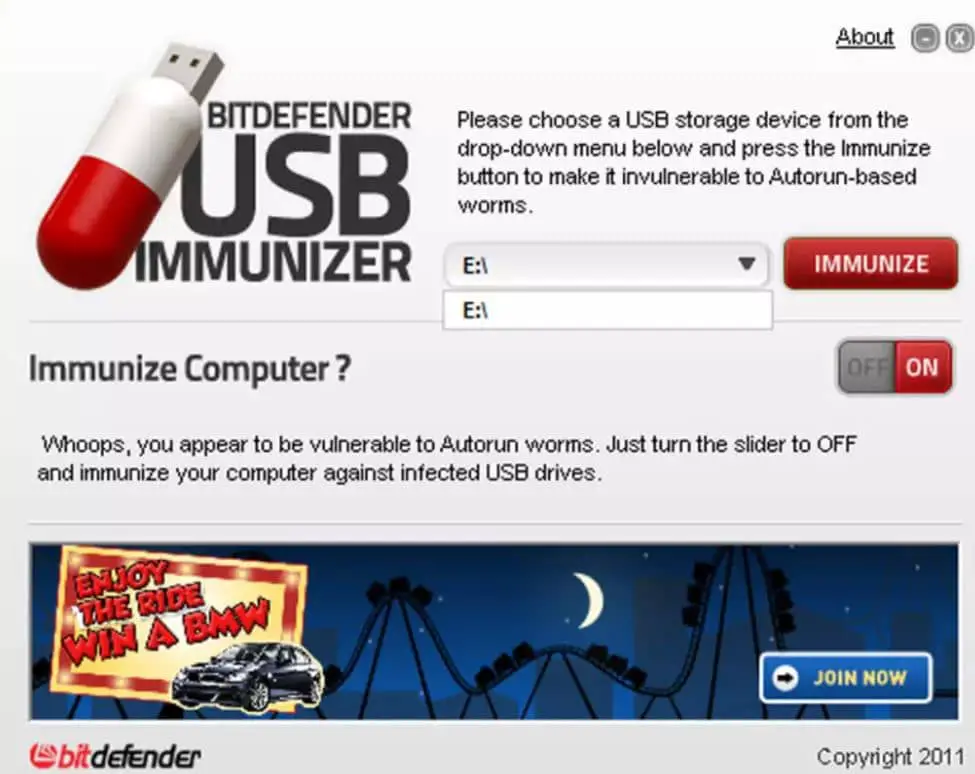
The Bit defender antivirus program comes with a ‘USB- immunizer’ feature that aids in blocking viruses from entering your PC.
Features:-
1. You can download the Bitdefender USB Virus Scanner completely free from the internet which makes it especially useful for PC owners who don’t want to spend large bucks for getting their computers repaired.
2. The Bitdefender puts a stop on the autorun function of your computer system and therefore no files on a foreign USB device get a chance to upload themselves on your PC even if they have not been scanned yet.
3. Worm.Autorun.VHD, the Conficker worm, and Trojan.AutorunInf is some of the most popular malicious viruses that have been affecting PCs all over the world through USB flash drives and the Bitdefender has been proven to fight against all of them.
4. When detected, the Bitdefender takes powerful action against any malicious software on a foreign drive. In addition, the Bitdefender constantly monitors even after disabling threats from a USB Drive and looks for viruses to destroy on the go.
5. The Bitdefender provides an easy-to-use Interface as you can click on the ‘automatically immunize USB Drives’ button on the options tab and the Bitdefender will do the rest.
6. With the help of the Bitdefender, you can easily turn on or off the immunizer, which means you have control over whether a USB drive will run automatically on your PC.
However, if you turn the automatic immunizer off, then the Bitdefender will not help in preventing any malicious software from entering and harming your computer device.
Cons:-
1. One of the features of the Bitdefender is also one of its downsides. The prevention of the automatic run feature as stated before can be overwhelming at times for users.
2. One of the other faults with the Bitdefender is that the USB immunizer records removable media as they are the ones that are generally inclined to infections, for example, the autorun.inf type.
2. Kaspersky Pure
Most of you would have heard of the name Kaspersky. Kaspersky is one of the most famous names in the computer security game.
The Kaspersky antivirus program comes with a USB Virus Scanner that aids the user in identifying and diminishing threats such as viruses and other malicious software from your computer device.
The branched-out version of the Kaspersky antivirus with a pen drive scanner is known as the Kaspersky PURE (Download Here).
Features:-
- The Kaspersky antivirus has an easy to use Interface with minimal complications and various help features.
- This tool has various adjustable and customizable settings that aid the program to function per your needs accurately. These features help the PC to increase its performance and allow the user to not waste their time and energy on antivirus scans.
- The Kaspersky PURE comes with three options namely a full scan, a quick scan and a do not scan which you can adjust to your scanning needs.
- Unlike others on this list, the Kaspersky PURE provides you with a function where you can specify the maximum size of the pen drive that it needs to scan and subsequently immunize.
- The Kaspersky aims to proactively detect threats and vulnerabilities to your computers such as crypto lockers, ransomware, and hackers trying to take control over your PC remotely.
- This tool also allows the flow of automatic scanning of the USB flash drive as soon as it is inserted.
- The Kaspersky takes pride in blocking and deleting malware in real-time and allowing safe and smooth functioning of your PC
Cons:-
- Such a great name in the computer security industry also comes with a price. The price for the Kaspersky PURE is $30, around 2200 INR, which gives it disapproval from many users.
3. Panda USB Vaccine
This software tool just as the name recommends is a utility that forestalls malware infections on your PC.
Nowadays, reports about numerous malware and viruses entering computer systems through USB sticks add unnecessary discomfort and risks for the user.
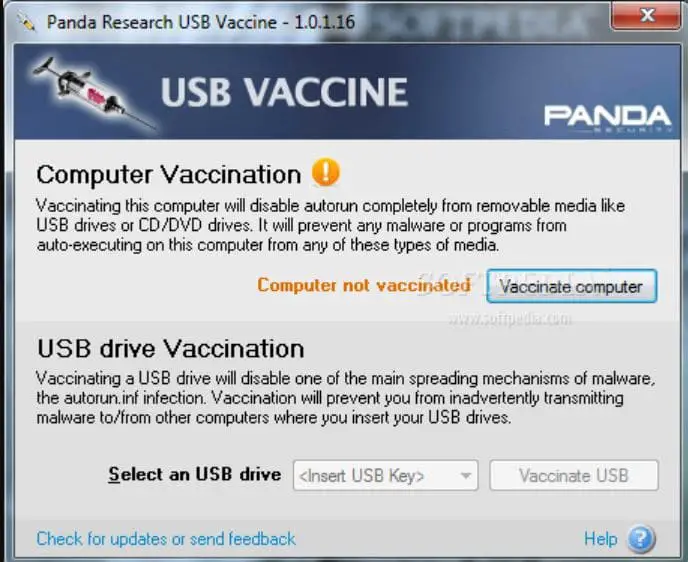
The Panda USB Vaccine (Download Here) destabilizes the functioning of these viruses and infections from entering your computer systems by preventing the autorun feature and detecting and blocking such viruses.
Features:-
1.The first and foremost use of the Panda USB Vaccine is that it does not allow the AUTORUN.INF file to run.
Most malware that enters PCs is by attaching themselves to the AUTORUN.INF file as executable and then goes on to silently upload itself on your computer device.
Through the Panda, users can easily access foreign pen drives without worrying about any viruses entering their systems.
2. The Panda USB Vaccine is completely free, attracting most of its costumes compared to its competitors.
3. The Panda also comes with antimalware, which aids the user in accurately identifying and removing threats and dangerous malware from entering the computer system.
4. The Panda USB Vaccine permanently disables any USB drive from running automatically which adds additional protection so that some viruses may not attach themselves to other internal drives in your PC.
5. It can be easily downloaded to USB sticks and doesn’t take up much space.
Cons:-
1. The first inconvenience faced by many Panda Users is that you have to be there and allow every step of the process as it completely disallows files on your pen drive from running automatically.
2. Another negative for this Scanner tool is that it only works for FAT and FAT32 USB Drives so you have to be careful as to which drive you to apply it on.
4. USB Threat Defender
A definitive USB Anti-Virus arrangement, the USB Threat Defender (Download Here) with its remarkable Proactive and Definition scan Technology consolidated together releases another security fortification level.
These software tools detect thoroughly identify even molecule malware that at times goes undetected by an average antivirus program and provide many layers of security from viruses and threats entering your computer system through USB devices.
The USB Threat Defender is also quite special as unlike many other USB virus scanner tools on this list, this scanner tool focuses mainly on threats incoming through USB devices and has made thorough examinations and provided security for the same thereof.
Features:-
1. The most important feature for this tool is that, unlike traditional USB Virus Scanner tools, it’s not just another AUTORUN.INF file prevention tool, it is a lot more. It functions on exceeding rigor and does not let even minuscule viruses survive.
2. This USB Virus Scanner includes a proactive scanning tool that works on automatic detecting of both known and unknown malware that may try to harm your computer system or your data.
3. The USB Threat Defender in addition to its other variegated features also includes a definition-based scanning method that performs a thorough detection and cleansing of any kind of malware already existing in your computer system upon installation.
4. In comparison to others on this list, the USB Threat Defender is more inclined towards activity-based scanning which makes it a better defense mechanism.
Cons:-
- Although you can download the USB Threat Defender for free, it consists of a lot of in-app purchases which puts this application on the more expensive side.
- The USB Threat Defender does not offer an automatic scanning of your pen drives by working in the background.
- It does not work for mac ios.
5. McAfee Virus Scan USB
McAfee is the most sold and popular brand for your computer safety and security. The USB virus scanner software that McAfee provides is unmatchable at many levels.
Anyone who wants to get USB Virus security and other computer-based device security should very strongly consider McAfee as an option (Download Here).
Features:-
1. McAfee provides a very simple User Interface and adjustability schedule along with instructions and reading manuals which makes it very attractive to the average user looking for no complications.
2. This particular tool of the McAfee company produces numerous and regular updates for better virus scanning from USB intruding threats that are silently updated to your product in the background.
3. A very attractive feature of the McAfee Virus Scan USB is that it gives a 30- day money-back guarantee to all of its customers if the program does not give the expected performance.
4. McAfee provides active on- insertion and on-demand virus detections and solutions.
5. This tool provides complete, regular, and thorough scanning of your computer device for viruses through its antivirus software along with scanning your USB device.
Cons:-
1. For this particular product (Virus Scan USB), McAfee does not provide its customers with a free trial run to understand what the product is all about.
2. This application software is more inclined towards the expensive side as compared to the other scanner tools on this list which are mostly free.
3. Only works for USB Flash Drives operating on the U3 platform. Find more information about U3 drives here.
6. Ninja Pendisk
Ninja is a famous freeware program intended for guarding PCs against infections communicated by USB pen disks.
The Ninja Pendisk (Download Here) has aimed at keeping USB Virus Scanning a simple job by being fully portable, requiring no installation whatsoever, and being self-contained.
Features:-
1. As the name of this security software tool itself suggests, the Ninja Pendisk silently waits in the background for the insertion of any known or unknown foreign USB device.
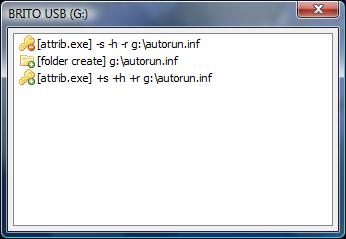
and suddenly attacks by detecting and erasing any malicious software or viruses that may try to enter your system such as the AUTORUN.INF file malware and ctfcommon.exe are amongst a list of many others.
2. The Ninja Pendisk is completely free to download from the internet.
3. Unlike most of the USB Virus Scanners on this list, the Ninja uses very minimal CPU and mostly around 6MB of RAM which is very impressive.
4. The Ninja provides adjustable settings and options and you can also set what files to be deleted or left alone upon detection.
5. In addition to all these features, the Ninja, upon cleansing your USB device, also creates a separate Autorun. Inf file inside the USB drive to prevent it from any further attack from malware through other computers, etc.
7. Avast
Avast (Download Here) is one of the most popular brands regarding computer system security in the market. The brand is well known for its multi-level security features that help to protect your PC from unwanted malware and viruses through USB flash drives.
Features:-
1. The Avast USB Virus Scanner does not allow any malware to enter or spread through a USB pen drive upon insertion and prevents the malware from spreading inside the drive itself.
2. The Avast scanner tool also provides a predefined automatic scanner tool installed on your computer device that keeps out a look for any potential malware or programs that may try to enter through the autorun feature.
3. The Avast scanner tool also provides a manual scan option where you can scan the files on your PC or a foreign USB flash drive on demand. All you have to do is select the scan option in the scan tab.
4. The Quick scan choice plays out an output of the C:\drive scan which generally distinguishes larger parts of malware found in documents with hazardous extensions, while a full framework scan plays out a point-by-point sweep of all your PC’s hard disks.
5. The Avast USB Virus Scanner plays an important role by checking every file to determine its type and then works out on whether to scan that particular file or not.
Cons:-
1. Avast does not provide its customers with separate products for antivirus and USB Virus Scanner, i.e, the user will have to buy both of them together.
2. Although Avast comes with a free trial, it is rather inclined on the more expensive side which does not attract many customers in comparison to most of its free competitors.
8. Bullguard
BullGuard (Download Here) antivirus examines compact drives like USB drives for dangers or malware that might be attached to files being moved to your PC from the drive, which can spread infections.
Bullguard ensures the safety and smooth working of both the PC and the USB device by scanning and removing all malicious software that can spread through the foreign device.
Features:-
1. Bullguard, with its next-gen antimalware USB detector, scans and detects in real-time, any malware or virus that may be stored in a USB flash drive and can enter your computer system as soon as it is inserted so that the infection may not spread.
2. The Bullguard antivirus with USB Virus Scanner has an easy to use Interface with very fewer complications and is adjustable to your scanning needs.
3. If you regularly work by sharing files through USB Flash drives, Bullguard might become very useful for you as it constantly functions in the background.
4. The user may also enjoy the other features that come along like its Antivirus product which applies to most computer devices at your home and produces unparalleled safety and security.
5. With a single subscription, you can enjoy using Bullguard antivirus for up to 10 devices for one year.
6. Bullguard provides exceptional customer service.
Cons:-
The cost of Bullguard is on the expensive side and does not attract many customers resisting to pay for their computer security needs.
Block privacy and data thefts through a USB drive?
Whether friend or colleague, work or home, any place, or anyone, trust is a factor that still hasn’t progressed. Technology has seen different upsides and downsides but the humanistic factor of trust hasn’t evolved much and still exists in the unconfirmed state.
Reports have suggested that people used to be rather more creative in using their brains rather than today. Why? Due to the threat of data losses and data thefts.
Why would anyone work knowing a few moments later, their data is going away from them with or without their consent? Where technology has opened gates to mass opportunities for us, the same door is open for those who we do not trust.
You never know the friend you are sitting along with at home is your friend at the front, but is a foe on the inside. Any moment you walk in the kitchen to grab some snacks and hence find your data being stolen through a USB drive (inserted in your laptop) and now you are a goner.
USB block review:-
For this very reason, many users contacted us doing a brief review on how you can eliminate such threats from your life. Just sitting in one place thinking all is lost is not the solution is it? No, it never was. Hence, we thought of reviewing software that could help you eliminate such threats.
USB Block, for example, is considered an option that would prevent anyone from accessing your confidential files or folders. The developers of this software had the concept of creating something unique which would have the ability to restrict any unauthorized device from connecting to your device.
Hence, you limit the devices hackers use to exploit your data, you stay in safe hands. We personally liked the concept and now let’s talk about their features.
Features:-
Hack attempt monitoring:-
A hacker when tries to aces your account can make wrong login attempts and when it happens, the software would notify you of any such activity. Rest assured since you are the only one having the password, no hack attempts would generate any success and such attempts would be monitored regularly.
Authorize trusted USB devices:-
The developers knew restricting all the USB drives isn’t a solution as if that happens; even you won’t be able to insert your USB for different purposes.
Hence, USB block brought you the whitelisting feature where you can whitelist the device that you commonly use. Hence, you gain access while the unauthorized devices remain restricted. We found this feature a groundbreaking one that so far none of the competitors have created.
Set a master password:-
The software would ask you to set a password after installation. You must have a good memory to keep the created password in your memory.
If not, try writing it down at a safe place as whenever you insert your drive-in, you would asked to enter that password. The best part? USB block remembers the devices it had interacted with in the past.
The program’s interface has a modern design and is quite user-friendly. This means that any type of person can work with it, no matter their previous experience.
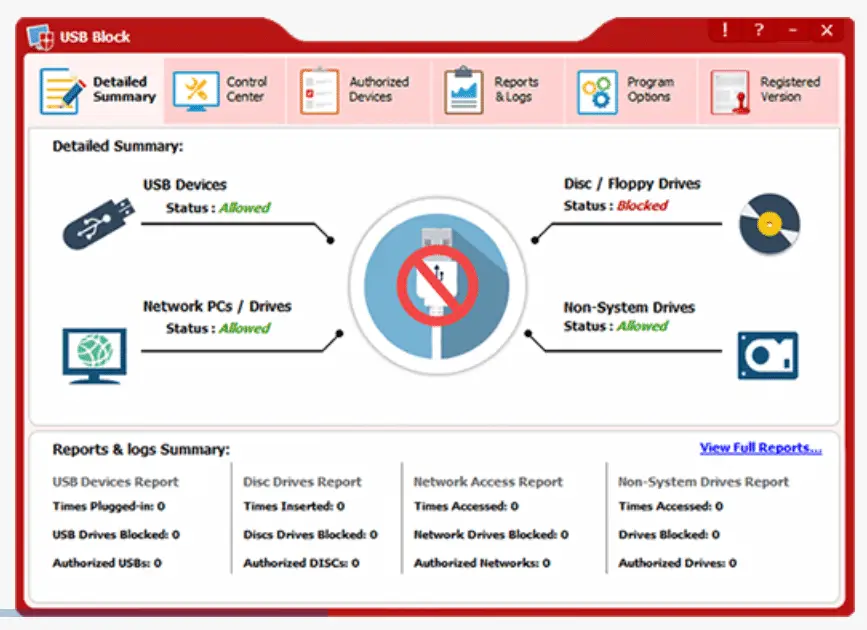
The main window has a tabbed display that enables you to browse through a detailed summary, control center, authorized devices, reports and logs, and settings.
You can change your password anytime:
The software utility shows the last one hundred reports and logs possessing information like device name, type, total insertions, and more which further lets you monitor the actions taken on your computer and make sure the security wants tempered with.
Developer page for downloading free Usb Block https://www.newsoftwares.net/usb-block/
Pros:-
- Check logs to monitor any illegal activity
- Hack attempt monitoring
- Whitelist your trusted devices
Cons:-
- Flashy interface
Hence, blocking unauthorized devices has now become possible as whether it is CDs, DVDs, and USBs etc. you are safe from any harm as long as you don’t share your password with anyone.
You may also like to read this awesome tutorial article
A Complete Essential Guide to Encrypting Your Data
Best Bootable USB Virus Scanners
In today’s rapidly evolving digital landscape, protecting our computers from the ever-increasing threat of malware and viruses has become a critical priority.
To fortify your system’s defenses and ensure comprehensive security, it’s essential to consider the best bootable USB virus scanners. These innovative tools offer a unique advantage by allowing you to scan your computer for viruses even before the operating system boots up.
When it comes to safeguarding your system, choosing the best bootable USB virus scanner can make all the difference.
These scanners, such as Avast Rescue Disk, Bitdefender Rescue CD, or Kaspersky Rescue Disk, provide a reliable and comprehensive solution to detect and eliminate malicious threats that may lurk within your system.
Here’s a table showcasing some of the best bootable USB virus scanners available:-
| Virus Scanner | Description | Features |
|---|---|---|
| Avast Rescue Disk | A powerful bootable antivirus tool with a user-friendly interface. | – Comprehensive virus scanning |
| – Ability to update virus definitions | ||
| – Option to scan specific files or folders | ||
| – Rescue mode for advanced malware removal | ||
| Bitdefender Rescue CD | A bootable antivirus solution based on Bitdefender’s scanning engine. | – Automatic updates of virus signatures |
| – Malware detection and removal | ||
| – Ability to disinfect infected files | ||
| – Browser-based user interface | ||
| Kaspersky Rescue Disk | A bootable antivirus tool from Kaspersky Lab. | – Bootable environment with GUI |
| – Scans and removes various types of malware | ||
| – Option to update virus definitions | ||
| – File backup and restore capabilities | ||
| Comodo Rescue Disk | A bootable antivirus scanner with an emphasis on malware removal. | – Full system scan with customizable options |
| – Real-time scanning and behavior analysis | ||
| – Quarantine and rollback features | ||
| – Secure browsing mode for online safety | ||
| Sophos Bootable Antivirus | A bootable antivirus scanner from Sophos. | – Malware detection and removal |
| – Rootkit detection and removal | ||
| – Network scanning for malware | ||
| – Simple and intuitive user interface |
📗FAQ’s
How do I scan a USB for viruses?
To scan a USB for viruses, you can use antivirus software installed on your computer. Insert the USB into your computer’s USB port and open the antivirus software. Select the option to scan your USB drive, and the software will scan the entire USB drive for viruses.
How do I free up viruses on my USB?
If your USB has viruses, you should not try to “free them up” as viruses are harmful to your computer. Instead, you should use antivirus software to remove the viruses from your USB.
Insert the infected USB into your computer, open your antivirus software, and select the option to scan and remove viruses from the USB.
Can USB have antivirus?
No, a USB drive cannot have antivirus software installed on it. Antivirus software is installed on your computer to scan and remove viruses from external storage devices such as USB drives.
You can use your antivirus software to scan and remove viruses from your USB drive when you connect it to your computer.
How do I make sure my USB is safe?
To make sure your USB is safe, you should avoid using it on unsecured public computers or sharing it with others.
Use antivirus software to scan your USB for viruses regularly and ensure that the antivirus software on your computer is up to date. You can also encrypt your USB drive to protect the data stored on it from unauthorized access.
Can a USB be infected with malware?
Yes, a USB drive can be infected with malware such as viruses, trojans, or ransomware. Malware can infect your USB drive when you connect it to an infected computer, download infected files, or install infected software.
To protect your USB from malware, use antivirus software and avoid using it on unsecured computers.
How do I know if my USB is corrupted?
If your USB is corrupted, you may experience errors when trying to access files or save new data to the drive. Your computer may also display error messages or fail to recognize the USB drive. You can run a disk check or use disk repair software to check for and repair any file system errors on your USB.
Will formatting a USB remove malware?
Yes, formatting a USB drive will remove all data, including any malware, from the drive. However, it is important to note that formatting will not necessarily remove any firmware-level malware that may have infected the USB controller itself.
To ensure your USB is free from malware, scan it with antivirus software after formatting.
How do I scan a USB for repair?
You can use disk repair software or run a disk check to scan a USB for repair. Insert the USB drive into your computer, open the disk repair software, and select the option to scan for and repair file system errors. This should identify and repair any issues with the USB drive.
Can you uncorrupt a USB stick?
In some cases, it may be possible to uncorrupt a USB stick. You can use disk repair software or run a disk check to identify and repair any file system errors on the USB drive. However, if the corruption is due to physical damage to the USB, it may not be possible to uncorrupt it.
Are viruses still there after formatting?
No, viruses are not present on a USB drive after formatting. Formatting will remove all data from the drive, including any viruses or malware that may have been present.
However, it is important to note that formatting will not remove any firmware-level malware that may have infected the USB controller itself.
What malware can be dropped from a USB?
A USB drive can be used to drop various types of malware, including viruses, trojans, ransomware, and spyware. These can be used to steal sensitive information, encrypt files, or gain unauthorized access to your computer or network.
To protect yourself from malware dropped from a USB, it is important to use antivirus software and avoid using USB drives on unsecured or unknown computers. Additionally, you should be cautious of opening files from unknown or suspicious sources, as they may contain malware.
How do I wipe a flash drive clean?
To wipe a flash drive clean, you can format the drive using your computer’s built-in disk management tools. Insert the USB drive into your computer, open the disk management tools, and select the option to format the USB drive.
This will remove all data, including any viruses or malware, from the drive. It is important to note that formatting will not necessarily remove any firmware-level malware that may have infected the USB controller itself.
Conclusion
In conclusion, USB virus scanners are indispensable tools for ensuring the security and integrity of your digital devices.
By employing a robust USB virus scanner, you can effectively safeguard your computer and other USB-enabled devices from the ever-evolving threats lurking within infected external storage devices.
With their advanced scanning capabilities, these powerful tools provide comprehensive protection by detecting and eliminating malicious software, viruses, and malware before they can infiltrate your system.
USB virus scanners act as a vital line of defense, minimizing the risk of data breaches, unauthorized access, and potential damage to your valuable files and sensitive information.
Moreover, USB virus scanners offer convenience and ease of use, allowing you to scan USB drives and external devices effortlessly.
Whether you’re a business professional, student, or home user, investing in a reliable USB virus scanner is a proactive step towards maintaining a secure digital environment.
Don’t leave your digital assets vulnerable to the threat of USB-borne malware. Take control of your device’s security and gain peace of mind by incorporating a USB virus scanner into your digital defense strategy.
Embrace the power of cutting-edge technology and safeguard your valuable data from the ever-present risks associated with USB storage devices.
Remember, prevention is always better than cure when it comes to digital security. By staying proactive with the help of a dependable USB virus scanner, you can ensure a safer and more protected digital experience.
Stay one step ahead of potential threats and empower yourself with the right tools to secure your digital world. Choose a USB virus scanner today and keep your devices and data safe from harm.