













Are you curious about learning an Elvish language and looking for The Best Elvish Translator Tools? 🤔 You are in the right place.
Let’s get deep dive in. 📗
Elvish is a Middle-Earth language used for communication amongst Elves. J.R.R Tolkien created this language to make communication easy for all his Elves. The Elves are fictitious, partly heavenly, and mythological bodies found in the author’s novels.
These characters have gained huge popularity after the introduction of works like The Lord of the Rings and The Hobbit. In these modern times, the Elvish language has greatly evolved and gained much popularity.
Nowadays, there are a large number of people who are on the lookout for Elvish translator tools for converting regular English into Elvish language.
One of the main reasons why people look out for such translation tools is because they have this strong desire to transcribe phrases or quotes and even names into the Elvish language.
Once done, they post the same on different social media platforms to appear cool and trendy.
No matter what your reason is for using these tools, one thing you must always have in mind is choosing the right solution in this category.
Of course, learning a new language, on the whole, simply using a translator tool might not be possible. Nevertheless, this can help you better understand the language.
Learning or understanding the Elvish language will reveal incredible details of stories behind Sindarin or Middle-Earth phrases and names. Furthermore, learning this language will also help you learn other languages used in various parts of the world.
These include German, Spanish, and French. In these modern times, the Elvish language has gained huge momentum and prominence.
Some cool and exclusive tools that can help you translate basic English into the Elvish language are as follows:
Best Elvish Translator Tools – Our Top Pick 👌
1. Runes elvish translator
This is one app that will make Elvish translations now a possibility even for Apple device users. This is because the app works on Apple iOS devices.
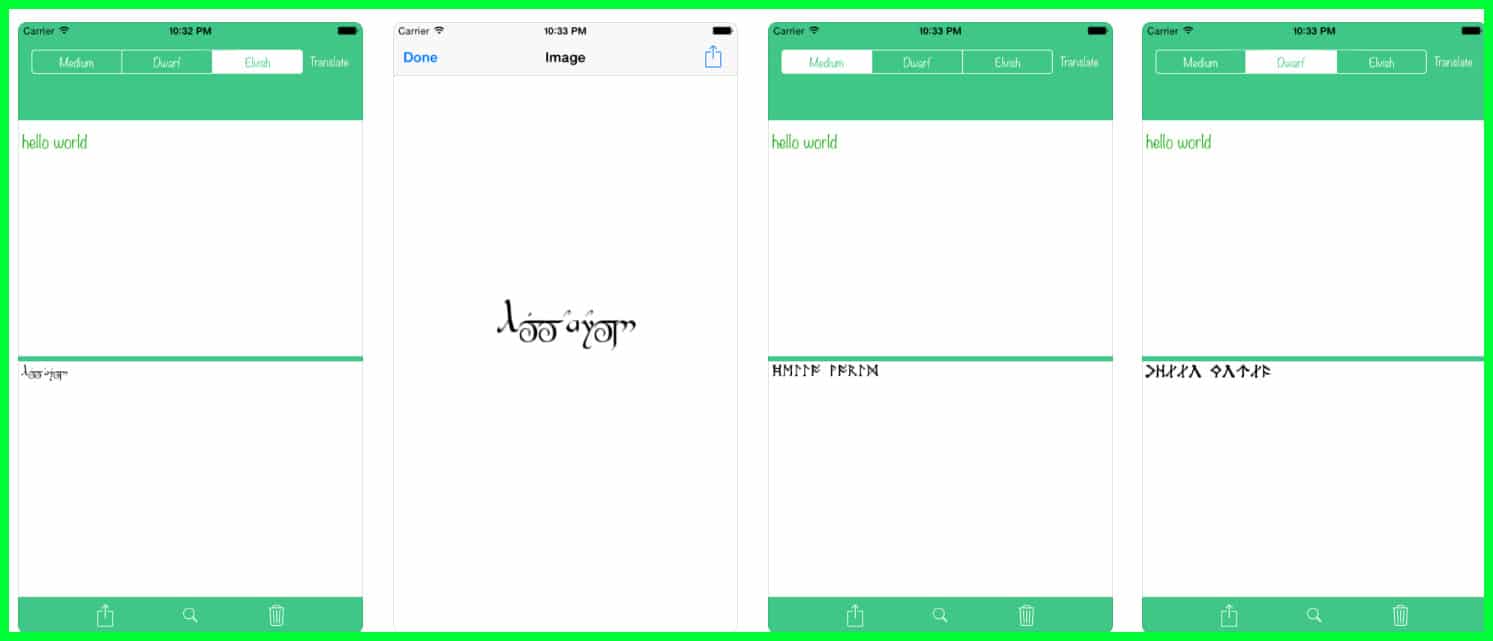
Simply because it is available for an Apple device does not mean that the app differs from the other Elvish translation tools available online.
It works in the same way as the other Elvish translation tools. It is more efficient and useful than the other translator tools detailed in this list.
Features include:-
- Straightforward and easy-to-use user interface. The interface comes with three options: Elvish, Dwarf, and Medium.
- Download the app from the Apple store. Next, install it on your device so you can indulge in language conversions even on the go. The only thing you need to do is open the application, choose Elvish, and begin with the process of typing as many words as you want.
- The app keeps generating Elvish texts and phrases simultaneously and all by itself.
- Results are generated in image form. Users can save the images on their devices.
- If they want to share the images with their friends, they can open the gallery on their device and do the same using emails or social media platforms.
Though the work procedure of the Runes is the same as all the other Elvish translation tools available online, it is different. It makes things easier for its users.
2. Elfic
This is a wonderful elvish translator app to translate any sentence or phrase to Elvish. Besides, this app helps you write sentences in Elvish and know which lyrics you use.
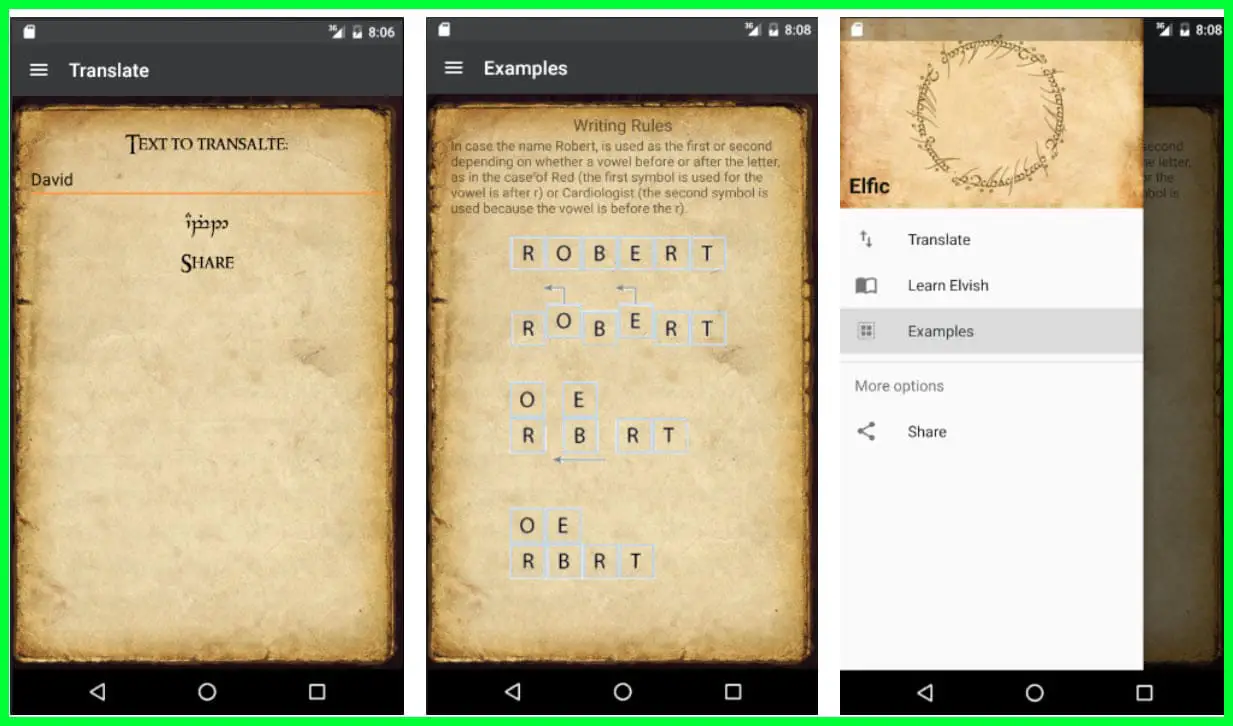
The most important thing is it also helps you save the translated phrases on your tablet and a smartphone in the gallery section.
3. Jens Hansen
No Elvish translator tool as genuine and authenticated as Jens Hansen-The Ringmaker. It best translates regular English phrases and terms into the Elvish language.
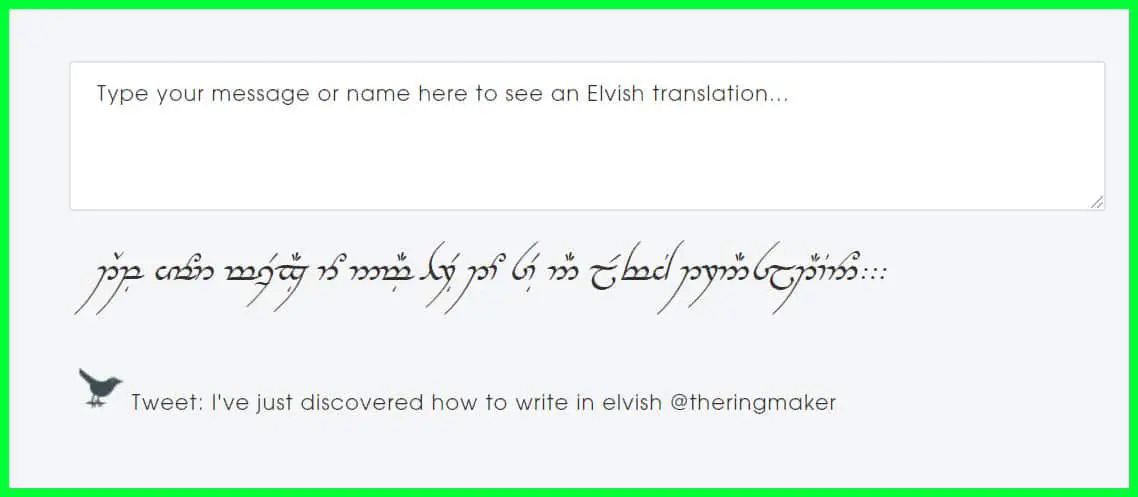
The user interface of this translator is easy to handle and simple. To get the best language conversion results, the users must keep typing their content or the words they intend to translate in Elvish in the text box provided.
The tool automatically generates the Elvish phrases and texts as they continue doing so. The users do not need to tap or click anywhere to get the translation results. This proves to be highly user-friendly and efficient as well.
Noteworthy features of the translator tool are as follows:-
- Translation output is displayed in the input text box for ease of use for the users.
- Users can either copy the text they want to translate or take screenshots.
- Results delivered by the translator tool can be copied and pasted on different platforms. But remember, the majority of the platforms do not support Elvish characters.
- Taking a screenshot of the translation result and then sharing it through mail or social media can prove useful.
Jens Hansen is one of the most reliable elvish name translator tools available online. It contains all the features required to make the language conversion procedure easy for the users. Translation results generated by Jens Hansen are 100% accurate.
4. Learn Elvis Free
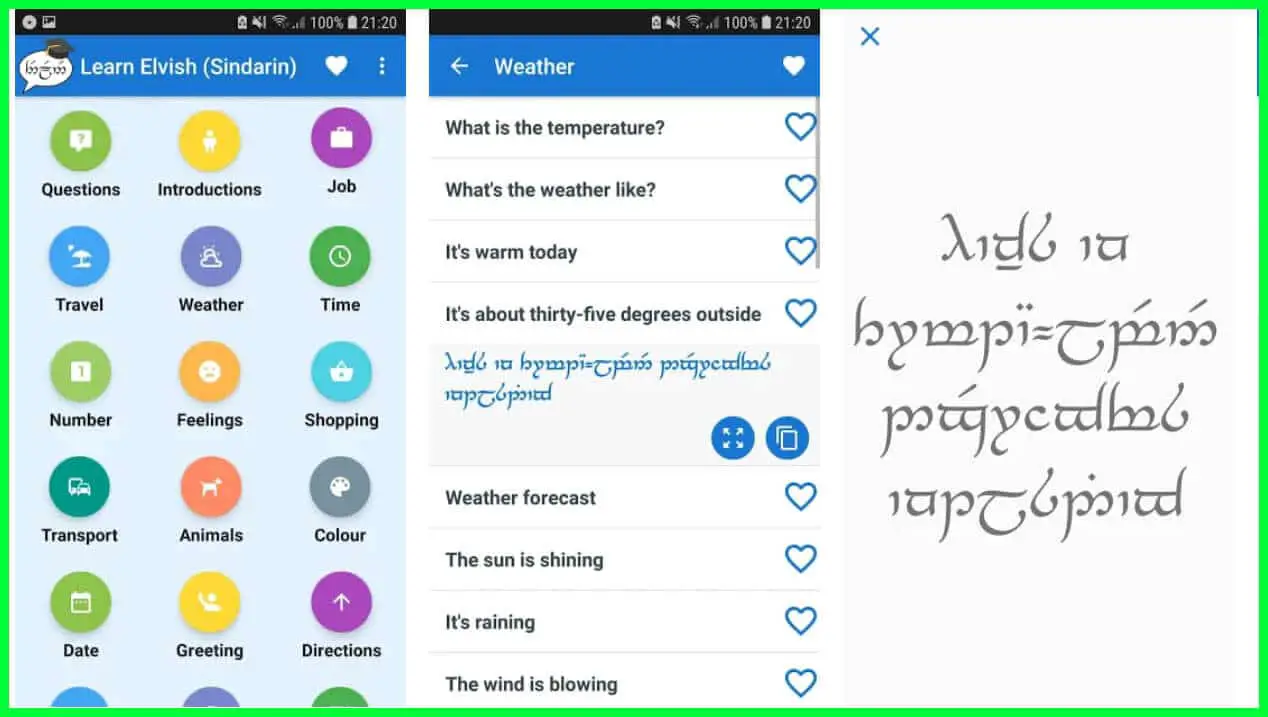
If you are a tourist or interested in learning the elvish language so that you can speak and translate smoothly, this app will come to your aid.
It comes with some wonderful features:-
- You can use this app even if you don’t have the internet.
- Every word, as well as sentence, comes in proper categories. So you don’t have to search a lot.
- Both novice and advanced learners can use this app.
- Do you have any favorite words? Then you can select it and display it using this app.
- This app shows every word in your local language and Elvish language.
- An elvish voice pronounces every word for you.
- You can also copy that word in your email, so you don’t forget it.
- Are you an animal lover? Then you will get to know the details of the animals in the Elvish language.
- It will give you the Elvish number equivalents in your language.
- Want to apply for a job in the Elvish language? No worries, as this app, will help you.
- You can even show your feelings and know the significance of each country in the Elvish language.
5. Parf Edhellen
Next on the list is Parf Edhellen or Elfdict available. It offers users Elvish interpretations like never before.
The site features a dictionary of Elvish words, and the users can explore interpretations of different terms, just like expressions accessible on the database of this site.
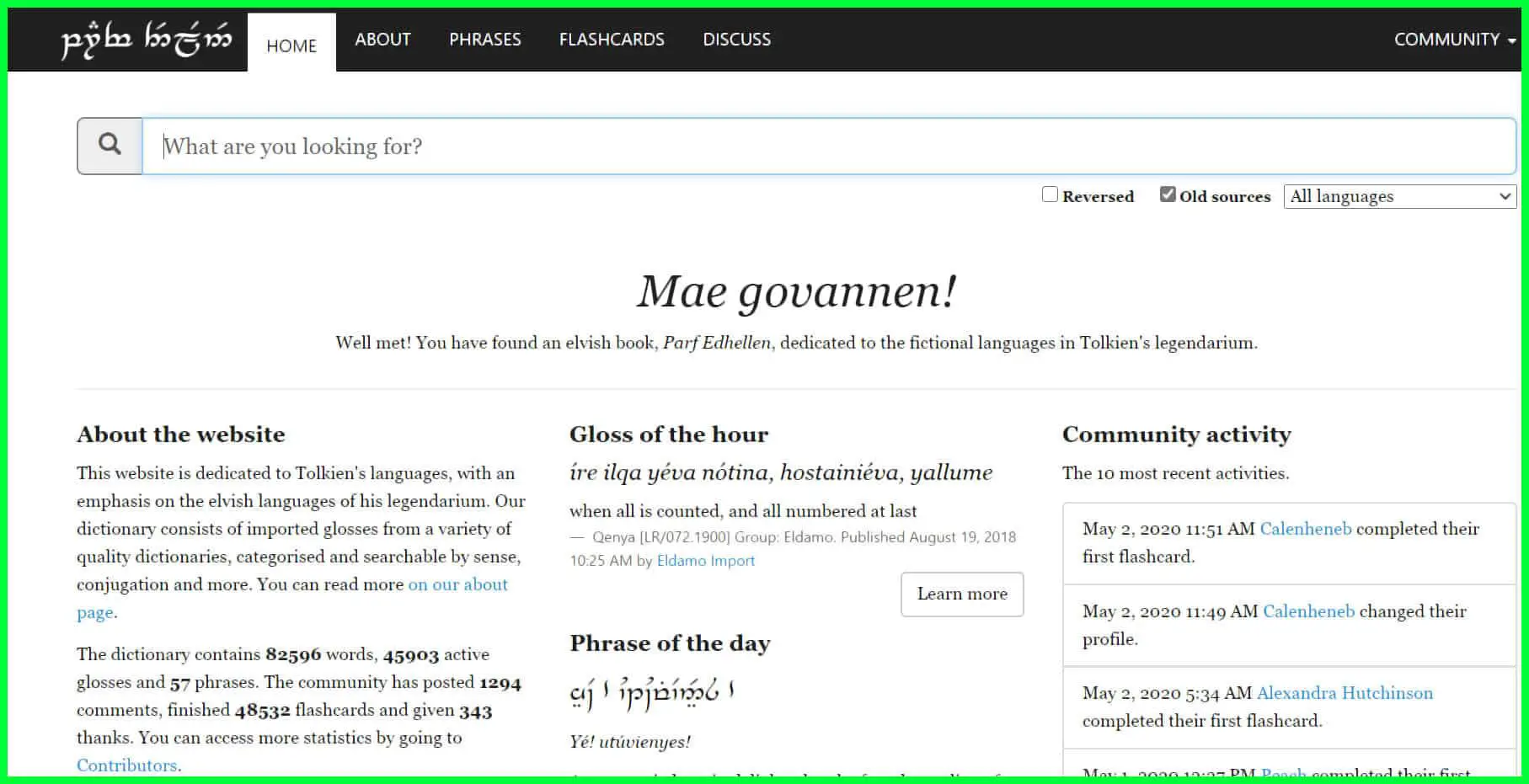
It is probably one of the best Elvish translation tools available out there. This kind of dictionary site contains tons of Elvish terms translated into English. The terms and their English meanings are available from several top-quality dictionaries.
They are categorized correctly so users can search for them easily and get their exact meanings. The site boasts of 56 phrases, 82596 words, and 45903 active glosses.
Significant attributes of Parf Edhellen are as follows:-
- There is a separate search box for the users to put in the text they want to translate, and they will get the Elvish form of the text in the dictionary.
- While the users type the texts, they get a complete list of words and senses they are looking for.
- Direct matches contain the characters users entered, while indirect matches are thematically relevant to the words users might be looking for.
- The users can also expect results showing the star sign along with a warning. This denotes that the word originates from a certain source that is questionable or outdated.
Parf Edhellen is one translator tool you can depend on to get the meanings of the different Elvish terms and phrases you might not know. This translator tool will offer you the best results within the shortest time possible.
At the time of our research on elvish writing, we found a video about “Learn To Speak Elvish In 8 Minutes | Basics of Sindarin,” which is worth watching. 🤴🏆

6. English-Elvish Translator-Angelfire
There is no other tool (Check Here) that works as efficiently and as beneficially as Angelfire. It is one of the simplest translator tools available out there.
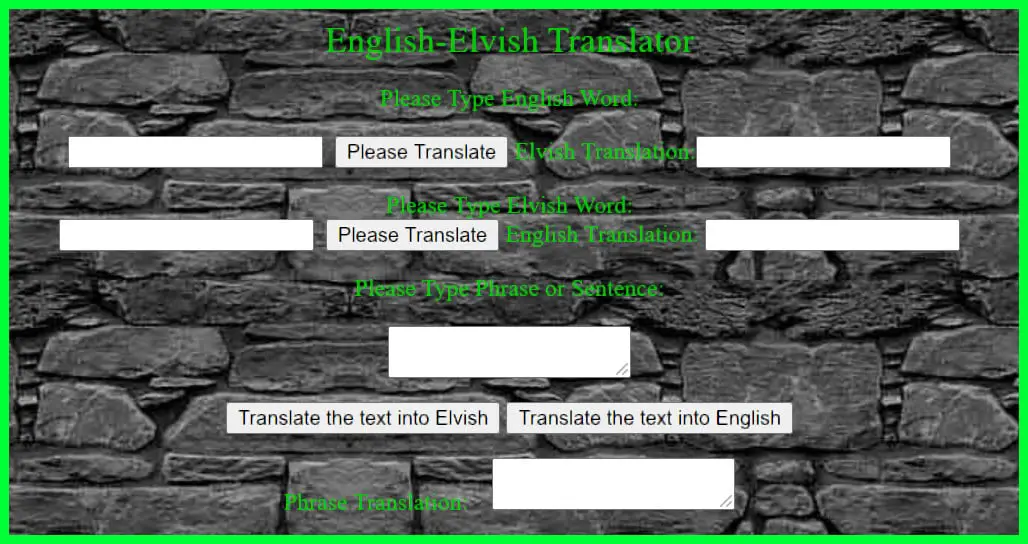
It is a one-page tool helping users get their translation jobs done without going through a lot of stress.
The site is so simple that users can quickly type the text they want to translate, and it gets translated in a matter of seconds. Users also have the flexibility of pasting whole sentences to be translated into the Elvish language.
Exclusive features of the translator tool are as follows:-
- Angelfire generates translation results within the shortest time possible. Once you type the text you want to translate into the Elvish language, you need to click on the button that says “Translate.”
- Results appear as soon as you type in the text or paste it into the box.
Angelfire might not have the reputation of being one of the most satisfying translator tools available in the market, but it is always worth giving a try.
It will offer you the best translation results owing to its simple user interface and a great collection of Elvish content.
7. Sindarin Dictionary
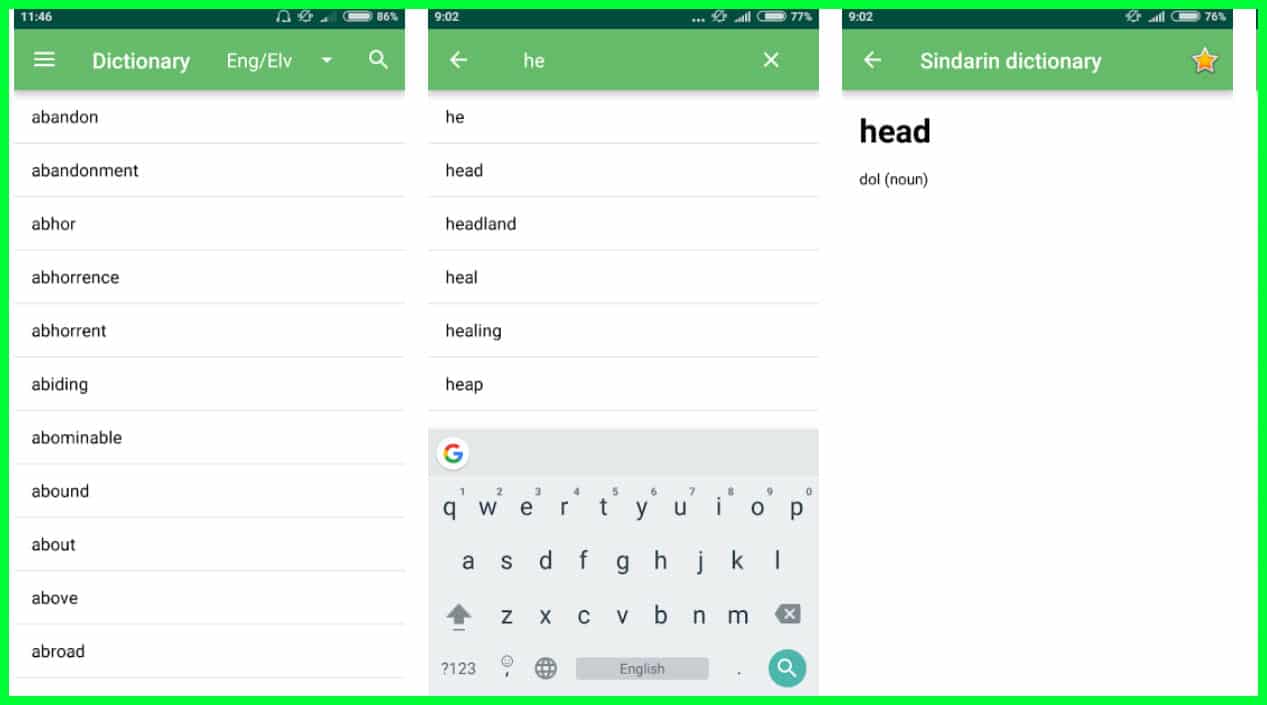
If you are interested in knowing the Elvish language and Tolkien’s writing, this app will greatly help. It helps you with a smooth word search and a phrasebook of the English-Sindarin language.
8. Flamingo Elvish
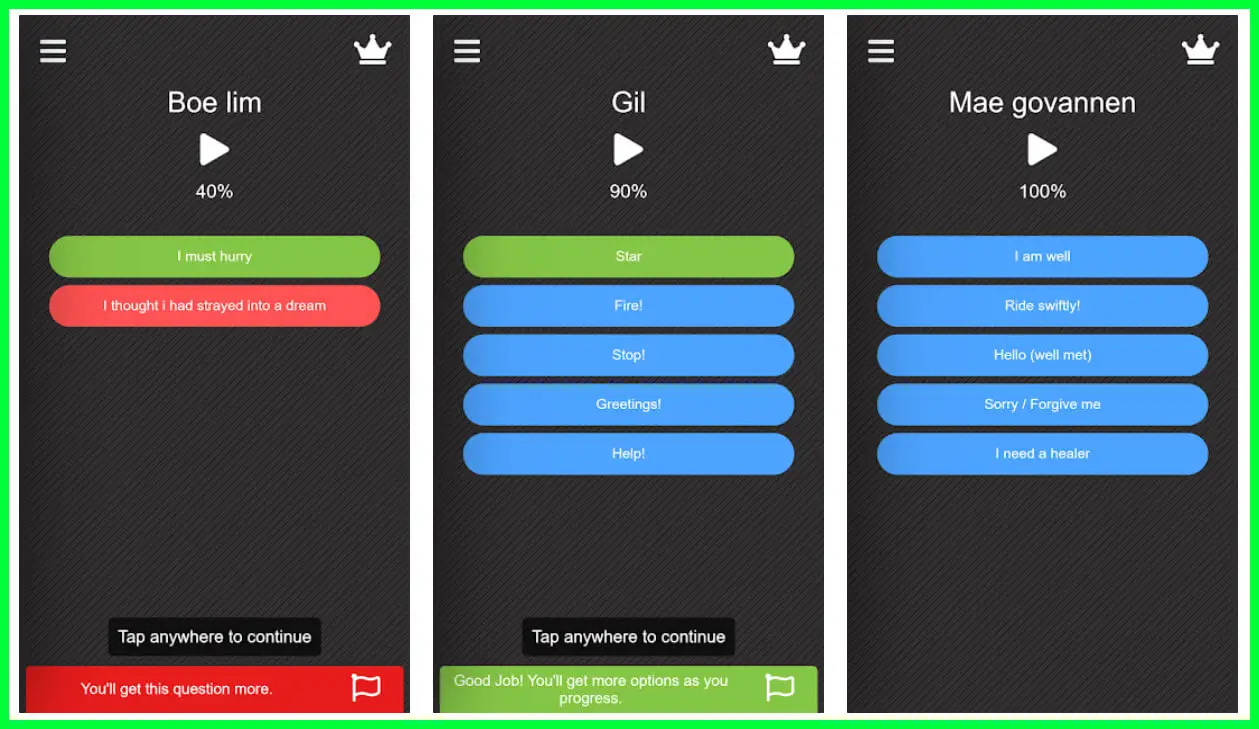
This app will help you keep the common phrases of Elvis language in memory by using the polished and easy flashcard memorizer.
9. Runes Translator
This is a highly suggested Elvish translation tool that even beginners can use in language conversions. This free tool proficiently carries out translating any text into the Elvish language.
It is one of the most devoted translators for android users. The user interface of this runes-elvish translator is simple and easy. You need to download the translator on your system and install it religiously to start using it for conversions.
You will find a drop-down menu where you must select the option Elvish. Once you are done with this, you can type any text.
The translator creates Elvish content for each entered character or content without getting other forms of input.
Features of this tool are as follows:-
- The produced Elvish content on the tool cannot be copied to be utilized elsewhere.
- To use this tool, you will have to save the image on your smartphone’s display or share it straightforwardly using Bluetooth, email, informing application, or an online social networking application.
- Almost any individual can download this app from the Google Play Store free of cost.
Translating any text into Elvish can be a little challenging, but not anymore when you have the Runes Translator at your disposal. This app will help you translate texts into the Elvish language without having to go through any hassle.
10. The Rune Generator (derHOBBIT)
Yet again, a free Elvish translator tool will make it very easy to translate the intended text into the Elvish language. This tool (Check Here) is completely different from the other available tools because it is in no way an automated device.
Users going for this tool can adjust the background color, size, and font color of the results they are getting. This is mainly because of the results that they get in the form of image files.
Once all the picture options are written and explained, users must choose the third alternative, “Alien Character.” Next, they need to click on “Run.” The translator will take only a few seconds to produce the Elvish form of the terms provided.
Once the results are presented, users need to right-click on the icon on their computer and choose the option “Save Image.” The ones using their smartphones need to press and hold to save the image.
Once done, the image can easily be shared online with family and friends through social media or emails.
Features of this tool include:-
- Perfect translator tool for people looking to translate terms and phrases in Elvish and then post them on their social media platforms.
- Easy to use and simple interface makes translations a breeze.
- Free of cost, which means huge savings on language conversions.
Get The Rune Generator (derHOBBIT) if you want to translate almost any term into the Elvish language. This tool will not just make it easy for you to deal with language conversions but will also make it a fun experience. The tool is quite engaging and interesting as it offers users the scope of being social simultaneously.
📗FAQ
Is Elvish real language?
Elvish is a made-up language created by J.R.R. Tolkien for his fantasy world, Middle-earth.
Tolkien, a linguist, invented several languages for different races in his fictional world, such as Elvish, Dwarvish, and Orcish. Elvish, also known as Quenya or Sindarin, is one of the most well-developed of these languages.
Elvish is not a real language because humans do not speak it, but it has a large following among Tolkien’s fans. The language has complex grammar and vocabulary, and enthusiasts have studied and become fluent in it.
Additionally, Elvish has significantly impacted constructed languages, inspiring the development of many other fictional languages in popular culture.
Is Elvish on duolingo?
Elvish is not available on Duolingo.
How do you say hi in Elvish?
There are multiple ways to say “hi” in Elvish, depending on the dialect of the language.
For instance, in Quenya, one of the Elvish languages created by J.R.R. Tolkien, “Namárië” (pronounced nah-MAH-ree-eh), translates to “farewell” or “be well.”
Alternatively, in Sindarin, another Elvish language devised by Tolkien, “Suilad” (pronounced SWEE-lahd) means “greeting” or “hail,” while “Mae govannen” (pronounced MY goh-VAH-nen) serves as an informal greeting, meaning “well met” or “good to see you.”
What Elvish language is used in Lord of the Rings?
Both Quenya and Sindarin, the two primary Elvish languages created by J.R.R. Tolkien, are used in the “Lord of the Rings” trilogy.
Quenya is utilized in formal situations and religious ceremonies, serving as the language of the High Elves. It boasts a complex grammar and a melodious sound, and is spoken by characters like Galadriel, Elrond, and Gandalf.
Sindarin, by contrast, is the more commonly spoken Elvish language in Middle-earth, used in everyday conversation by the Grey Elves. Characters such as Legolas, Arwen, and the elves of Lothlórien speak Sindarin.
Tolkien’s constructed languages, including Quenya and Sindarin, are integral to his legendarium and play a crucial role in the world-building of his works.
Can people speak Elvish?
While not spoken by any human population, a large community of fans has learned to speak and write in Elvish based on J.R.R. Tolkien’s constructed language.
Tolkien created detailed guides for the grammar, vocabulary, and pronunciation of his invented languages, making it possible to learn and become fluent in Elvish. Various resources, including books, websites, and online courses, are available for those interested in learning Elvish.
Some enthusiasts have become so fluent in Elvish that they can easily write and speak the language. However, it’s important to note that Elvish is not a living language and is not used in any official capacity.
It is primarily studied and spoken by fans of Tolkien’s works who enjoy exploring the richly detailed world of the Middle-earth.
What Elvish does Legolas speak?
Legolas, the Prince of the Woodland Realm in J.R.R. Tolkien’s legendarium, is a Sindarin Elf, and it is widely believed that Sindarin is the Elvish language he speaks.
Sindarin is one of two primary Elvish languages invented by Tolkien, the other being Quenya. In Middle-earth, Sindarin was more commonly spoken and used in everyday conversations by the Grey Elves.
At the same time, Quenya was reserved for formal settings and religious ceremonies by the High Elves.
Legolas is depicted as fluent in both Sindarin and Westron, the common tongue of Middle-earth, in the “Lord of the Rings” books and movies. He is well-known for his archery skills, keen eyesight, and loyalty to his companions.
What language do Santa’s elves speak?
In modern Christmas folklore, Santa’s elves are often portrayed as speaking a unique language called “Elvish” or “Elfian.” It’s important to note that this language is not a real language but a fictional one created for Christmas stories and movies.
Different Christmas stories and movies may depict Santa’s elves communicating in Elvish in varying ways, with different vocabulary, grammar, and pronunciation. Some stories may not even address the language that Santa’s elves use.
It’s worth mentioning that the concept of Santa’s elves as we know them today is a relatively recent creation.
The depiction of these elves speaking a specific language is not a consistent aspect of Christmas folklore.
What is the most common Elvish language?
Sindarin and Quenya are the two most commonly used Elvish languages in J.R.R. Tolkien’s works. Sindarin was widely spoken and primarily used in everyday conversation by the Grey Elves. In contrast, Quenya was used by the High Elves and reserved for formal and religious settings.
Sindarin has a melodic sound and vocabulary influenced by Celtic languages, with around 2000 developed words.
Quenya has a more formal feel, influenced by Finnish and Latin languages, with more than 5000 developed words.
While both Sindarin and Quenya have unique characteristics and uses, Sindarin is the more well-known and commonly spoken of the two.
Which Elvish is easiest to learn?
The ease of learning an Elvish language depends on the individual’s language learning background and personal preferences. Some enthusiasts consider Sindarin to be an easier language to learn than Quenya for a few reasons.
First, Sindarin has a simpler vocabulary influenced by Celtic languages that may be more familiar to English speakers, while Quenya’s vocabulary is more complex and influenced by Finnish and Latin.
Second, Sindarin has a simpler grammar system with fewer verb conjugations and noun cases than Quenya.
Finally, more resources are available for learning Sindarin, including online courses, language textbooks, and tutorials, than for Quenya.
However, learning any constructed language, such as Elvish, requires dedication and effort. Passion and enthusiasm for the language can make learning more enjoyable and less challenging.
What is Elvish for yes?
In Sindarin, one of J.R.R. Tolkien’s Elvish languages, “mîn” (pronounced “meen”) translates to “yes.” In Quenya, another Elvish language, “hâ” (pronounced “hah”) is used for “yes.”
What is Elvish for cheers?
In Sindarin, one of J.R.R. Tolkien’s Elvish languages, “iaur” (pronounced “yowr”) can be used to express “cheers” or “good health” in a toast or celebratory context.
What is my love in Elvish?
In Sindarin, “my love” can be translated as “meleth nîn” (pronounced “meh-leth neen”).
How do you say goodbye in Elvish?
In Sindarin, one of the Elvish languages created by J.R.R. Tolkien, “goodbye” can be translated as “namárië” (pronounced “nah-mah-ree-eh”). This word is commonly used in the “Lord of the Rings” series, particularly by the Elves.
How do you say thank you in Elvish?
In Sindarin, one of the Elvish languages created by J.R.R. Tolkien, “thank you” can be translated as “hannon le” (pronounced “hah-non lay”). Elves commonly use this phrase in “The Lord of the Rings” series to express gratitude or appreciation.
Conclusion
Now that you have got an idea of the best Elvish translator tools, it is quite likely for you to ponder whether they are 100% accurate or not.
As mentioned earlier in this content, understanding any language simply using a translator tool is impossible. The d&d elvish translator tools detailed above work best in helping users understand the Elvish language through their limited resources.
Nevertheless, they will not provide 100% accurate results. No translator tool can offer complete and perfect language conversion results. Depending on how the terms sound and look, they will offer you the translated outcomes in the Elvish language.
Hopefully, they will be able to satisfy your requirements and fetch you the results that you might be on the lookout for. Most of these translator tools are designed on certain algorithms that cannot decide on the correctness and accuracy of these tools. However, there is nothing wrong with trying them, as they are available for free.